World history1912 – 194946 events

Republican China and Imperial Japan

The age when the Republic of China, born of the 1911 Revolution, passed through warlord division, the May Fourth Movement, the United Front and the Northern Expedition, fought Japan’s invasion and split in civil war — as Japan moved from Taishō democracy through the Manchurian Incident and military coups to the war in China and the Co-Prosperity Sphere, and colonized Korea resisted through the March First Movement and armed struggle

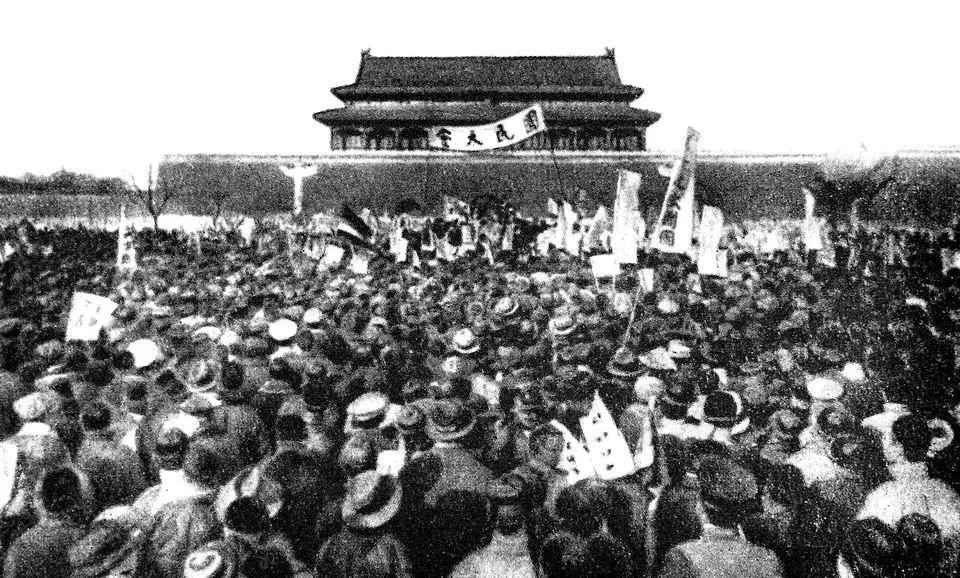
산둥 문제에 항의해 톈안먼 앞에 모인 베이징의 학생들 — 5·4 운동, 1919년 5월 4일

Unknown author · Public domain · Source

At a glance

TopicChinaJapanKorea
Politics, 1910sYuan’s dictatorship → warlordsTaishō crisis (1913)Military rule; gendarmerie police
First World WarAccepts 21 Demands (1915)Takes Qingdao; 21 DemandsLand survey; Company Law
Ideas and cultureNew Culture — New YouthYoshino’s minponshugiSelf-strengthening; socialism
Rice and foodCountryside ruined by warlordsRice Riots (1918) → HaraRice production plan (1920)
1919May Fourth; rejects VersaillesWins Shandong at ParisMarch First → Provisional Gov.
Communist partiesCCP founded (1921)JCP (1922), illegalKorean CP (1925)
1923Sun turns to MoscowGreat Kantō earthquakeMassacre of Koreans
1925May Thirtieth MovementUniversal suffrage; Peace LawPeace Preservation Law applied
United frontsFirst United Front (1924)— (communists suppressed)Singanhoe (1927)
1926–1928Northern Expedition; Nanjing gov.Shandong expedition; Zhang ZuolinJune Tenth (1926); Singanhoe
Manchuria (1931)Appeals to LeagueKwantung Army blows railwayJoint Korean–Chinese campaigns
Manchukuo and the LeagueLytton Report sides with ChinaManchukuo; quits League (1933)Yun Bong-gil attack (1932)
Mid-1930sAnti-communist drive; Long MarchMay 15 & Feb. 26 — army risesSupply base; Revolutionary Party
War in China (1937)Xi’an → Second United FrontMarco Polo Bridge; MobilizationImperial-subject policy; KVC
1940sChongqing resists; Wang regimeCo-Prosperity Sphere → Pacific WarLiberation Army; war on Japan
After 1945Civil war → PRC (1949)Surrender; Allied occupationLiberation → division (1948)

The theme on the map

OpenFreeMap © OpenMapTiles © OpenStreetMap contributors

46 events in this theme

  1. Beginning with the Wuchang Uprising, revolution spread until the Republic of China was founded and the Qing fell. Over two thousand years of imperial rule ended, and China’s first republic was born.

  2. 1912 – 1932Taishō Democracy

    Under the Taishō Emperor (1912–1926) a democratic current spread in Japan, as the movement to protect constitutional government and the idea of minponshugi pressed for party government and universal suffrage.

  3. Having taken over the provisional presidency, Yuan Shikai crushed the Nationalist Party and tried to make himself emperor; after his failure and death China fell into an age of rival regional warlords.

  4. Having seized Germany’s leasehold in Shandong during the First World War, Japan presented Yuan Shikai’s government with twenty-one demands for rights in Shandong, southern Manchuria and elsewhere, and forced it to accept most of them.

  5. Gathered around Chen Duxiu’s New Youth, intellectuals raised the banner of “democracy and science”, attacked Confucian ethics and launched a literature in the vernacular language people actually spoke.

  6. As rice prices soared, riots that began in the summer of 1918 among women of fishing villages in Toyama spread across Japan, bringing down the Terauchi cabinet and bringing in Hara Takashi’s party cabinet.

  7. Beginning on 1 March 1919 with the reading of a declaration of independence, demonstrations spread across the country. It led to the founding of the Provisional Government of the Republic of Korea.

  8. After the March First Movement, on 11 April 1919, the Provisional Government of the Republic of Korea was founded in Shanghai, the first Korean government to adopt a democratic republic. In September it merged the several provisional governments.

  9. When the Paris Peace Conference decided to hand Germany’s former rights in Shandong to Japan, Beijing students demonstrated in front of Tiananmen on 4 May 1919, and an anti-imperialist, anti-warlord movement spread nationwide.

  10. 1919 – 1931"Cultural Rule"

    After the March First Movement the new Governor-General Saitō Makoto proclaimed "cultural rule". The military police gave way to a civil police and Korean newspapers were allowed, but the real aim was to cultivate collaborators and divide the nation.

  11. Kim Won-bong founded the Uiyeoldan at Jilin in Manchuria to destroy key Japanese institutions and assassinate officials.

  12. To cover Japan’s rice shortage, Japan planned to raise rice output in Korea. More rice was shipped to Japan than the increase in production, and Korean food supplies worsened.

  13. In July 1921 thirteen delegates met in the French Concession of Shanghai and, with Comintern support, founded the Chinese Communist Party, choosing Chen Duxiu as its leader.

  14. On 1 September 1923 a great earthquake and fires struck Tokyo and Yokohama, leaving over 100,000 dead or missing. In the chaos rumours that “Koreans are rioting” spread, and vigilantes, soldiers and police massacred large numbers of Koreans.

  15. 1924 – 1927First United Front

    In 1924 Sun Yat-sen’s Nationalist Party adopted the policies of “alliance with the Soviet Union, admission of communists, and support for peasants and workers”, letting Communists join as individuals, and founded the Whampoa Military Academy to prepare to overthrow the warlords.

  16. The Korean Communist Party was founded in secret in Seoul, but in November the Sinuiju incident exposed it and many members were arrested under the Peace Preservation Law.

  17. Japan extended to Korea its Peace Preservation Law punishing groups that sought to change the national polity or deny private property. It became a tool against both socialism and the independence movement.

  18. In 1925 the Katō Takaaki cabinet abolished the tax qualification and gave the vote to all men aged 25 and over. In the same year it passed the Peace Preservation Law to suppress socialism and independence movements.

  19. 1926 – 1928Northern Expedition

    In July 1926 the National Revolutionary Army under Chiang Kai-shek marched north from Guangzhou to destroy the warlords; in 1928 it took Beijing, and with Zhang Xueliang’s submission China was formally unified.

  20. 1927 – 1931Singanhoe

    Uncompromising nationalists and socialists joined to found the Singanhoe, the largest legal national organization of the colonial period.

  21. On 12 April 1927, in the middle of the Northern Expedition, Chiang Kai-shek violently purged Communists and labour organizations in Shanghai, and on 18 April set up a National Government in Nanjing. The First United Front was broken.

  22. To revive the stagnant Provisional Government, Kim Gu organized the Korean Patriotic Organization in Shanghai to carry out armed attacks.

  23. 1931 – 1932Manchurian Incident

    On 18 September 1931 Japan’s Kwantung Army blew up a section of the South Manchuria Railway at Liutiaohu near Shenyang, blamed Chinese troops, and launched an offensive that occupied most of Manchuria within six months.

  24. Ji Cheong-cheon’s Korean Independence Army, allied with Chinese forces, defeated the Japanese at Ssangseongbo, Sadohaja, Donggyeongseong and Daejeonjaryeong in northern Manchuria.

  25. On 1 March 1932 Japan’s Kwantung Army set up the puppet state of Manchukuo with its capital at Changchun (Xinjing), installing the last Qing emperor Puyi as chief executive; in 1934 Puyi became emperor.

  26. Korean Patriotic Organization member Yun Bong-gil threw a bomb onto the platform at the celebration of the emperor’s birthday and the Shanghai victory in Hongkou Park, killing and wounding Japanese commanders.

  27. On 15 May 1932 young naval officers stormed the prime minister’s residence and killed Prime Minister Inukai Tsuyoshi, bringing the era of party cabinets to an end.

  28. When the League of Nations, drawing on the Lytton Commission’s report, refused to recognize Manchukuo and called for the withdrawal of Japanese troops, Japan gave notice in March 1933 that it would leave the League.

  29. 1934 – 1935Long March

    Driven from its base at Ruijin in Jiangxi by Nationalist encirclement campaigns, the Communist Red Army walked about 12,000 km over a year from October 1934 to northern Shaanxi; along the way Mao Zedong took the leadership.

  30. The Uiyeoldan, the Korean Independence Party, the Korean Revolutionary Party and others formed the National Revolutionary Party in Nanjing, the fruit of the drive for a single party in China proper.

  31. On 26 February 1936 young officers of the army’s Imperial Way faction seized central Tokyo with about 1,400 troops and murdered senior ministers in an attempted coup. After its suppression the rival Control faction took over and military dominance of politics was entrenched.

  32. On 12 December 1936 Chiang Kai-shek was detained in Xi’an by his own commanders, Zhang Xueliang and Yang Hucheng, who pressed him to stop fighting the Communists and turn against Japan. Mediation by the Communist Zhou Enlai won Chiang’s release, paving the way for the Second United Front.

  33. Having launched the war with China, Japan proclaimed "Japan and Korea as one body" and tried to turn Koreans into loyal imperial subjects, forcing them to recite the Oath of Imperial Subjects, worship at Shinto shrines and bow toward the imperial palace.

  34. A clash at the Marco Polo Bridge near Beiping on 7 July 1937 became the occasion for Japan’s full-scale invasion of China. China resisted for eight years through the United Front; from 1941 the war merged with the Pacific War, ending with Japan’s surrender in 1945.

  35. 1937 – 1941Second United Front

    When the war with Japan broke out, the Nationalists and Communists joined hands again in September 1937 to form an anti-Japanese national united front; the Red Army was reorganized as the Eighth Route Army and the New Fourth Army of the National Revolutionary Army.

  36. 1937 – 1938Nanjing Massacre

    After capturing Nanjing, capital of the Republic of China, on 13 December 1937, the Japanese army spent several weeks massacring prisoners and civilians and committing rape, looting and arson.

  37. Japan enacted the National Mobilization Law and drew Korea’s people and materials into its wars of aggression at will, taking rice and even brassware and sending young people to battlefields and factories.

  38. With support from the Chinese Nationalist government, Kim Won-bong founded the Korean Volunteer Corps at Hankou, the first Korean armed unit in China proper.

  39. In 1940 Japan proclaimed a Greater East Asia Co-Prosperity Sphere binding Japan, Manchukuo, China and Southeast Asia, claiming to liberate Asia from Western imperialism; in reality it was a slogan for conquest and domination to secure resources for war.

  40. Settled in Chongqing, the Provisional Government founded the Korean Liberation Army under Commander-in-Chief Ji Cheong-cheon; the Korean Volunteer Corps joined it in 1942.

  41. Japanese naval aircraft made a surprise attack on the US Pacific Fleet at Pearl Harbor, Hawaii. America entered the war, which spread across the Pacific (the Pacific War).

  42. The leaders of the United States, Britain and China met in Cairo and declared that Korea would become free and independent in due course, the first international pledge of Korean independence.

  43. On 15 August 1945 Japan's surrender ended its rule over Korea. US and Soviet troops moved in on either side of the 38th parallel.

  44. Japan accepted the Potsdam Declaration and Emperor Hirohito announced the surrender by radio on 15 August. The instrument of surrender was signed aboard USS Missouri in Tokyo Bay on 2 September, ending the Second World War.

  45. 1946 – 1949Chinese Civil War

    After Japan’s surrender, full-scale civil war between the Nationalists and the Communists resumed in 1946. Having won over the peasants through land reform, the Communists triumphed in three great campaigns in 1948–1949, and the Nationalist government moved to Taiwan.

  46. Victorious in the civil war, the Communist Party proclaimed the People's Republic in Beijing. The Nationalist government withdrew to Taiwan.

Key people

  • Chiang Kai-shek1887 – 1975

    Leader of the Chinese Nationalist Party who unified China through the Northern Expedition and led the Nanjing government through the war with Japan; after losing the civil war he moved to Taiwan and ruled the Republic of China there

  • Kim Gu1876 – 1949

    Known as Baekbeom; founded the Korean Patriotic Organization and led the Liberation Army as Chairman of the Provisional Government

  • Mao Zedong1893 – 1976

    Chairman of the Chinese Communist Party who won the civil war and founded the People’s Republic in 1949, and launched the Great Leap Forward and the Cultural Revolution

  • Zhou Enlai1898 – 1976

    First premier of the People’s Republic of China (1949–1976), long in charge of diplomacy, who arranged Nixon’s 1972 visit

  • Kim Won-bong1898 – 1958

    Leader of the Uiyeoldan, the National Revolutionary Party and the Korean Volunteer Corps; Deputy Commander of the Liberation Army

  • Sun Yat-sen1866 – 1925

    Leader of the Chinese revolution who led the Tongmenghui under the Three Principles of the People and became provisional president of the Republic of China after the Xinhai Revolution

  • Inukai Tsuyoshi1855 – 1932

    Party politician who led the movement to protect constitutional government and became prime minister (1931–1932) as Seiyūkai president; murdered in his residence by young naval officers in the May 15 Incident

  • Chen Duxiu1879 – 1942

    Founder of the magazine New Youth who led the New Culture Movement under the banner of “democracy and science”, then helped found the Chinese Communist Party and became its first leader

  • Kim Kyu-sik1881 – 1950

    Envoy of the New Korea Youth Party to the Paris Peace Conference, later Vice-Chairman of the Provisional Government

  • Saitō Makoto1858 – 1936

    Third and fifth Governor-General of Korea, who proclaimed "cultural rule" after the March First Movement

  • Zhang Xueliang1901 – 2001

    Son of the Fengtian warlord Zhang Zuolin who joined the Nationalist government after Japanese officers killed his father; in the 1936 Xi’an Incident he detained Chiang Kai-shek to demand resistance to Japan

  • Ji Cheong-cheon1888 – 1957

    Commander of the Korean Independence Army in the joint Korea–China campaigns and Commander-in-Chief of the Liberation Army