PoliticsJanuary 1924 – 1927

First United Front

Also called: First KMT–CCP United Front, Whampoa Military Academy

In 1924 Sun Yat-sen’s Nationalist Party adopted the policies of “alliance with the Soviet Union, admission of communists, and support for peasants and workers”, letting Communists join as individuals, and founded the Whampoa Military Academy to prepare to overthrow the warlords.
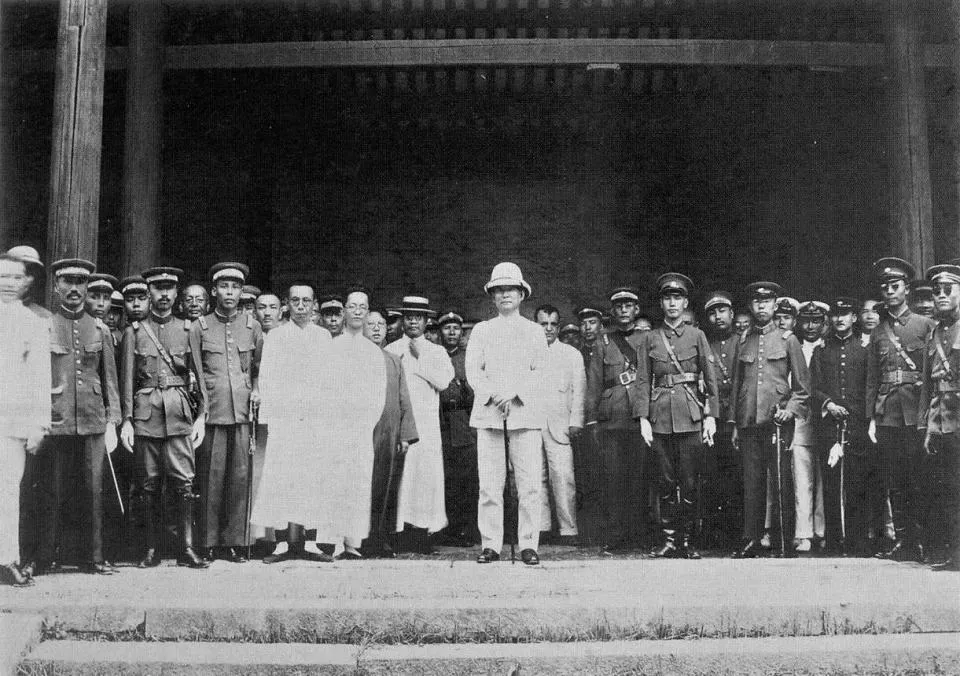
Sun Yat-sen at the opening ceremony of the Whampoa Military Academy, 16 June 1924

Unknown author · Public domain · Source

Repeatedly hard pressed by warlords in Guangzhou, Sun Yat-sen turned to the Soviet Union rather than the Western powers for help. In 1923 he issued a joint statement with the Soviet envoy Adolph Joffe, and in January 1924 the Nationalists’ First National Congress in Guangzhou adopted the policies of allying with the USSR, admitting Communists and aiding peasants and workers. Communists joined the Nationalist Party as individuals while keeping their own party membership, and Sun reinterpreted his Three Principles of the People in an anti-imperialist, anti-warlord sense.

In June the Whampoa Military Academy opened with Soviet money and advisers. Chiang Kai-shek was commandant and Zhou Enlai ran the political department, and young Koreans, including members of the Heroic Corps, trained there. The alliance outlived Sun, who died in 1925 declaring that “the revolution is not yet complete”, and lasted into the Northern Expedition, until Chiang’s anti-communist coup of 1927 broke it.

The map in 1924

OpenFreeMap © OpenMapTiles © OpenStreetMap contributors

States and rulers at the time
Republic of China
Soviet Union · sponsor — Leader Vladimir Lenin
Places
Whampoa Military Academy

People

  • Sun Yat-sen1866 – 1925

    leader · Leader of the Chinese revolution who led the Tongmenghui under the Three Principles of the People and became provisional president of the Republic of China after the Xinhai Revolution

  • Chiang Kai-shek1887 – 1975

    participant · Leader of the Chinese Nationalist Party who unified China through the Northern Expedition and led the Nanjing government through the war with Japan; after losing the civil war he moved to Taiwan and ruled the Republic of China there

  • Zhou Enlai1898 – 1976

    participant · First premier of the People’s Republic of China (1949–1976), long in charge of diplomacy, who arranged Nixon’s 1972 visit

Before and after

Themes that include this event

  • Republican China and Imperial Japan1912 – 1949

    The age when the Republic of China, born of the 1911 Revolution, passed through warlord division, the May Fourth Movement, the United Front and the Northern Expedition, fought Japan’s invasion and split in civil war — as Japan moved from Taishō democracy through the Manchurian Incident and military coups to the war in China and the Co-Prosperity Sphere, and colonized Korea resisted through the March First Movement and armed struggle