PoliticsSaitō arrived September 1919

"Cultural Rule"

After the March First Movement the new Governor-General Saitō Makoto proclaimed "cultural rule". The military police gave way to a civil police and Korean newspapers were allowed, but the real aim was to cultivate collaborators and divide the nation.
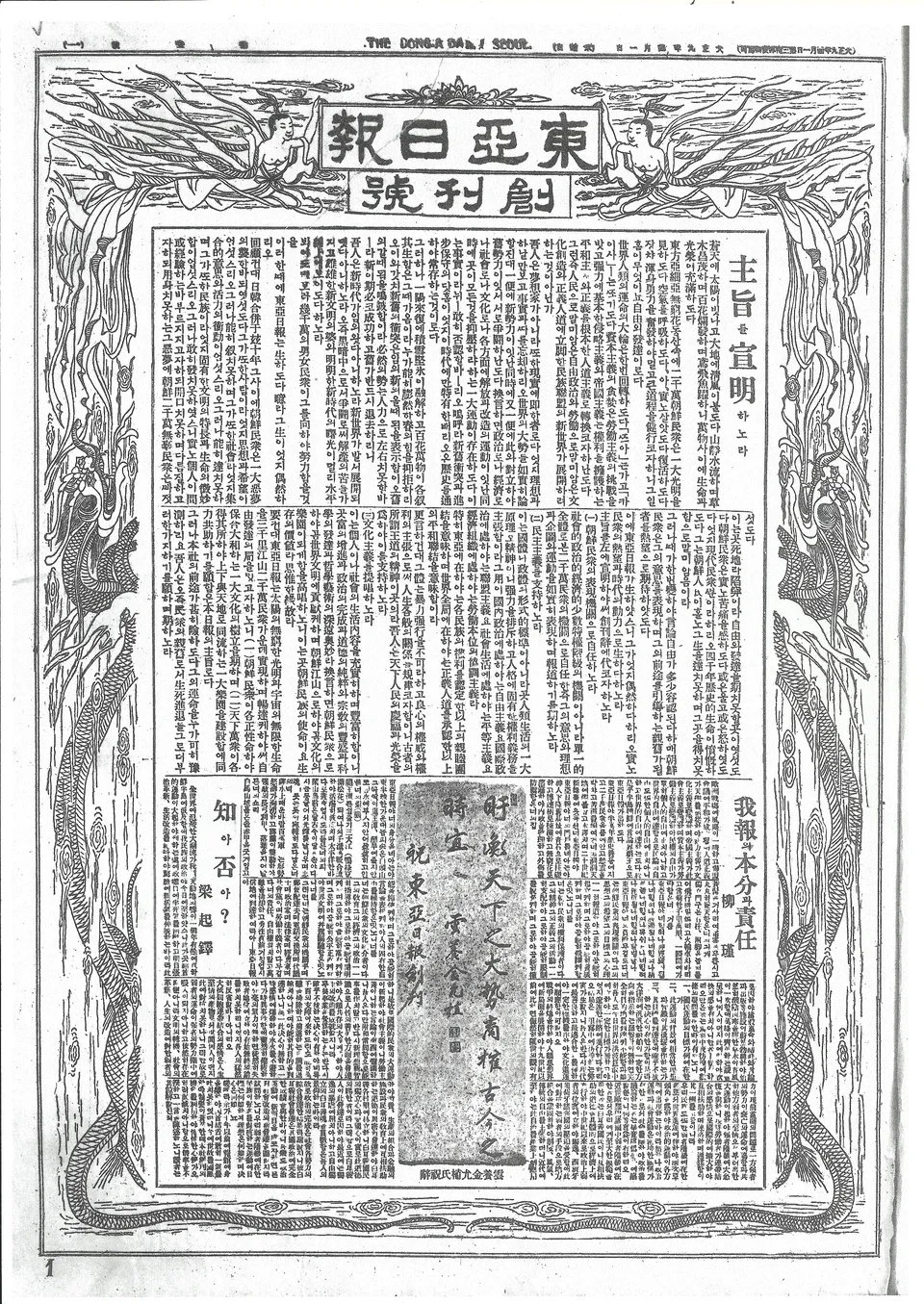
First issue of the Dong-a Ilbo, a Korean-language paper permitted under "cultural rule" — 1 April 1920

동아일보 · Public domain · Source

Civilians became eligible for Governor-General, yet none was ever appointed. The gendarmes were replaced by ordinary police, but stations, officers and spending all grew sharply. The Chosun Ilbo and Dong-A Ilbo were licensed in 1920 but censored, cut and suspended. The Second Education Ordinance (1922) lengthened common schools to six years and allowed a university, but higher education remained scarce. Provincial and municipal councils were advisory only, and their members were Japanese or collaborators.

The Peace Preservation Law of 1925 punished independence and socialist activity more harshly. Textbooks describe cultural rule as a deceptive policy that co-opted some intellectuals, encouraged compromising ideas such as home rule and sought to split the national movement.

The map in 1919

OpenFreeMap © OpenMapTiles © OpenStreetMap contributors

States and rulers at the time
Korea under Japanese rule — Governor-General Saitō Makoto
Japan · ruling power — Emperor Taishō
Places
Site of the Government-General Building

People

  • Saitō Makoto1858 – 1936

    leader · Third and fifth Governor-General of Korea, who proclaimed "cultural rule" after the March First Movement

  • Gang U-gyu1855 – 1920

    related figure · Threw a bomb at the incoming Governor-General Saitō Makoto at Namdaemun Station, Seoul, in 1919; executed in Seodaemun Prison

Before and after

Themes that include this event

  • Republican China and Imperial Japan1912 – 1949

    The age when the Republic of China, born of the 1911 Revolution, passed through warlord division, the May Fourth Movement, the United Front and the Northern Expedition, fought Japan’s invasion and split in civil war — as Japan moved from Taishō democracy through the Manchurian Incident and military coups to the war in China and the Co-Prosperity Sphere, and colonized Korea resisted through the March First Movement and armed struggle