Policy of Making Koreans Imperial Subjects
Having launched the war with China, Japan proclaimed "Japan and Korea as one body" and tried to turn Koreans into loyal imperial subjects, forcing them to recite the Oath of Imperial Subjects, worship at Shinto shrines and bow toward the imperial palace.
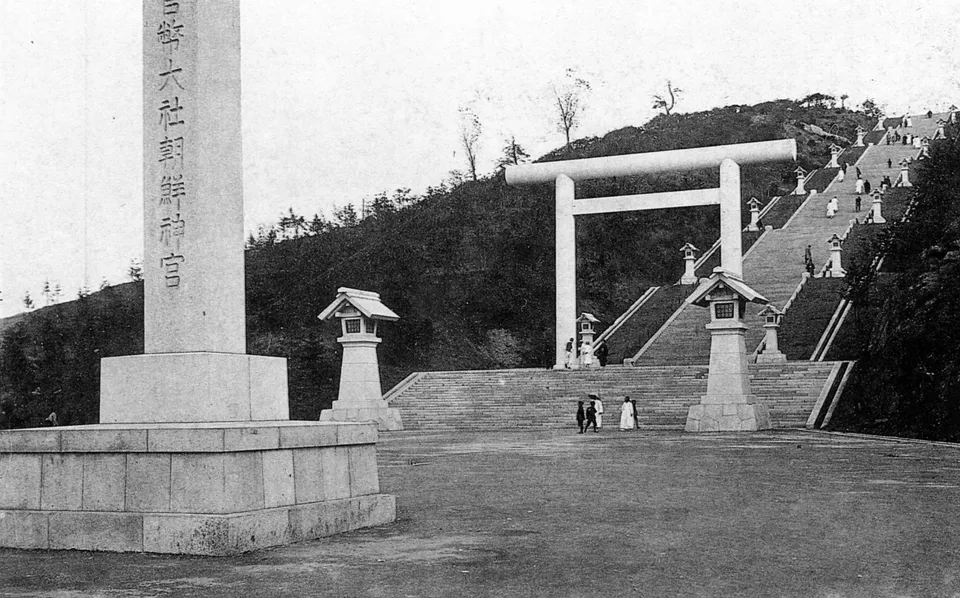
Unknown author · Public domain · Source
After the outbreak of the Sino-Japanese War in 1937, Governor-General Minami Jirō sought to erase Korean identity, claiming that Japan and Korea were one (naisen ittai) and shared common ancestors. Schools and offices had to recite the Oath of Imperial Subjects ("We are subjects of the Great Japanese Empire"), every township got a Shinto shrine for compulsory worship, and people had to bow toward the palace in Tokyo. Christian schools that refused shrine worship were closed.
The Third Education Ordinance (1938) made Korean an elective, effectively ending its teaching; in 1941 primary schools were renamed "national schools" (for imperial subjects), and the Fourth Ordinance (1943) abolished Korean-language classes. The Chosun Ilbo and Dong-A Ilbo were closed in 1940. Surveillance and preventive-detention ordinances for "thought criminals" (1936, 1941) kept activists under watch or in custody.