Korean history1937 – 194514 events
World War II and Korea
Wartime mobilization and exploitation, independence armies, from the Cairo Declaration to liberation
Unknown author · Public domain · Source
Wartime mobilization and exploitation, independence armies, from the Cairo Declaration to liberation
Unknown author · Public domain · Source
In its wars of aggression Japan set up military "comfort stations" and forcibly mobilized women from Korea and other countries as "comfort women" for the Japanese army. The women suffered grievously and their human rights were violated.
Having launched the war with China, Japan proclaimed "Japan and Korea as one body" and tried to turn Koreans into loyal imperial subjects, forcing them to recite the Oath of Imperial Subjects, worship at Shinto shrines and bow toward the imperial palace.
Japan enacted the National Mobilization Law and drew Korea’s people and materials into its wars of aggression at will, taking rice and even brassware and sending young people to battlefields and factories.
With support from the Chinese Nationalist government, Kim Won-bong founded the Korean Volunteer Corps at Hankou, the first Korean armed unit in China proper.
Japan forcibly took Koreans to coal mines, munitions plants and airfield construction in Japan, Sakhalin, the South Sea islands and elsewhere, and in the last years of the war conscripted them as soldiers.
Beginning with Germany's invasion of Poland, the largest war in human history was fought across Europe, Asia and the Pacific.
Japan made Koreans adopt Japanese-style family and given names. Those who refused faced penalties such as their children being barred from school and exclusion from food rations.
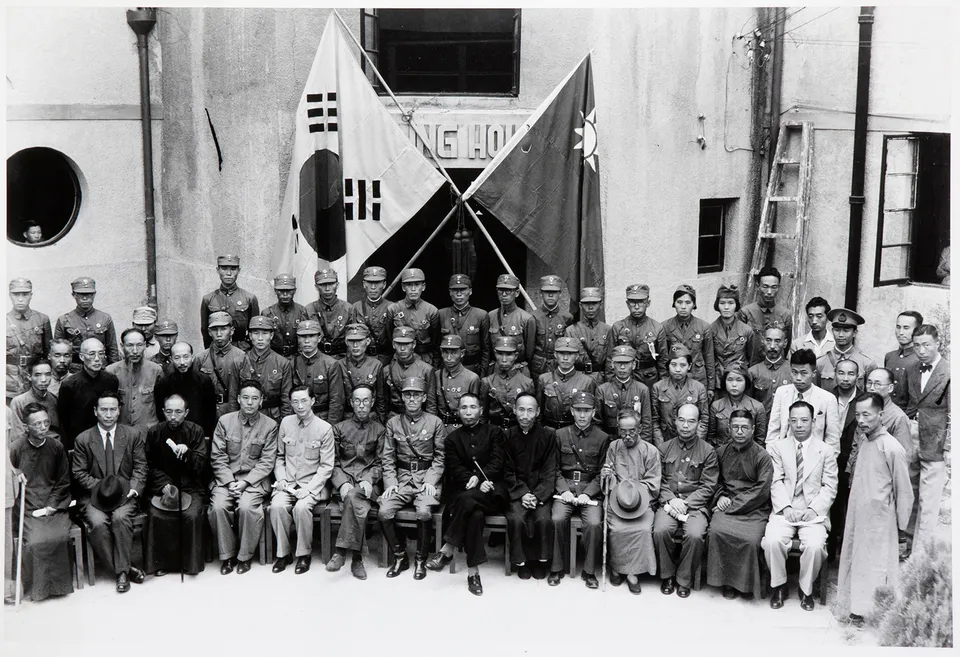
Settled in Chongqing, the Provisional Government founded the Korean Liberation Army under Commander-in-Chief Ji Cheong-cheon; the Korean Volunteer Corps joined it in 1942.
Socialist independence activists in north China founded the Korean Independence League around Kim Du-bong and reorganized the North China Detachment of the Volunteer Corps as the Korean Volunteer Army.
Japan branded the Korean Language Society an independence organization and imprisoned its members. Yi Yun-jae and Han Jing died in custody and the society was dissolved.
The leaders of the United States, Britain and China met in Cairo and declared that Korea would become free and independent in due course, the first international pledge of Korean independence.
Anticipating Japan’s defeat, Yeo Un-hyeong formed the secret Korean Founding League at home. It became the basis of the Committee for the Preparation of Korean Independence right after liberation.
The Korean Liberation Army trained with the US Office of Strategic Services (OSS) for an operation into Korea, but Japan surrendered before it could be carried out.
On 15 August 1945 Japan's surrender ended its rule over Korea. US and Soviet troops moved in on either side of the 38th parallel.
Seventh Governor-General of Korea, who pushed "Japan and Korea as one", imperial-subject policies and the name-change order
Known as Baekbeom; founded the Korean Patriotic Organization and led the Liberation Army as Chairman of the Provisional Government
Leader of the Uiyeoldan, the National Revolutionary Party and the Korean Volunteer Corps; Deputy Commander of the Liberation Army
Commander of the Korean Independence Army in the joint Korea–China campaigns and Commander-in-Chief of the Liberation Army
Officer at the Battle of Cheongsan-ri, later chief of staff and Second Detachment commander of the Korean Liberation Army
Envoy of the New Korea Youth Party to the Paris Peace Conference, later Vice-Chairman of the Provisional Government
Hangeul scholar and pupil of Ju Si-gyeong who led the Korean Independence League in north China
Linguist of the Korean Language Society, author of "Urimalbon" and "Hangeulgal", imprisoned from the 1942 society incident until liberation
Founded the New Korea Youth Party in Shanghai and in 1944 the underground Korean Founding League at home