Conflict1945

Planned Homeland Advance Operation

The Korean Liberation Army trained with the US Office of Strategic Services (OSS) for an operation into Korea, but Japan surrendered before it could be carried out.
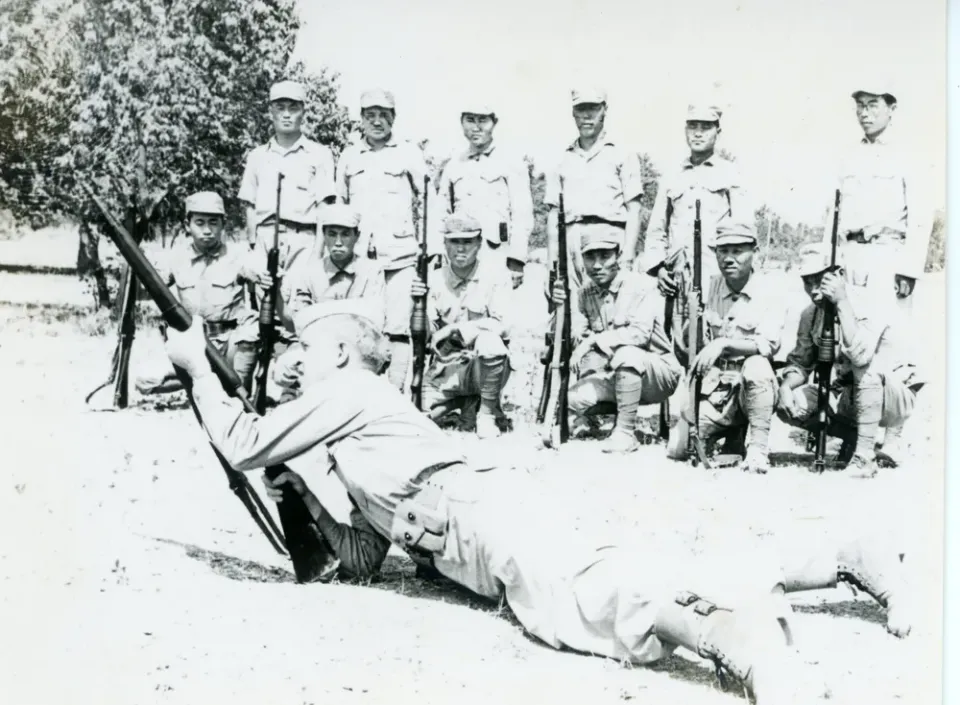
Eagle Project — Korean Liberation Army troops training with an OSS instructor, 1945

Provisional Government of the Republic of Korea · Public domain · Source

In 1945 men of the Second Detachment at Xi’an (under Lee Beom-seok) and the Third at Fuyang took OSS special training and formed an advance force to enter Korea in August. Japan’s surrender on 15 August came first, and the operation never took place.

Kim Gu wrote in his memoir Baekbeom ilji: "Ah! The Japanese have surrendered! For me this was less joyful news than the sky falling in." He feared that because Koreans had not won liberation by fighting Japan themselves, their voice in the postwar settlement would be weak.

The map in 1945

OpenFreeMap © OpenMapTiles © OpenStreetMap contributors

States and rulers at the time
United States · allied force — President Franklin D. Roosevelt → President Harry S. Truman
Republic of China
Places
Xi'an

People

  • Kim Gu1876 – 1949

    leader · Known as Baekbeom; founded the Korean Patriotic Organization and led the Liberation Army as Chairman of the Provisional Government

  • Lee Beom-seok1900 – 1972

    commander · Officer at the Battle of Cheongsan-ri, later chief of staff and Second Detachment commander of the Korean Liberation Army

  • Ji Cheong-cheon1888 – 1957

    commander · Commander of the Korean Independence Army in the joint Korea–China campaigns and Commander-in-Chief of the Liberation Army

Before and after

Themes that include this event

  • World War II and Korea1937 – 1945

    Wartime mobilization and exploitation, independence armies, from the Cairo Declaration to liberation