Politics4 – 11 February 1945

Yalta Conference

Roosevelt, Churchill and Stalin met at Yalta in Crimea and agreed on the occupation of Germany, the founding of the UN and Soviet entry into the war against Japan, laying the foundations of the post-war order and the Cold War.
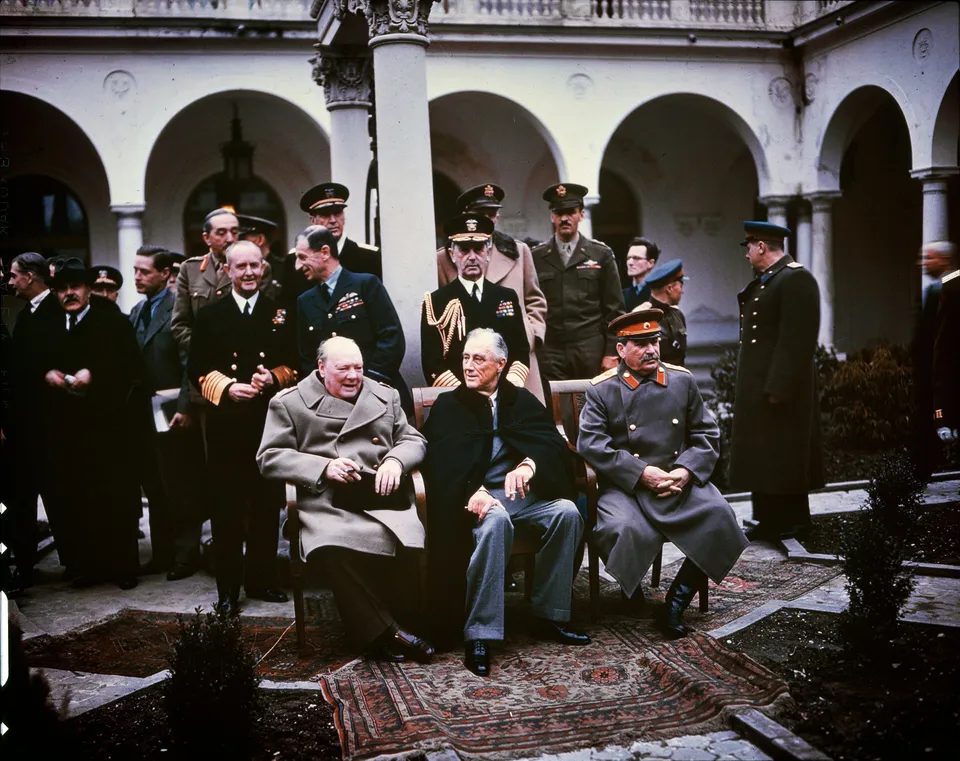
Churchill, Roosevelt and Stalin (front, from left) at the Yalta Conference, Livadia Palace, 9 February 1945

U.S. Army Signal Corps Collection · Public domain · Source

In February 1945, with Germany’s defeat in sight, the three leaders met at the Livadia Palace. Germany would be divided into zones occupied by the US, Britain, the USSR and France, and a conference would found the United Nations. The Soviet Union would enter the war against Japan within two or three months of Germany’s surrender in return for southern Sakhalin and the Kuril Islands.

Poland’s borders were to move west and free elections were to be held, but a Soviet-backed government took power. Korea was not on the formal agenda, though Roosevelt and Stalin are said to have discussed a trusteeship. As Eastern Europe passed into the Soviet sphere, the Yalta settlement became the starting point of the Cold War order.

The map in 1945

OpenFreeMap © OpenMapTiles © OpenStreetMap contributors

States and rulers at the time
United States · signatory — President Franklin D. Roosevelt
Great Britain · signatory
Soviet Union · signatory — Leader Joseph Stalin
Places
Livadia Palace

People

  • Franklin D. Roosevelt1882 – 1945

    diplomat · 32nd US president (1933–1945) who led the New Deal and took the US to war after Pearl Harbor; he attended the Cairo and Yalta conferences

  • Winston Churchill1874 – 1965

    diplomat · British prime minister (1940–1945, 1951–1955) who led Britain’s resistance through the Battle of Britain and named the “Iron Curtain” in 1946

  • Joseph Stalin1878 – 1953

    diplomat · General Secretary of the Soviet Communist Party who ruled the USSR from the late 1920s until his death, led the war against Germany and drew Eastern Europe into the Soviet bloc

Before and after

Themes that include this event

  • World War II1939 – 1945

    From the invasion of Poland to the surrender of Japan — the largest war in human history, across Europe, Asia and the Pacific

  • The Cold War1945 – 1991

    From Yalta to the dissolution of the Soviet Union — half a century in which two blocs led by the US and the USSR divided the world