Politics15 August 1945

Liberation of Korea

Also called: National Liberation Day of Korea

On 15 August 1945 Japan's surrender ended its rule over Korea. US and Soviet troops moved in on either side of the 38th parallel.
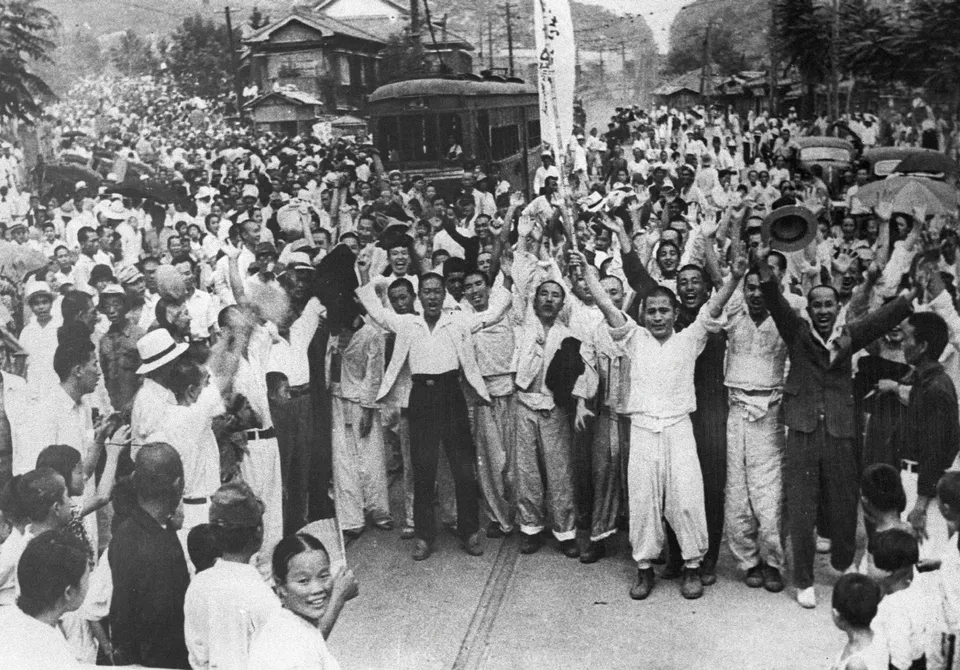
Independence activists released from Seodaemun Prison greeted by crowds — 16 August 1945

Unknown author · Public domain · Source

Liberation came with the Allied victory and as the fruit of a long independence struggle at home and abroad. At Cairo in 1943 the Allies first promised Korean independence "in due course", and the Potsdam Declaration of July 1945 confirmed it. In China the Korean Liberation Army was preparing an advance into the homeland with the US Office of Strategic Services, and at home Lyuh Woon-hyung formed the Korea Founding League to prepare for liberation.

After the United States dropped atomic bombs on Hiroshima and Nagasaki and the Soviet Union entered the war, Japan announced its unconditional surrender on 15 August, before the Liberation Army’s advance could take place. That same day Lyuh formed the Committee for the Preparation of Korean Independence.

As Soviet troops had already entered the north, the United States proposed dividing the occupation at the 38th parallel. US troops entering Seoul in September set up a military government, while the Soviets in the north ruled indirectly through people’s committees. This division was the beginning of the split of Korea.

The map in 1945

OpenFreeMap © OpenMapTiles © OpenStreetMap contributors

States and rulers at the time
Korea under Japanese rule · liberated — Governor-General Abe Nobuyuki
Japan · surrendered — Emperor Shōwa
United States · occupying force — President Harry S. Truman
Soviet Union · occupying force — Leader Joseph Stalin

Before and after

Related works

  • Book: Understanding the History Before and After LiberationBook · 1979 · Song Kon-ho et al. · Hangilsa
  • Book: Reconsidering the History Before and After LiberationBook · 2006 · Park Ji-hyang, Kim Chul, Kim Il-young, Lee Young-hoon (eds.) · Chaeksesang
  • TV episode: Naked Korean History Episode 16: Liberation Day — Why Did Koreans Not Cheer?TV episode · 2022 · Jo Geon · tvN STORY

Themes that include this event

  • World War II and Korea1937 – 1945

    Wartime mobilization and exploitation, independence armies, from the Cairo Declaration to liberation

  • Republican China and Imperial Japan1912 – 1949

    The age when the Republic of China, born of the 1911 Revolution, passed through warlord division, the May Fourth Movement, the United Front and the Northern Expedition, fought Japan’s invasion and split in civil war — as Japan moved from Taishō democracy through the Manchurian Incident and military coups to the war in China and the Co-Prosperity Sphere, and colonized Korea resisted through the March First Movement and armed struggle

  • World War II1939 – 1945

    From the invasion of Poland to the surrender of Japan — the largest war in human history, across Europe, Asia and the Pacific