Politics15 August – 2 September 1945

Surrender of Japan

Also called: VJ Day, Victory over Japan Day

Japan accepted the Potsdam Declaration and Emperor Hirohito announced the surrender by radio on 15 August. The instrument of surrender was signed aboard USS Missouri in Tokyo Bay on 2 September, ending the Second World War.
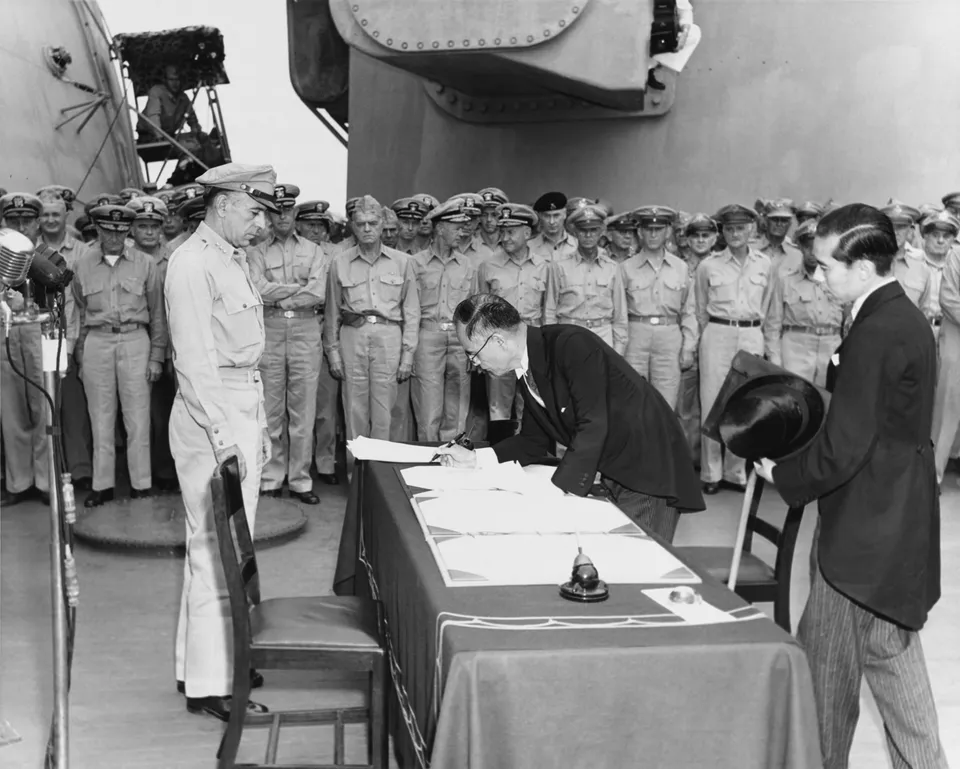
Japanese Foreign Minister Shigemitsu Mamoru signs the Instrument of Surrender aboard USS Missouri, Tokyo Bay, 2 September 1945

Army Signal Corps photographer LT. Stephen E. Korpanty; restored by Adam Cuerden · Public domain · Source

After the atomic bombings and the Soviet entry into the war, the Japanese government decided on 14 August to accept the Potsdam Declaration, and at noon the next day the emperor’s surrender broadcast went out. Korea was liberated the same day.

On 2 September Japanese representatives signed the instrument of surrender aboard the battleship USS Missouri in Tokyo Bay, received by the Supreme Commander for the Allied Powers, MacArthur, and the Allied delegates. Japan was occupied under MacArthur’s General Headquarters, while in Korea Soviet and American forces took the Japanese surrender on either side of the 38th parallel.

The map in 1945

OpenFreeMap © OpenMapTiles © OpenStreetMap contributors

States and rulers at the time
Japan · surrendered — Emperor Shōwa
United States · victor — President Harry S. Truman
Places
Tokyo

People

  • Hirohito (Emperor Shōwa)1901 – 1989

    monarch · Emperor of Japan (r. 1926–1989), sovereign during the war with China and the Pacific War, who announced the surrender by radio on 15 August 1945

  • Douglas MacArthur1880 – 1964

    participant · US General of the Army; as UN commander in the Korean War he directed the Incheon landing. Relieved of command in April 1951

  • Chester W. Nimitz1885 – 1966

    participant · Commander of the US Pacific Fleet who directed the Battle of Midway and signed Japan’s instrument of surrender for the United States

Before and after

Themes that include this event

  • Republican China and Imperial Japan1912 – 1949

    The age when the Republic of China, born of the 1911 Revolution, passed through warlord division, the May Fourth Movement, the United Front and the Northern Expedition, fought Japan’s invasion and split in civil war — as Japan moved from Taishō democracy through the Manchurian Incident and military coups to the war in China and the Co-Prosperity Sphere, and colonized Korea resisted through the March First Movement and armed struggle

  • World War II1939 – 1945

    From the invasion of Poland to the surrender of Japan — the largest war in human history, across Europe, Asia and the Pacific