Conflict6 and 9 August 1945

Atomic Bombings of Hiroshima and Nagasaki

Also called: Hiroshima bombing, Nagasaki bombing

The United States dropped atomic bombs on Hiroshima and Nagasaki. More than 200,000 people died in the two cities that year, and Japan surrendered soon after.
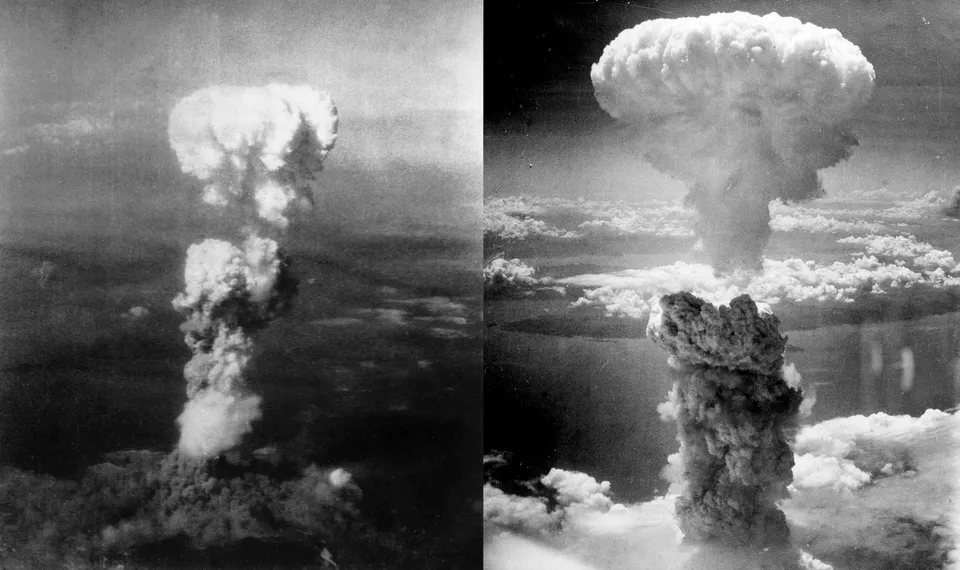
Atomic clouds over Hiroshima (left) and Nagasaki (right), 6 and 9 August 1945

George R. Caron / Charles Levy · Public domain · Source

When Japan did not accept the Potsdam Declaration, Truman decided to use the atomic bomb. On 6 August a B-29 dropped a uranium bomb (Little Boy) on Hiroshima, and on 9 August a plutonium bomb (Fat Man) on Nagasaki. In between, on 8 August, the Soviet Union declared war on Japan and invaded Manchuria.

Both cities were destroyed in an instant; by the end of 1945 some 140,000 people had died in Hiroshima and some 70,000 in Nagasaki, by common estimates. Tens of thousands of Koreans, many brought to Japan as forced labourers, were also exposed. The effects of radiation lasted for decades, and the bomb cast the long shadow of the nuclear arms race and the Cold War.

The map in 1945

OpenFreeMap © OpenMapTiles © OpenStreetMap contributors

States and rulers at the time
United States · belligerent — President Harry S. Truman
Japan · targeted — Emperor Shōwa
Places
Hiroshima Peace Memorial (Atomic Bomb Dome), Nagasaki

People

  • Harry S. Truman1884 – 1972

    leader · 33rd US president (1945–1953) who ordered the atomic bombings, set the policy of containment with the Truman Doctrine and sent US forces to the Korean War

Before and after

Related works

  • Film: OppenheimerDramatizedFilm · 2023 · Christopher Nolan
  • Book: American PrometheusBook · 2005 · Kai Bird, Martin J. Sherwin (tr. Choi Hyung-sub) · ScienceBooks

Dramatized works (films, dramas, novels) may differ from the historical record.

Themes that include this event

  • World War II1939 – 1945

    From the invasion of Poland to the surrender of Japan — the largest war in human history, across Europe, Asia and the Pacific