Politics1 March 1919

March First Movement

Also called: Samil Movement

Beginning on 1 March 1919 with the reading of a declaration of independence, demonstrations spread across the country. It led to the founding of the Provisional Government of the Republic of Korea.
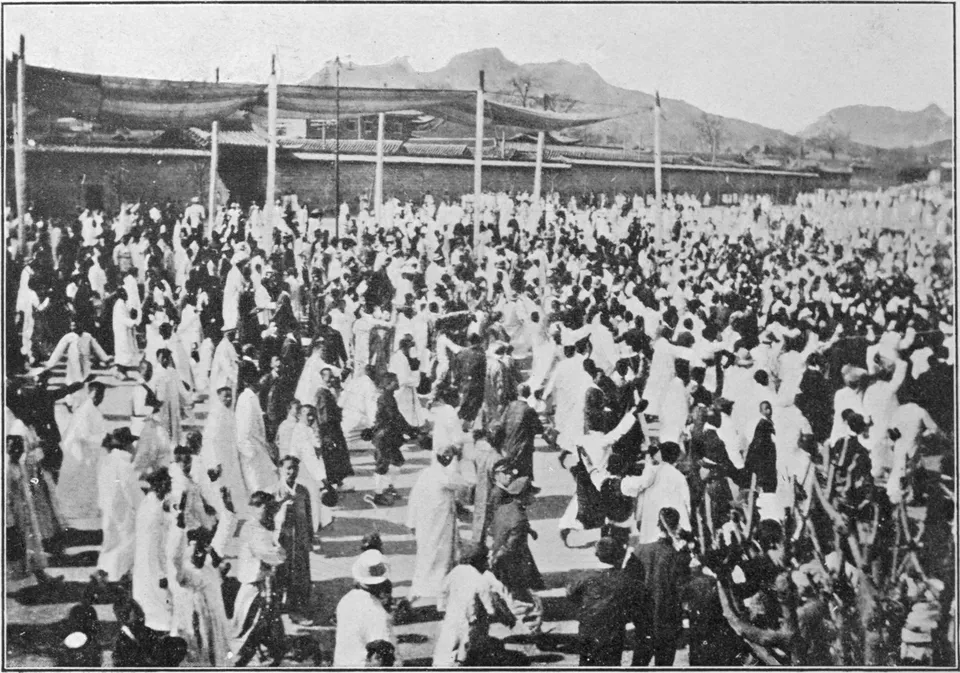
Independence demonstration in Seoul, March 1919

Bureau d'information coréen · Public domain · Source

Near the end of the First World War, US President Wilson proclaimed national self-determination and Russia’s revolutionary government promised to support the liberation of small nations. At home, resentment of military rule and the land survey ran deep, and the sudden death of the former emperor Gojong in January 1919 spread rumours of poisoning. Abroad, the New Korea Youth Party sent Kim Kyu-sik to the Paris Peace Conference, and Korean students in Tokyo issued the February Eighth Declaration of Independence.

Beginning on 1 March with the declaration by the 33 national representatives and the demonstration in Tapgol Park, the movement spread for more than two months across the country and to Manchuria, the Maritime Province and America. Japan put it down by force with troops and military police; the Aunae market protest led by Yu Gwan-sun and the Jeamni massacre belong to this time.

The movement showed the need for a leadership to direct the struggle, leading to the founding of the Provisional Government of the Republic of Korea, and it forced Japan to switch to so-called cultural rule. Afterward the national movement branched out into armed struggle, self-strengthening movements and socialism.

The map in 1919

OpenFreeMap © OpenMapTiles © OpenStreetMap contributors

States and rulers at the time
Korea under Japanese rule — Governor-General Hasegawa Yoshimichi
Japan · ruling power — Emperor Taishō

3 parts of this event

  1. 1

    The 33 national representatives proclaimed independence at Taehwagwan while students and citizens read the declaration in Tapgol Park and began demonstrating. The protests spread from the cities to the countryside and abroad.

  2. 2

    Ewha student Yu Gwan-sun led a market-day protest at Aunae in her home county of Cheonan. Japanese gendarmes opened fire, killing several people including her parents.

  3. 3

    Japanese troops herded the men of Jeam-ri, Hwaseong, into the church, shot them and set it on fire, killing over twenty.

Before and after

Related works

  • Film: A ResistanceDramatizedFilm · 2019 · Cho Min-ho
  • TV episode: Naked Korean History Episode 97: How Did 17-Year-Old Yu Gwan-sun Become a National Independence Fighter?TV episode · 2024 · tvN STORY

Dramatized works (films, dramas, novels) may differ from the historical record.

Themes that include this event

  • World War I and the Russian Revolution1908 – 1923

    From the Balkan crises to a war of trenches and total mobilization that toppled four empires; the Russian Revolution it unleashed, which created the first socialist state; and the Versailles settlement of national self-determination and the League of Nations

  • Republican China and Imperial Japan1912 – 1949

    The age when the Republic of China, born of the 1911 Revolution, passed through warlord division, the May Fourth Movement, the United Front and the Northern Expedition, fought Japan’s invasion and split in civil war — as Japan moved from Taishō democracy through the Manchurian Incident and military coups to the war in China and the Co-Prosperity Sphere, and colonized Korea resisted through the March First Movement and armed struggle

  • National Movements in Asia and Africa1915 – 1948

    From the Hussein–McMahon correspondence to the founding of Israel — three decades in which India, West Asia, Southeast Asia and Africa, swept up in the tide of self-determination after the First World War, pressed toward independence and modernization

  • Suwon1601 – 1919

    From Jeongjo’s new city of Hwaseong to the tragedy of Jeam-ri — where a king’s filial devotion and reform politics were built into stone walls