World history1915 – 194826 events

National Movements in Asia and Africa

From the Hussein–McMahon correspondence to the founding of Israel — three decades in which India, West Asia, Southeast Asia and Africa, swept up in the tide of self-determination after the First World War, pressed toward independence and modernization
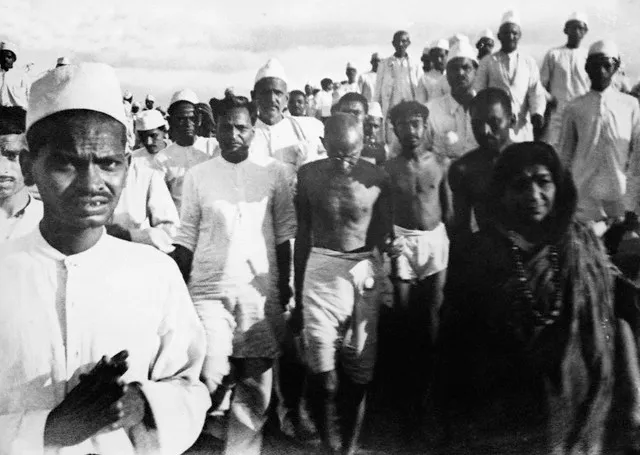
소금 행진 중의 간디 — 1930년 3–4월

Unknown author · Public domain · Source

At a glance

YearRegionEventKey points
1915–16Arab landsHussein–McMahon lettersArab independence for a revolt
1916Arab landsSykes–Picot AgreementSecret UK–French (–Russian) carve-up
1917PalestineBalfour DeclarationJewish national home backed
1919–22Egypt1919 Revolution (Wafd)Independent 1922; British rights kept
1919–23TurkeyWar of Independence (Kemal)Sèvres rejected → Lausanne
1920West AsiaMandates (San Remo)Syria, Lebanon: Fr.; Iraq, Palestine: UK
1920–22IndiaNon-cooperationRowlatt, Amritsar → Gandhi; Khilafat
1923TurkeyRepublic and reformsCaliphate ended, secularism, new alphabet
1925IranPahlavi dynasty (Reza Shah)Qajars out; modernization from above
1927IndonesiaNationalist Party (Sukarno)Non-cooperation; Youth Pledge
1929IndiaLahore session (Nehru)Purna swaraj = complete independence
1930VietnamCommunist Party (Ho Chi Minh)→ Indochinese CP; Viet Minh (1941)
1930IndiaSalt MarchSalt law defied; civil disobedience
1932ArabiaSaudi Arabia foundedIbn Saud, Wahhabism, oil
1942IndiaQuit India"Do or die"; leaders jailed
1948PalestineIsrael founded; 1948 warWar of Independence / Nakba; refugees

The theme on the map

OpenFreeMap © OpenMapTiles © OpenStreetMap contributors

26 events in this theme

  1. During the First World War Britain promised Sharif Hussein of Mecca that it would support Arab independence after the war if he rose against the Ottoman Empire.

  2. With Russia’s assent, Britain and France secretly agreed to divide the Ottoman Empire’s Arab lands between them after the war.

  3. 1916 – 1918Arab Revolt

    With British support, Sharif Hussein of Mecca rose against the Ottoman Empire; Arab forces took Aqaba and entered Damascus in 1918.

  4. British Foreign Secretary Balfour declared support for establishing "a national home for the Jewish people" in Palestine, adding that the rights of the existing non-Jewish communities would not be prejudiced.

  5. Timed to coincide with the Paris Peace Conference, Du Bois gathered Black delegates from Africa, the Americas and the Caribbean, who called for African rights and self-government.

  6. Beginning on 1 March 1919 with the reading of a declaration of independence, demonstrations spread across the country. It led to the founding of the Provisional Government of the Republic of Korea.

  7. When leaders of the Wafd ("delegation") headed by Saad Zaghlul were exiled, anti-British protests swept Egypt. Britain recognized Egyptian independence in 1922 but kept troops and other privileges.

  8. When Britain passed the Rowlatt Act allowing arrest and detention without warrant, protests broke out across India. At Jallianwala Bagh in Amritsar British troops fired on an unarmed crowd, killing hundreds.

  9. When the Ottoman Empire, defeated in the First World War, faced partition by the Allies, Mustafa Kemal organized resistance from Ankara, drove out the Greek army and overturned the Treaty of Sèvres.

  10. After the war the Allies divided the Ottoman Empire’s Arab lands as League of Nations mandates: France took Syria and Lebanon, Britain Iraq, Palestine and Transjordan.

  11. Gandhi and the Indian National Congress led a non-violent movement to boycott British goods, schools, courts and offices—the first nationwide mass movement uniting Hindus and Muslims.

  12. Peace treaty between Turkey and the Allies signed at Lausanne, Switzerland. Replacing the Treaty of Sèvres, it fixed the borders of modern Turkey and abolished the unequal privileges known as the capitulations.

  13. Mustafa Kemal proclaimed the Republic of Turkey and became its first president, pushing through Western-style modernizing reforms: the abolition of the caliphate, secularism, a Latin-based alphabet and votes for women.

  14. The soldier Reza Khan, having seized power in a coup, had parliament depose the Qajar dynasty and made himself shah, founding the Pahlavi dynasty and driving modernization from above.

  15. Sukarno founded the Indonesian Nationalist Party in Bandung, calling for non-cooperation with the Dutch and full independence. The next year a youth congress pledged "one motherland, one nation, one language".

  16. At its Lahore session the Indian National Congress resolved to seek complete independence (purna swaraj) rather than dominion status, and proclaimed 26 January 1930 Independence Day.

  17. Young Burmese founded the We Burmans Association (the Thakins) to resist Britain, calling themselves "masters" (thakin) to assert that the Burmese were the masters of their own country.

  18. Nguyễn Ái Quốc (Ho Chi Minh) united several communist groups in Hong Kong into the Communist Party of Vietnam, renamed the Indochinese Communist Party later that year.

  19. Defying the British salt monopoly, Gandhi walked some 390 km from his ashram to the seaside at Dandi and made salt from seawater, signalling civil disobedience across India.

  20. Rising from Nejd, Ibn Saud drove Hussein’s family out of the Hejaz, unified most of the Arabian Peninsula and founded the Kingdom of Saudi Arabia.

  21. Iraq, a British mandate, became independent on joining the League of Nations—the first mandate to do so—though Britain kept military bases and oil interests.

  22. Britain passed a Government of India Act widening self-government in the provinces; in the elections it held in 1937 the Congress formed governments in many provinces.

  23. The US Congress passed a law promising Philippine independence after ten years, and the Commonwealth government took office with Manuel Quezon as president.

  24. 1942 – 1944Quit India Movement

    During the Second World War the Congress demanded that Britain leave India at once and launched a mass campaign. Gandhi and the leadership were arrested immediately and the movement was crushed, but British rule became harder to sustain.

  25. British India became independent as two states, India and Pakistan. Mass migration and violence followed.

  26. On the day the British Mandate ended, the Jewish leadership declared the State of Israel and neighbouring Arab states invaded. Israel calls it the "War of Independence"; Palestinians, some 700,000 of whom lost their homes, call it the "Nakba" (catastrophe).

Key people

  • Mahatma Gandhi1869 – 1948

    Leader of the Indian independence movement who resisted British rule through non-violent civil disobedience grounded in satyagraha ("holding to truth")

  • Faisal I of Iraq1885 – 1933

    Son of Hussein bin Ali and a commander of the Arab Revolt, briefly King of Syria (1920) and then King of Iraq (1921–1933)

  • Mustafa Kemal Atatürk1881 – 1938

    Leader of the Turkish War of Independence and founding president of the Republic of Turkey (1923), who pushed through secularism, the alphabet reform and other modernizing reforms

  • Jawaharlal Nehru1889 – 1964

    Indian National Congress leader who carried the call for complete independence at Lahore in 1929 and became independent India’s first prime minister (1947–1964)

  • Hussein bin Ali1854 – 1931

    Sharif of Mecca who, after his correspondence with Britain, launched the Arab Revolt in 1916 and became King of the Hejaz

  • Henry McMahon1862 – 1949

    British diplomat and colonial official who, as High Commissioner in Egypt (1915–1916), corresponded with Hussein of Mecca

  • Mark Sykes1879 – 1919

    British diplomatic adviser and MP who negotiated the division of the Ottoman Arab lands with France’s Picot

  • François Georges-Picot1870 – 1951

    French diplomat who concluded the Sykes–Picot Agreement with Britain’s Mark Sykes

  • T. E. Lawrence1888 – 1935

    British archaeologist and intelligence officer who served as liaison to the Arab Revolt and became known as "Lawrence of Arabia"

  • Arthur Balfour1848 – 1930

    British statesman, prime minister (1902–1905) and, as foreign secretary, author of the Balfour Declaration of 1917

  • W. E. B. Du Bois1868 – 1963

    African American sociologist and civil rights leader who convened the Pan-African Congress in Paris in 1919 and led the Pan-African movement

  • Saad Zaghlul1859 – 1927

    Leader of the Egyptian national movement who headed the Wafd, stood at the centre of the 1919 revolution and became prime minister in 1924