Hussein–McMahon Correspondence
Also called: McMahon–Hussein Correspondence
During the First World War Britain promised Sharif Hussein of Mecca that it would support Arab independence after the war if he rose against the Ottoman Empire.
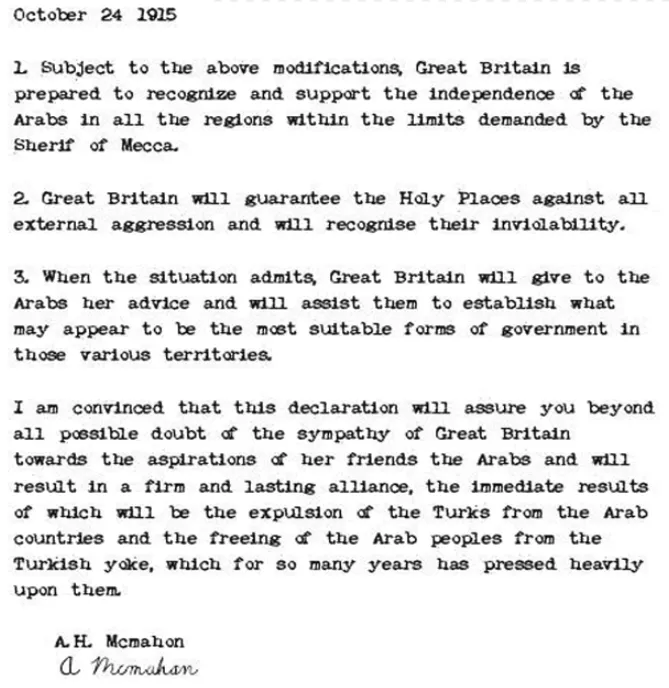
When the Ottoman Empire joined Germany in the First World War, Britain sought to win over the Arabs under Ottoman rule to protect the Suez Canal and the route to India. From July 1915 to March 1916 Hussein bin Ali, guardian of the holy city of Mecca, and Henry McMahon, British High Commissioner in Cairo, exchanged about ten letters. McMahon’s letter of 24 October 1915 declared that, with certain areas excepted, Britain would recognize and support Arab independence.
Trusting this promise, Hussein launched the Arab Revolt in 1916. Yet at almost the same time Britain concluded the Sykes–Picot Agreement with France, and the next year it issued the Balfour Declaration to the Jews—what is often called Britain’s "double (or triple) diplomacy". Whether Palestine lay within the excluded "districts west of Damascus, Homs, Hama and Aleppo" became a lasting dispute: Britain held that it had been excluded from the start, while the Arab side insisted it had been promised. These clashing readings became one root of the Palestine question.