Sykes–Picot Agreement
With Russia’s assent, Britain and France secretly agreed to divide the Ottoman Empire’s Arab lands between them after the war.
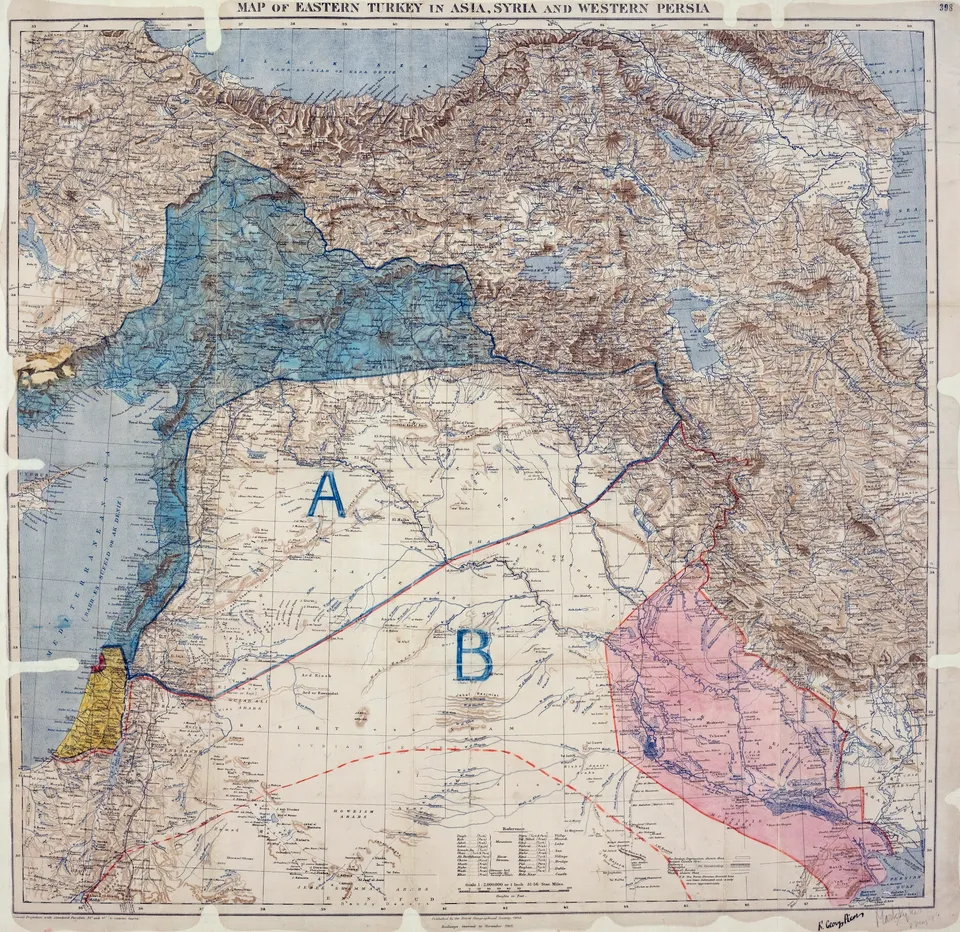
Royal Geographical Society (Map), Mark Sykes & François Georges-Picot (Annotations) · Public domain · Source
Mark Sykes of Britain and François Georges-Picot of France negotiated from late 1915 and concluded the agreement through an exchange of letters in May 1916. Drawing lines on a map, they gave Britain direct control of what is now southern Iraq (Baghdad and Basra) and the ports of Haifa and Acre, and France the Syrian coast, Lebanon and south-eastern Anatolia, while the interior between them was split into British and French spheres of influence. The heart of Palestine was to be under international administration.
The agreement contradicted the promise of Arab independence in the Hussein–McMahon correspondence. It became public when the Bolshevik government published the old regime’s secret treaties after the 1917 Russian Revolution, provoking Arab outrage. The postwar borders drawn under the mandates differed somewhat, but because the great powers drew them with little regard for where peoples and faiths lived, the agreement is often seen as a starting point of today’s conflicts in West Asia.