Founding of Israel and the First Arab–Israeli War
Also called: 1948 Arab–Israeli War, Israeli War of Independence, Nakba, 1948 Palestine War
On the day the British Mandate ended, the Jewish leadership declared the State of Israel and neighbouring Arab states invaded. Israel calls it the "War of Independence"; Palestinians, some 700,000 of whom lost their homes, call it the "Nakba" (catastrophe).
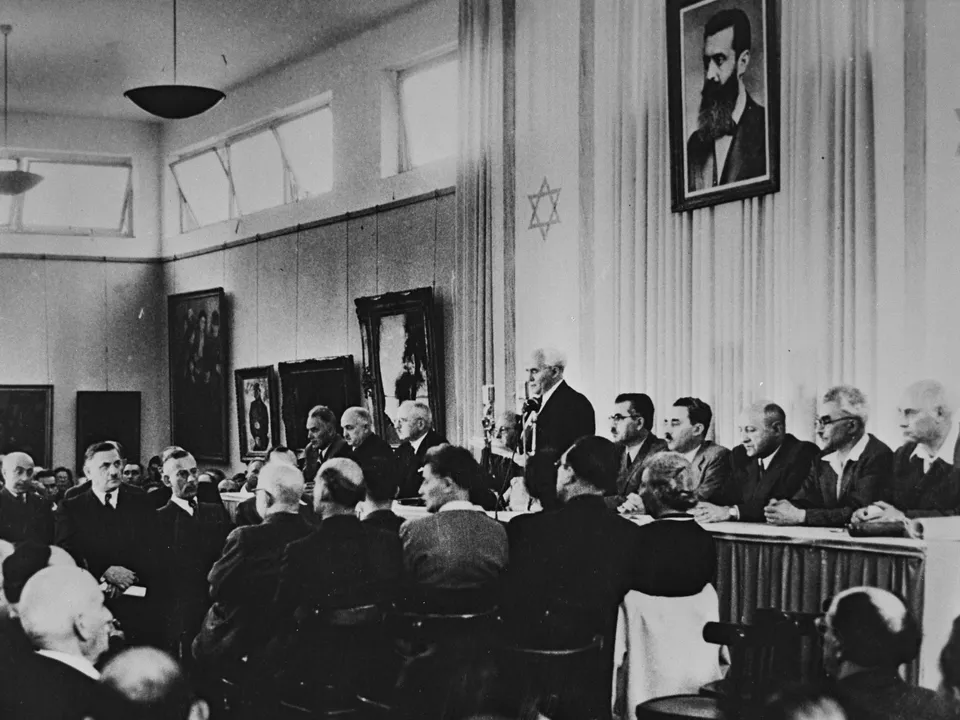
Rudi Weissenstein · CC BY-SA 3.0 · Source
During the mandate, Jewish immigration grew until Jews made up about a third of the population, and clashes with the Arab population intensified. After the Holocaust, international support for a Jewish state grew, and Britain handed the question to the United Nations. On 29 November 1947 the UN General Assembly adopted a partition plan (Resolution 181) dividing Palestine into a Jewish state and an Arab state, with Jerusalem under international administration. The Jewish side accepted it; the Arab side, objecting to giving more than half the land to the less populous Jewish state, rejected it, and civil war soon broke out.
On 14 May 1948 David Ben-Gurion proclaimed the State of Israel in Tel Aviv, and the next day the armies of Egypt, Transjordan, Syria, Lebanon and Iraq invaded. The war ended with the armistice agreements of 1949, leaving Israel with about three-quarters of the former mandate, more than the partition plan had allotted. Jordan took the West Bank, Egypt the Gaza Strip, and Jerusalem was divided in two.
In Israel the war is remembered as the "War of Independence" that secured the new state. For Palestinians it is the "Nakba" (catastrophe), in which some 700,000 people fled or were driven out and hundreds of villages disappeared; it is commemorated every 15 May. In the following years several hundred thousand Jews from Arab countries also moved to Israel. The return of refugees and the status of Jerusalem remain at the unresolved heart of the Palestinian question.