Quit India Movement
Also called: August Movement, Bharat Chhodo Andolan
During the Second World War the Congress demanded that Britain leave India at once and launched a mass campaign. Gandhi and the leadership were arrested immediately and the movement was crushed, but British rule became harder to sustain.
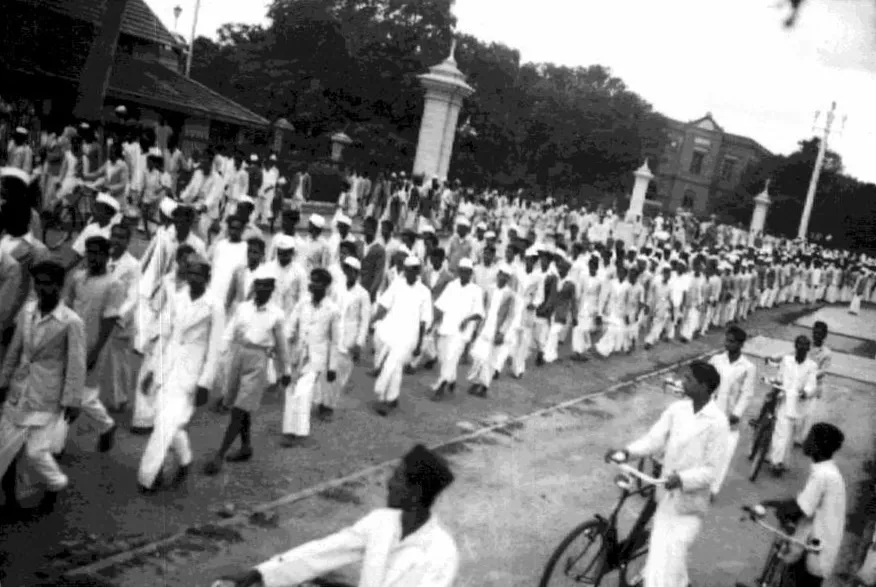
No machine-readable author provided. Dore chakravarty~commonswiki assumed (based on copyright claims). · CC BY-SA 2.5 · Source
In 1939 Britain brought India into the Second World War without consulting Indians, and the Congress provincial governments resigned in protest. As Japanese forces pushed into Burma, Britain sent the Cripps Mission in 1942 offering dominion status after the war, but the Congress refused. On 8 August 1942 the Congress meeting in Bombay passed the "Quit India" resolution, and Gandhi called on Indians to "do or die".
At dawn the next day Gandhi, Nehru and the entire leadership were arrested. Leaderless crowds attacked railways, telegraph lines and government buildings, and Britain put the movement down with troops; close to 100,000 were jailed and more than a thousand killed. Meanwhile Subhas Chandra Bose led the Indian National Army with Japanese backing, and the Muslim League, having called for a separate Pakistan in its Lahore Resolution of 1940, grew stronger during the war. When the war ended an exhausted Britain decided to leave India, and independence came in the form of the partition of India and Pakistan.