Founding of the Republic of Turkey and Kemal’s Reforms
Also called: Atatürk’s Reforms, Kemalism
Mustafa Kemal proclaimed the Republic of Turkey and became its first president, pushing through Western-style modernizing reforms: the abolition of the caliphate, secularism, a Latin-based alphabet and votes for women.
Presidency of the Republic of Turkey · Public domain · Source
On 13 October 1923 Ankara was made the capital, and on 29 October the Grand National Assembly proclaimed the republic and elected Mustafa Kemal president. In 1924 Kemal abolished the caliphate, the spiritual authority of the Islamic world, along with religious schools and sharia courts. A civil code modelled on Switzerland’s banned polygamy in 1926, and in 1928 the clause making Islam the state religion was removed from the constitution.
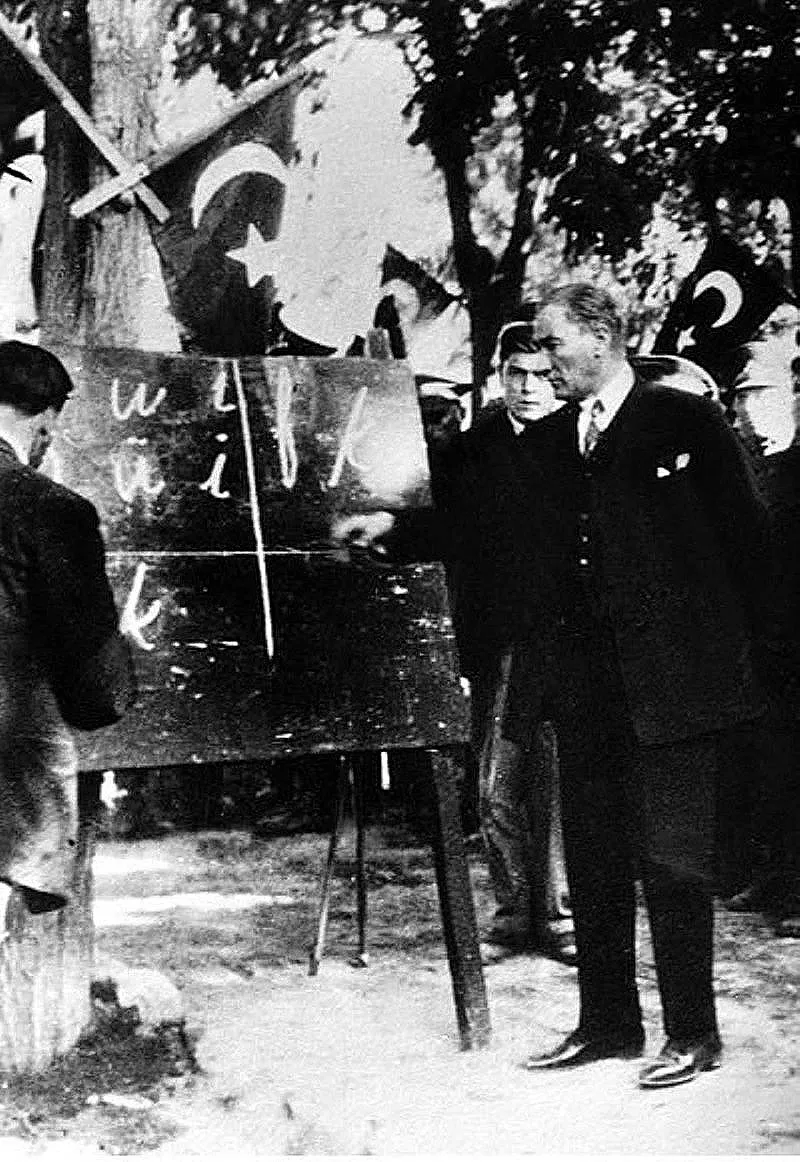
That same year a new Turkish alphabet based on Latin letters replaced the Arabic script, and Kemal himself taught it at the blackboard in a campaign against illiteracy. The fez was banned, the Western calendar and measures adopted, and in 1934 women won the vote in parliamentary elections. Under a surname law of the same year the assembly gave him the name Atatürk, "Father of the Turks".
Its six principles—republicanism, nationalism, populism, statism, secularism and reformism (Kemalism)—became the foundation of modern Turkey. Yet the reforms were imposed from above under the one-party rule of the Republican People’s Party, and Kurdish uprisings and religious opposition were put down by force. As the first secular modern state in the Muslim world, Turkey served as a model for reforms in Iran and Afghanistan.