Politics15 May 1932

May 15 Incident

Also called: 5.15 Incident

On 15 May 1932 young naval officers stormed the prime minister’s residence and killed Prime Minister Inukai Tsuyoshi, bringing the era of party cabinets to an end.
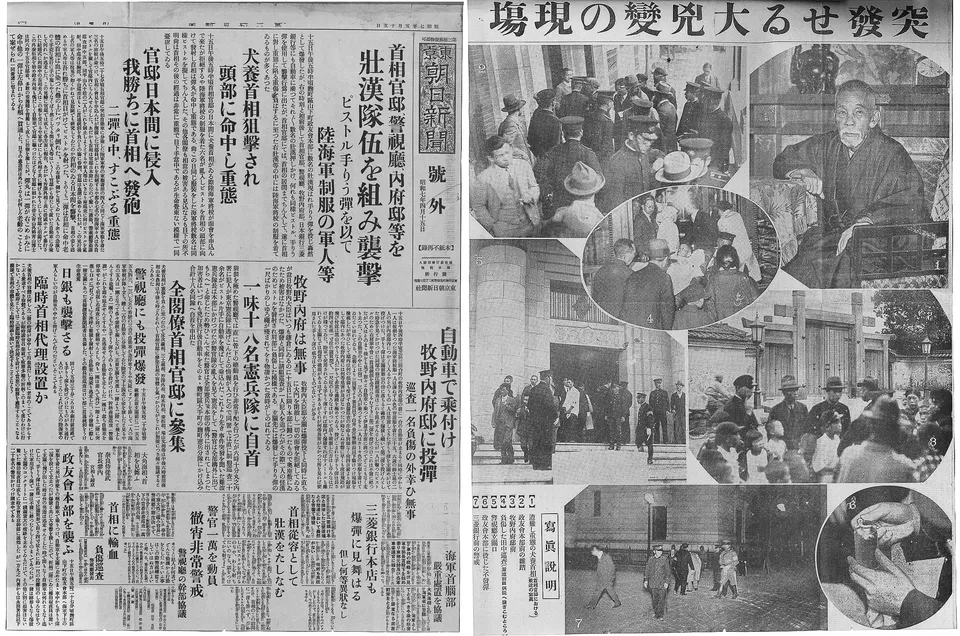
Tokyo Asahi Shimbun extra reporting the shooting of Prime Minister Inukai, 15 May 1932

Tokyo Asahi Shimbun · Public domain · Source

Amid the Depression and rural poverty, soldiers and right-wing activists who blamed the parties and the zaibatsu for ruining the country turned to terror in the name of “national reconstruction”. On 15 May 1932 young naval officers and army cadets burst into the prime minister’s residence and shot Prime Minister Inukai Tsuyoshi, who had been cautious about recognizing Manchukuo.

His successor, Admiral Saitō Makoto, a former Governor-General of Korea, formed a “national unity” cabinet, and the party cabinets that had ruled since 1924 never returned before Japan’s defeat. The assassins’ light sentences and the public sympathy they won only emboldened military interference in politics.

The map in 1932

OpenFreeMap © OpenMapTiles © OpenStreetMap contributors

States and rulers at the time
Japan — Emperor Shōwa
Places
Tokyo

People

  • Inukai Tsuyoshi1855 – 1932

    related figure · Party politician who led the movement to protect constitutional government and became prime minister (1931–1932) as Seiyūkai president; murdered in his residence by young naval officers in the May 15 Incident

  • Saitō Makoto1858 – 1936

    related figure · Third and fifth Governor-General of Korea, who proclaimed "cultural rule" after the March First Movement

Before and after

Themes that include this event

  • Republican China and Imperial Japan1912 – 1949

    The age when the Republic of China, born of the 1911 Revolution, passed through warlord division, the May Fourth Movement, the United Front and the Northern Expedition, fought Japan’s invasion and split in civil war — as Japan moved from Taishō democracy through the Manchurian Incident and military coups to the war in China and the Co-Prosperity Sphere, and colonized Korea resisted through the March First Movement and armed struggle