Conflict7 December 1941

Attack on Pearl Harbor

Also called: Pearl Harbor attack

Japanese naval aircraft made a surprise attack on the US Pacific Fleet at Pearl Harbor, Hawaii. America entered the war, which spread across the Pacific (the Pacific War).
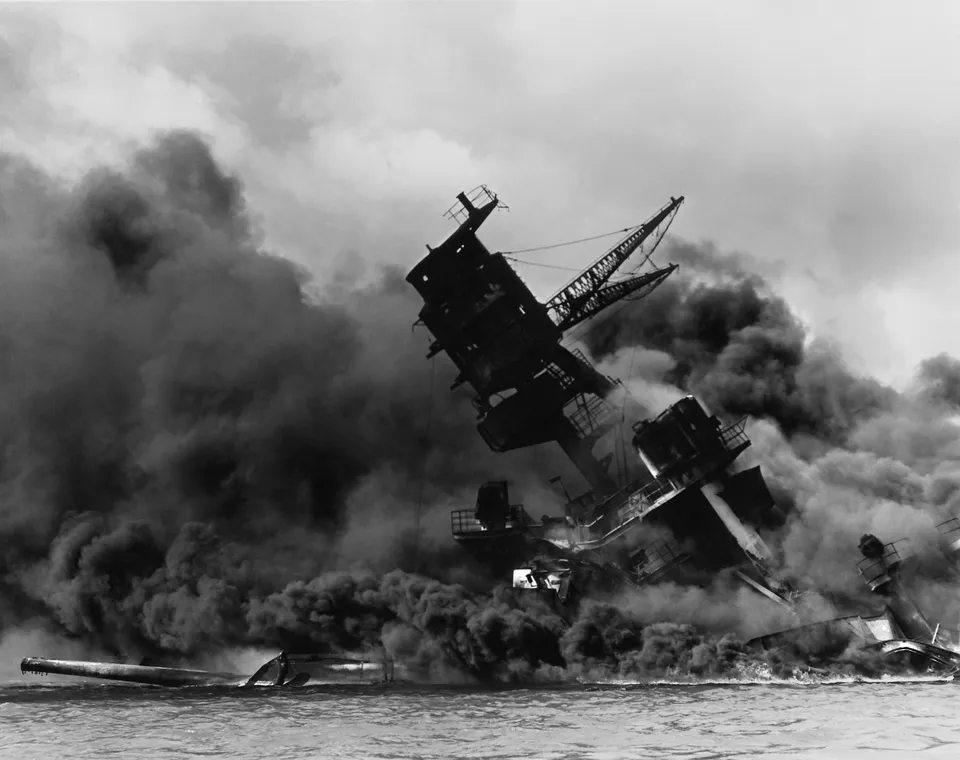
The battleship USS Arizona burning and sunk after the Japanese attack, Pearl Harbor, 7 December 1941

Photographer: Unknown Unknown Retouched by: Mmxx · Public domain · Source

When Japan, already at war with China, moved into French Indochina, the United States cut off its oil. Seeking resources in Southeast Asia, Japan set out to cripple the American fleet first. On the morning of 7 December 1941 (8 December in Japan) aircraft from six carriers struck Pearl Harbor, sinking several battleships and killing nearly 2,400 people. The same day Japanese forces attacked Malaya, the Philippines and Hong Kong.

The next day the US declared war on Japan, and on 11 December Germany and Italy declared war on the US, making the conflict truly global. The Korean Provisional Government also declared war on Japan on 10 December.

The map in 1941

OpenFreeMap © OpenMapTiles © OpenStreetMap contributors

States and rulers at the time
Japan · invader — Emperor Shōwa
United States · invaded — President Franklin D. Roosevelt
Places
Pearl Harbor

People

  • Yamamoto Isoroku1884 – 1943

    commander · Commander of Japan’s Combined Fleet who planned the attack on Pearl Harbor and the Midway operation; shot down over the South Pacific in 1943

  • Franklin D. Roosevelt1882 – 1945

    related figure · 32nd US president (1933–1945) who led the New Deal and took the US to war after Pearl Harbor; he attended the Cairo and Yalta conferences

Before and after

Related works

  • Film: Tora! Tora! Tora!DramatizedFilm · 1970 · Richard Fleischer, Toshio Masuda, Kinji Fukasaku

Dramatized works (films, dramas, novels) may differ from the historical record.

Themes that include this event

  • Republican China and Imperial Japan1912 – 1949

    The age when the Republic of China, born of the 1911 Revolution, passed through warlord division, the May Fourth Movement, the United Front and the Northern Expedition, fought Japan’s invasion and split in civil war — as Japan moved from Taishō democracy through the Manchurian Incident and military coups to the war in China and the Co-Prosperity Sphere, and colonized Korea resisted through the March First Movement and armed struggle

  • World War II1939 – 1945

    From the invasion of Poland to the surrender of Japan — the largest war in human history, across Europe, Asia and the Pacific