ConflictOctober 1934 – October 1935

Long March

Also called: Zunyi Conference, Chang Zheng

Driven from its base at Ruijin in Jiangxi by Nationalist encirclement campaigns, the Communist Red Army walked about 12,000 km over a year from October 1934 to northern Shaanxi; along the way Mao Zedong took the leadership.
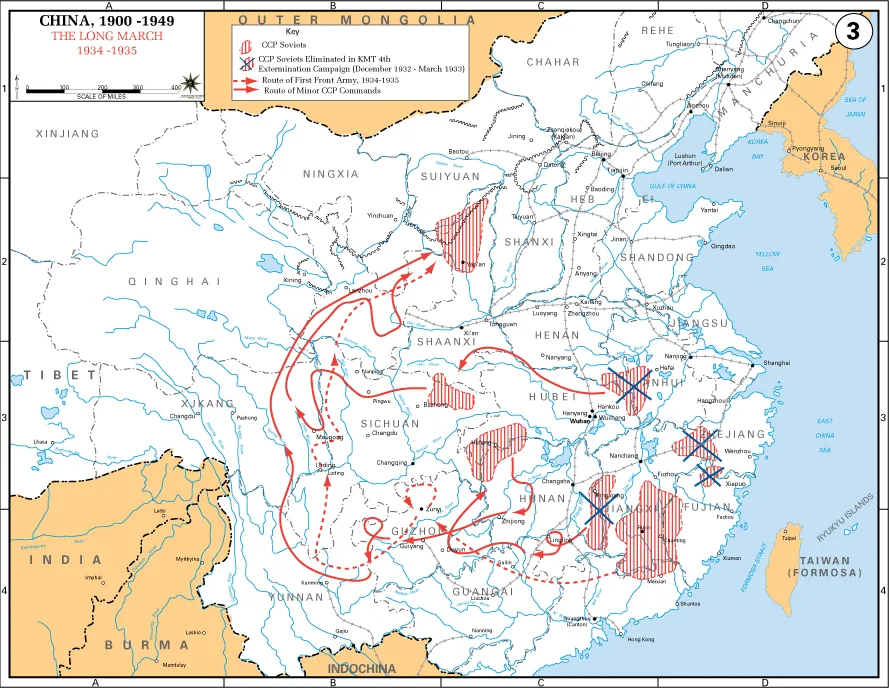
Routes of the Long March, 1934–1935 — US Army map

U.S. Army · Public domain · Source

After the Shanghai coup the Communists built rural bases and in 1931 proclaimed a Chinese Soviet Republic at Ruijin. Chiang Kai-shek, following the policy of “first internal pacification, then external resistance”, launched five encirclement campaigns, and in October 1934 about 86,000 Red Army troops abandoned the base and broke out westward.

After heavy losses crossing the Xiang River, a party conference at Zunyi in Guizhou in January 1935 criticized the existing military leadership and brought Mao Zedong into the leading group. Crossing the Luding Bridge over the Dadu River, snow-covered ranges and marshland, the army reached northern Shaanxi in October with only a few thousand of those who had set out. In the August First Declaration of 1935 the party called for an end to civil war and joint resistance to Japan, and from 1937 it made Yan’an its base.

The Long March saved the party from annihilation and consolidated a leadership centred on Mao; it also served as propaganda, spreading the revolution to the peasants along its route.

The map in 1934

OpenFreeMap © OpenMapTiles © OpenStreetMap contributors

States at the time
Republic of China
Places
Yan'an

People

  • Mao Zedong1893 – 1976

    commander · Chairman of the Chinese Communist Party who won the civil war and founded the People’s Republic in 1949, and launched the Great Leap Forward and the Cultural Revolution

  • Zhou Enlai1898 – 1976

    participant · First premier of the People’s Republic of China (1949–1976), long in charge of diplomacy, who arranged Nixon’s 1972 visit

  • Chiang Kai-shek1887 – 1975

    related figure · Leader of the Chinese Nationalist Party who unified China through the Northern Expedition and led the Nanjing government through the war with Japan; after losing the civil war he moved to Taiwan and ruled the Republic of China there

Before and after

Related works

Themes that include this event

  • Republican China and Imperial Japan1912 – 1949

    The age when the Republic of China, born of the 1911 Revolution, passed through warlord division, the May Fourth Movement, the United Front and the Northern Expedition, fought Japan’s invasion and split in civil war — as Japan moved from Taishō democracy through the Manchurian Incident and military coups to the war in China and the Co-Prosperity Sphere, and colonized Korea resisted through the March First Movement and armed struggle