Politics12–25 December 1936

Xi’an Incident

Also called: Sian Incident

On 12 December 1936 Chiang Kai-shek was detained in Xi’an by his own commanders, Zhang Xueliang and Yang Hucheng, who pressed him to stop fighting the Communists and turn against Japan. Mediation by the Communist Zhou Enlai won Chiang’s release, paving the way for the Second United Front.
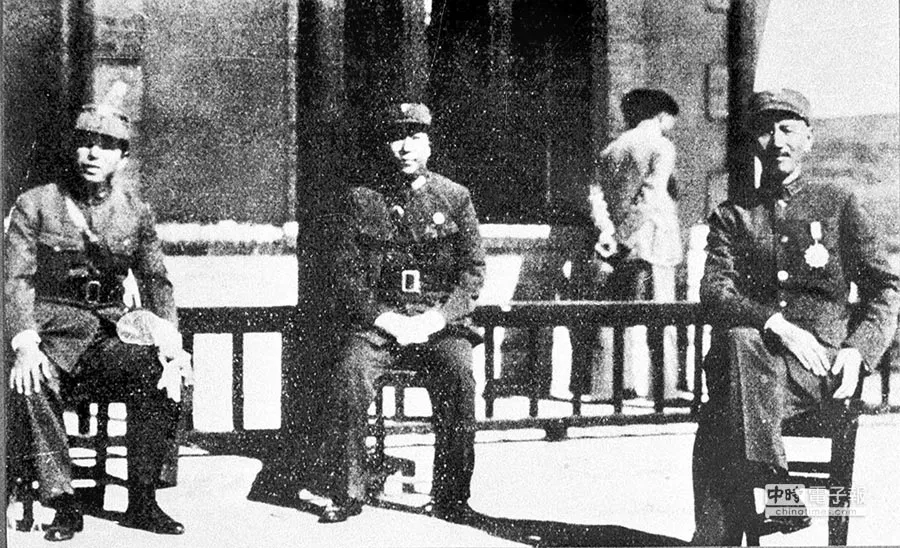
Zhang Xueliang (left), Yang Hucheng (centre) and Chiang Kai-shek (right) two months before the incident, October 1936

Unknown author · Public domain · Source

Having lost Manchuria, Zhang Xueliang’s Northeastern Army had moved to Shaanxi and been thrown against the Communists, but among soldiers longing to recover their homeland the cry that “Chinese should not fight Chinese” grew loud. Anti-Japanese national salvation movements, such as the student protests of 9 December 1935 in Beiping, were also gathering strength. Zhang secretly contacted the Communists and urged Chiang to stop the campaign, but was rebuffed.

When Chiang came to spur the campaign on and stayed at Huaqing Pool in Lintong, Zhang and Yang Hucheng of the Northwestern Army seized him before dawn on 12 December and demanded an end to the civil war and united resistance to Japan. Zhou Enlai for the Communists and Chiang’s wife Soong Mei-ling, among others, negotiated, and Chiang, having in effect agreed to halt the civil war, was released on the 25th. Zhang voluntarily accompanied him to Nanjing, was court-martialled, and spent more than fifty years under house arrest.

The Xi’an Incident halted the Nationalist campaign against the Communists, and when war with Japan broke out the following year the Second United Front was formed.

The map in 1936

OpenFreeMap © OpenMapTiles © OpenStreetMap contributors

States at the time
Republic of China
Places
Xi'an

People

  • Zhang Xueliang1901 – 2001

    leader · Son of the Fengtian warlord Zhang Zuolin who joined the Nationalist government after Japanese officers killed his father; in the 1936 Xi’an Incident he detained Chiang Kai-shek to demand resistance to Japan

  • Chiang Kai-shek1887 – 1975

    related figure · Leader of the Chinese Nationalist Party who unified China through the Northern Expedition and led the Nanjing government through the war with Japan; after losing the civil war he moved to Taiwan and ruled the Republic of China there

  • Zhou Enlai1898 – 1976

    diplomat · First premier of the People’s Republic of China (1949–1976), long in charge of diplomacy, who arranged Nixon’s 1972 visit

Before and after

Themes that include this event

  • Republican China and Imperial Japan1912 – 1949

    The age when the Republic of China, born of the 1911 Revolution, passed through warlord division, the May Fourth Movement, the United Front and the Northern Expedition, fought Japan’s invasion and split in civil war — as Japan moved from Taishō democracy through the Manchurian Incident and military coups to the war in China and the Co-Prosperity Sphere, and colonized Korea resisted through the March First Movement and armed struggle