Politics22 September 1937

Second United Front

Also called: Eighth Route Army, Anti-Japanese National United Front

When the war with Japan broke out, the Nationalists and Communists joined hands again in September 1937 to form an anti-Japanese national united front; the Red Army was reorganized as the Eighth Route Army and the New Fourth Army of the National Revolutionary Army.
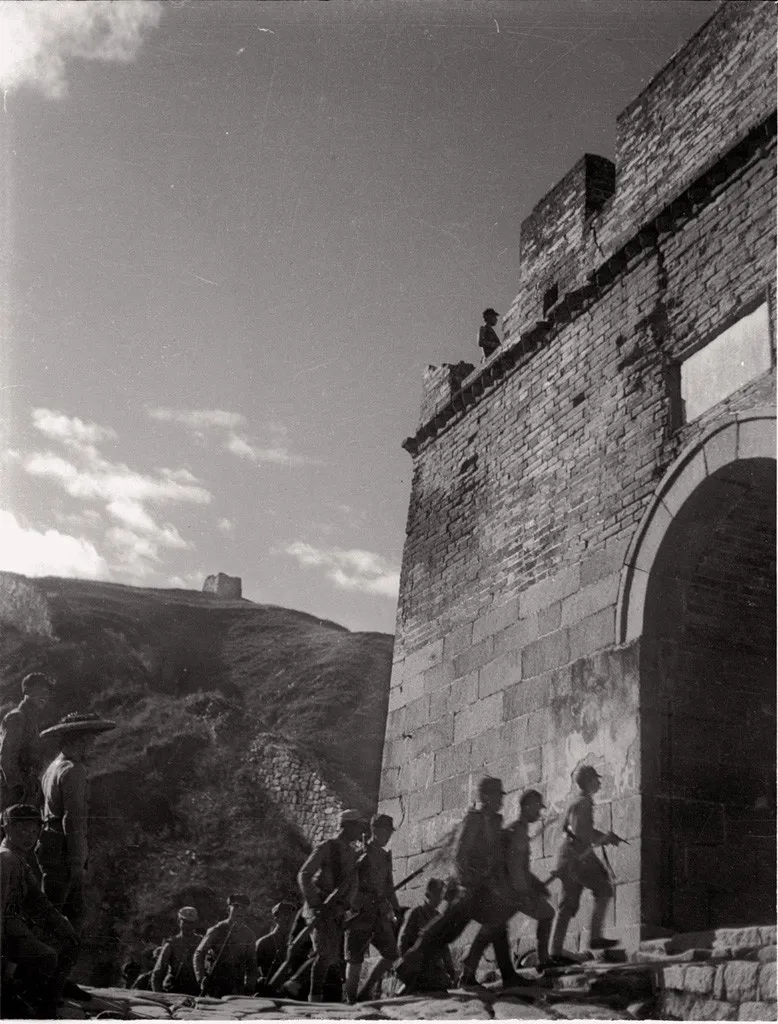
Eighth Route Army soldiers on the Great Wall — photograph by Sha Fei, 1937

Sha Fei · Public domain · Source

The two parties, which had been negotiating since the Xi’an Incident, quickly reached agreement once the Marco Polo Bridge Incident started full-scale war. In August the Red Army became the Eighth Route Army of the National Revolutionary Army, and in October the southern guerrillas became the New Fourth Army; on 22 September the Nationalists published the Communists’ declaration on cooperation, and the next day Chiang Kai-shek issued a statement accepting it. The Communists dissolved their Soviet government and turned it into the Shaan-Gan-Ning Border Region government.

The Eighth Route Army fought guerrilla campaigns in north China, such as the Battle of Pingxingguan (1937) and the Hundred Regiments Offensive (1940), expanding anti-Japanese base areas in the countryside. But rivalry between the parties continued, and after Nationalist troops attacked the New Fourth Army in the Wannan (South Anhui) Incident of January 1941 the alliance survived in name only. During the war the Communists vastly expanded their membership and army, building the strength to confront the Nationalists in the post-war civil war.

The map in 1937

OpenFreeMap © OpenMapTiles © OpenStreetMap contributors

States at the time
Republic of China
Places
Yan'an

People

  • Chiang Kai-shek1887 – 1975

    leader · Leader of the Chinese Nationalist Party who unified China through the Northern Expedition and led the Nanjing government through the war with Japan; after losing the civil war he moved to Taiwan and ruled the Republic of China there

  • Mao Zedong1893 – 1976

    leader · Chairman of the Chinese Communist Party who won the civil war and founded the People’s Republic in 1949, and launched the Great Leap Forward and the Cultural Revolution

  • Zhou Enlai1898 – 1976

    diplomat · First premier of the People’s Republic of China (1949–1976), long in charge of diplomacy, who arranged Nixon’s 1972 visit

Before and after

Themes that include this event

  • Republican China and Imperial Japan1912 – 1949

    The age when the Republic of China, born of the 1911 Revolution, passed through warlord division, the May Fourth Movement, the United Front and the Northern Expedition, fought Japan’s invasion and split in civil war — as Japan moved from Taishō democracy through the Manchurian Incident and military coups to the war in China and the Co-Prosperity Sphere, and colonized Korea resisted through the March First Movement and armed struggle