Politics1931

Korean Patriotic Organization

To revive the stagnant Provisional Government, Kim Gu organized the Korean Patriotic Organization in Shanghai to carry out armed attacks.
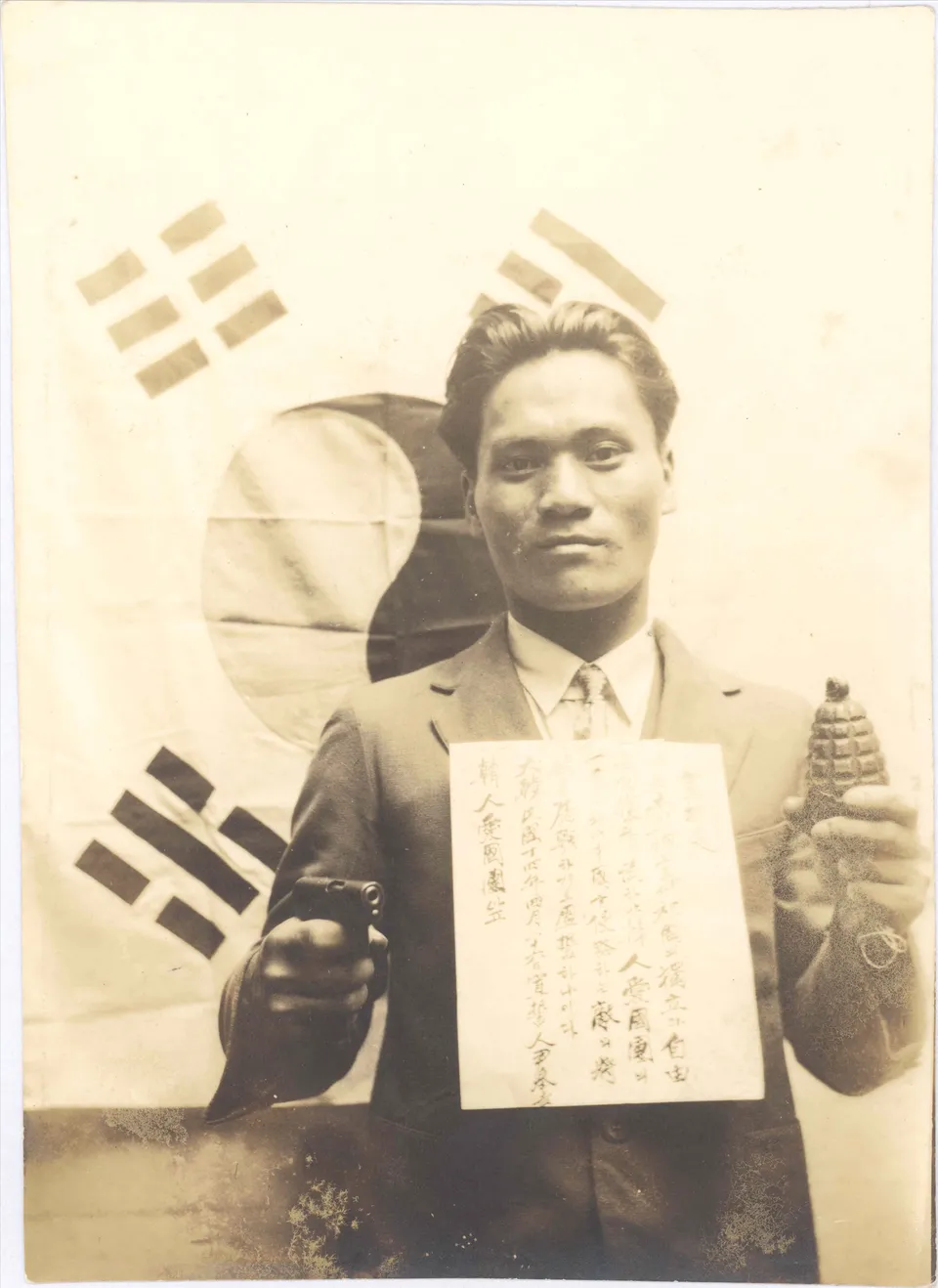
Yun Bong-gil wearing the Korean Patriotic Organization oath — 26 April 1932

한인애국단 본부(안공근 집) 상하이시 황푸구 황푸난루 863에서 · Public domain · Source

After the National Representatives’ Conference the government lacked people and money. In 1931 the Wanbaoshan incident strained relations between Koreans and Chinese, and Japan invaded Manchuria; Kim Gu formed the organization to show Korea’s will for independence by striking Japanese leaders.

The attacks of Yi Bong-chang and Yun Bong-gil made the Korean struggle known worldwide and won the support of the Chinese Nationalist government, which opened a Korean class at the Luoyang military academy. Pursued by the Japanese, the Provisional Government left Shanghai in 1932 and moved through Hangzhou, Zhenjiang, Changsha, Guangzhou, Liuzhou and Qijiang before settling in Chongqing in 1940.

The map in 1931

OpenFreeMap © OpenMapTiles © OpenStreetMap contributors

States at the time
Republic of China
Places
Provisional Government Building, Shanghai

People

  • Kim Gu1876 – 1949

    leader · Known as Baekbeom; founded the Korean Patriotic Organization and led the Liberation Army as Chairman of the Provisional Government

2 parts of this event

  1. 1

    Korean Patriotic Organization member Yi Bong-chang threw a bomb at the Japanese emperor’s procession outside the Sakuradamon gate in Tokyo. The emperor was unhurt, but Japan was badly shaken.

  2. 2

    Korean Patriotic Organization member Yun Bong-gil threw a bomb onto the platform at the celebration of the emperor’s birthday and the Shanghai victory in Hongkou Park, killing and wounding Japanese commanders.

Before and after

Related works

  • TV episode: Naked Korean History Episode 45: How Did Yi Bong-chang Throw a Bomb at the Japanese Emperor?TV episode · 2023 · Jo Geon · tvN STORY

Themes that include this event

  • Republican China and Imperial Japan1912 – 1949

    The age when the Republic of China, born of the 1911 Revolution, passed through warlord division, the May Fourth Movement, the United Front and the Northern Expedition, fought Japan’s invasion and split in civil war — as Japan moved from Taishō democracy through the Manchurian Incident and military coups to the war in China and the Co-Prosperity Sphere, and colonized Korea resisted through the March First Movement and armed struggle