World history1077 – 151731 events

Late Medieval Europe and the Renaissance

From Canossa to the eve of the Reformation — papal power at its height and in decline, towns and parliaments, royal power growing through the Hundred Years’ War and the Black Death, and the Renaissance and printing
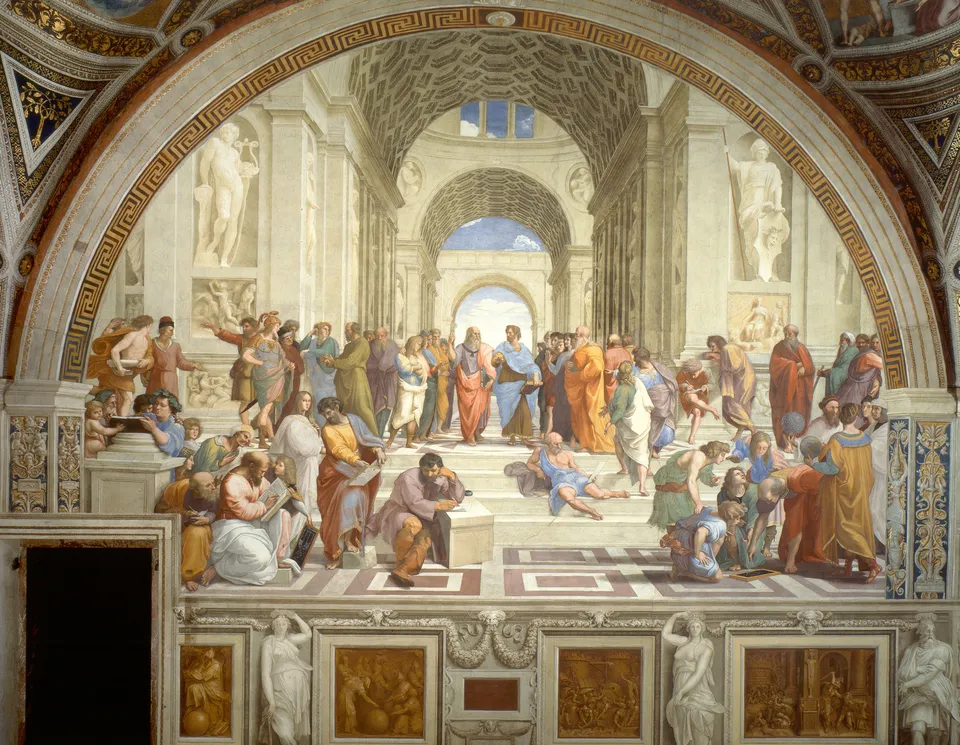
「아테네 학당」 — 라파엘로가 1509~1511년 바티칸 궁전에 그린 벽화. 플라톤과 아리스토텔레스를 가운데 둔 르네상스의 고전 부흥

Raphael · Public domain · Source

At a glance

YearStateEventKey point
Late 11th–13th c.Italy · FranceUniversities, scholasticismBologna, Paris; Aquinas’ Summa
12th–14th c.N. Germany · N. ItalyTowns; Hanseatic LeagueCharters, self-rule, guilds; Lübeck
1122Holy Roman EmpireConcordat of WormsInvestiture fight ends → papacy gains
1198–1216Papal StatesInnocent III“Pope the sun, emperor the moon” — peak
1215EnglandMagna CartaKing John; no tax without consent
1295EnglandModel ParliamentEdward I; knights and burgesses join
1302 · 1303FranceEstates General; AnagniPhilip IV vs Boniface VIII
1309–1377Papacy · FranceAvignon papacyPapacy under the French king
1337–1453England · FranceHundred Years’ WarCrown, Flanders; Joan → centralisation
1347–1351EuropeBlack DeathA third or more die → serfs gain
14th–16th c.ItalyRenaissanceHumanism; Medici; Leonardo, Michelangelo
1378–1417PapacyWestern SchismRival popes; Council of Constance, Hus
c. 1450GermanyGutenberg’s press42-line Bible (after Korea’s Jikji, 1377)
1455–1485EnglandWars of the RosesNobles ruined → Tudors (Henry VII)
1480MuscovyEnd of Mongol ruleIvan III; tsar, “Third Rome”
1479 · 1492SpainUnion of crowns; Granada fallsReconquista ends → backs Columbus

The theme on the map

OpenFreeMap © OpenMapTiles © OpenStreetMap contributors

31 events in this theme

  1. Excommunicated in a dispute with Pope Gregory VII over the right to appoint clergy (investiture), Holy Roman Emperor Henry IV begged forgiveness at the castle of Canossa in January 1077.

  2. From the late 11th century universities — guilds of masters and students — arose at Bologna, Paris and Oxford, and scholasticism, which sought to explain faith through reason, culminated in Thomas Aquinas.

  3. 1096 – 1099First Crusade

    Launched at the call of Pope Urban II, the crusade captured Jerusalem in 1099 and founded the Kingdom of Jerusalem.

  4. After the 11th century, as farm output and long-distance trade grew, towns of merchants and craftsmen rose across Europe and won self-government from their lords, and the German towns of the North Sea and Baltic formed the Hanseatic League.

  5. In 1122 Holy Roman Emperor Henry V and Pope Callixtus II made an agreement at Worms that brought the Investiture Controversy over the appointment of clergy to a close.

  6. The Gothic style, begun at the abbey of Saint-Denis near Paris in the mid-12th century, produced cathedrals such as Chartres and Notre-Dame with pointed arches, soaring spires and great stained-glass windows.

  7. Innocent III, pope from 1198, likened the pope to the sun and the emperor to the moon and brought papal power to its height by humbling the kings of England and France and the Holy Roman Emperor.

  8. Bound for Egypt but in debt to Venice, the crusade turned aside, captured and sacked the Christian city of Constantinople, and set up the Latin Empire.

  9. England's barons forced King John to seal the Great Charter, an early statement that even the king is bound by law.

  10. The parliament summoned in 1295 by Edward I of England, which brought together knights of the shires and burgesses of the towns as well as nobles and clergy, became the pattern for later parliaments.

  11. In 1302 King Philip IV of France, to stand against Pope Boniface VIII, gathered representatives of the clergy, nobility and commons in the first Estates General.

  12. Exiled from Florence, the poet Dante wrote the Divine Comedy from about 1308 to 1321 in Tuscan rather than Latin, opening the way for Italian literature and the Renaissance.

  13. 1309 – 1377Avignon Papacy

    From 1309 to 1377 the papacy left Rome and resided at Avignon in southern France under the influence of the French king — likened to the Babylonian captivity of the ancient Jews.

  14. The war fought from 1337 to 1453 between England and France over the French crown and the lands of Flanders and Guyenne. France won, and England withdrew from the Continent, keeping only Calais.

  15. On 26 August 1346 the English army of Edward III, led by its longbowmen, routed the French knights.

  16. 1347 – 1351Black Death

    Plague swept across Europe, killing a third or more of the population.

  17. 1350 – 1527Italian Renaissance

    From the late 14th to the early 16th century, a humanist culture that revived the culture of ancient Greece and Rome and put humanity at the centre flourished in the cities of Italy, under the patronage of the Medici of Florence.

  18. When lords tightened their grip on the peasants after the Black Death and heavy war taxes were levied, the Jacquerie broke out in France (1358) and Wat Tyler’s Rebellion in England (1381).

  19. The Jikji was printed with metal type at Heungdeoksa in Cheongju; it is the oldest extant book printed with movable metal type.

  20. 1378 – 1417Western Schism

    From 1378 to 1417 rival popes sat in Rome and Avignon, splitting the Western Church in two (for a time in three). The Council of Constance ended it by electing a new pope.

  21. On 6 July 1415 the Bohemian theologian Jan Hus, a critic of the Church, was condemned as a heretic by the Council of Constance and burned, leading to the Hussite Wars.

  22. In May 1429 a French army led by the peasant girl Joan of Arc lifted the English siege of Orléans, and Charles VII was crowned at Reims.

  23. The Renaissance north of the Alps, beginning with 15th-century Flemish painting, developed into a Christian humanism that called for a return to Scripture and the early Church, and Erasmus satirised the Church in The Praise of Folly (1511).

  24. Around 1450 Johannes Gutenberg of Mainz developed a way to print books in quantity with movable metal type and a press, producing the 42-line Bible. Printing carried the Renaissance and the Reformation across Europe.

  25. The Ottoman Empire conquered the Byzantine capital, an event often taken to mark the end of the Middle Ages.

  26. 1455 – 1485Wars of the Roses

    From 1455 to 1485 the English houses of Lancaster (red rose) and York (white rose) fought for the crown. It ended when Henry VII founded the Tudor dynasty.

  27. Isabella I of Castile and Ferdinand II of Aragon married in 1469, and when Ferdinand became king of Aragon in 1479 the two crowns were joined, creating the Kingdom of Spain.

  28. In 1480 Grand Prince Ivan III of Moscow faced down Akhmat Khan of the Great Horde at the Ugra River and forced him to withdraw, ending nearly 240 years of Mongol (Tatar) domination.

  29. Sponsored by Spain, Christopher Columbus crossed the Atlantic and landed in the Bahamas.

  30. On 2 January 1492 the Catholic Monarchs of Spain conquered Granada, the last Muslim kingdom of the Iberian Peninsula, ending the Reconquista that had lasted some 800 years.

  31. Martin Luther posted his Ninety-five Theses in Wittenberg, starting the Reformation.

Key people

  • Philip IV of France1268 – 1314

    King of France from 1285 to 1314 (“the Fair”) who summoned the Estates General against Pope Boniface VIII and had the papacy moved to Avignon

  • Edward III1312 – 1377

    King of England from 1327 to 1377 who claimed the French throne, began the Hundred Years’ War and won at Crécy

  • John Wycliffe1384

    Oxford theologian who attacked the wealth of the Church and papal authority and had the Bible translated into English — a forerunner of the Reformation

  • Isabella I of Castile1451 – 1504

    Queen of Castile who, ruling Spain with Ferdinand II of Aragon, conquered Granada and sponsored Columbus’s voyage

  • Ferdinand II of Aragon1452 – 1516

    King of Aragon who, married to Isabella I of Castile, united Spain and completed the Reconquista by conquering Granada

  • Pope Gregory VII1085

    Pope (1073–1085) who banned simony and clerical marriage and fought lay investiture of clergy in the Investiture Controversy

  • Henry IV1050 – 1106

    Holy Roman Emperor who, excommunicated in the investiture dispute with Pope Gregory VII, begged forgiveness at Canossa in 1077

  • Thomas Aquinas1225 – 1274

    Dominican theologian whose Summa Theologica reconciled Aristotelian philosophy with Christian faith, bringing scholasticism to its height

  • Innocent III1161 – 1216

    Pope from 1198 to 1216 who, likening the pope to the sun and the emperor to the moon, humbled Europe’s monarchs and brought papal power to its peak

  • Enrico Dandolo1205

    Doge of Venice who, old and blind, steered the Fourth Crusade to Zara and Constantinople

  • Edward I1239 – 1307

    King of England from 1272 to 1307 who summoned the Model Parliament of 1295 and conquered Wales

  • Boniface VIII1303

    Pope from 1294 to 1303 who claimed supremacy over secular rulers and was seized at Anagni by agents of Philip IV of France