Rise of the Universities and Scholasticism
Also called: Scholasticism, Medieval universities
From the late 11th century universities — guilds of masters and students — arose at Bologna, Paris and Oxford, and scholasticism, which sought to explain faith through reason, culminated in Thomas Aquinas.
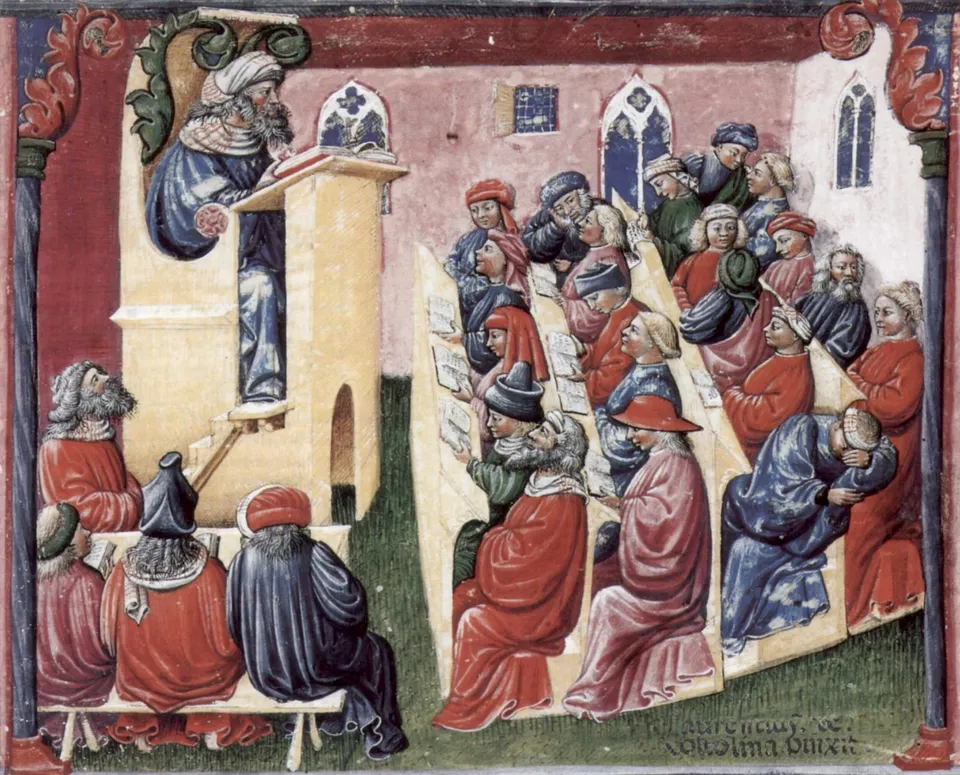
Laurentius de Voltolina · Public domain · Source
As towns grew and the learning of the Islamic world reached Europe through the crusades and Spain, the masters and students gathered at cathedral schools formed guild-like corporations (universitas). These were the first universities. Bologna, traditionally founded in 1088, was famed for the study of Justinian’s Roman law; Paris, established in the later 12th century, for theology; Salerno for medicine; and Oxford and Cambridge followed. Above a faculty of arts teaching the seven liberal arts stood faculties of theology, law and medicine, and the universities won self-government from popes and kings.
In the universities developed scholasticism, which sought to explain Christian faith through reason and logic. It rested on the works of Aristotle, translated into Latin together with the commentaries of Ibn Rushd (Averroes), and realists and nominalists argued over whether universals really exist. In his Summa Theologica Thomas Aquinas held that reason and faith cannot contradict each other, bringing scholasticism to its summit.
The universities trained the clergy, lawyers and physicians that Church and state needed, and became the ground for the later Renaissance and modern learning. At the same time in Goryeo, as private academies such as Choe Chung’s Nine Course Academy flourished, King Yejong set up seven specialised courses at the National Academy (1109) to revive state education.