Hundred Years’ War
Also called: Hundred Years War
The war fought from 1337 to 1453 between England and France over the French crown and the lands of Flanders and Guyenne. France won, and England withdrew from the Continent, keeping only Calais.
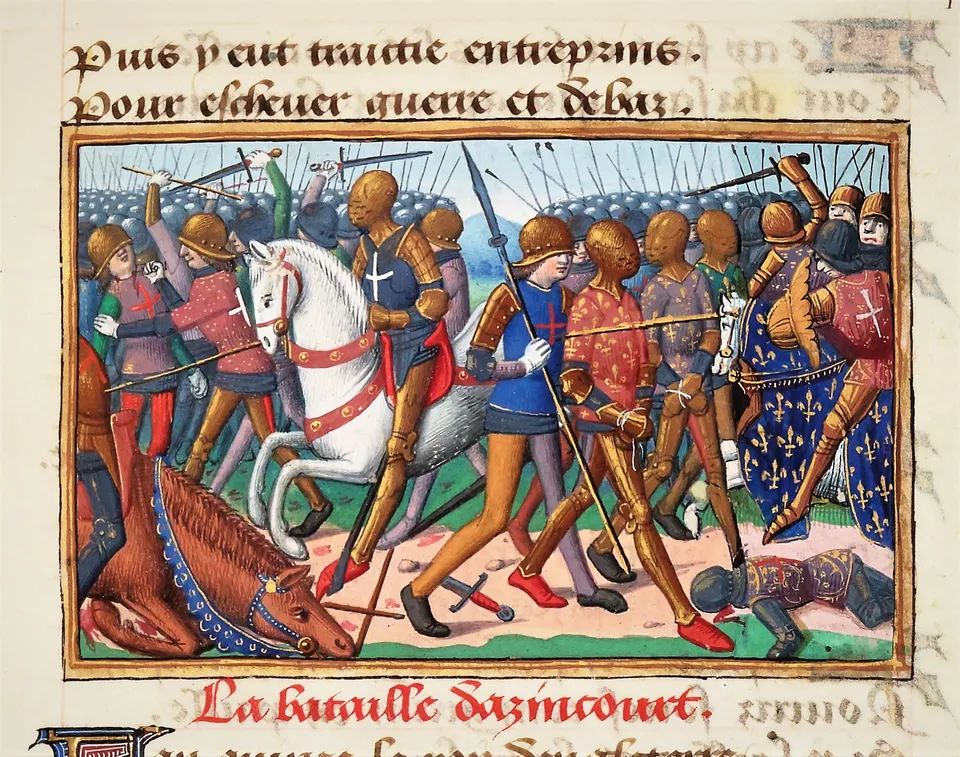
Unknown author · Public domain · Source
After the Norman Conquest the kings of England were also vassals of the French king for the lands they held in France. Guyenne (Gascony), a wine-growing region, belonged to the English king, and Flanders, whose cloth industry bought English wool, leaned towards England. When the direct Capetian line died out in 1328 and Philip VI of Valois took the throne, Edward III of England, whose mother was a Capetian, claimed the crown, and war broke out in 1337.
At first England, relying on its longbowmen, won great victories at Crécy (1346), Poitiers (1356) and Agincourt (1415), and in 1420 the Treaty of Troyes even gave it the right of succession to the French crown. But the tide turned when Joan of Arc relieved Orléans in 1429, and the war ended in 1453 when a French army equipped with cannon won at Castillon. England lost all its continental lands except Calais.
The long war weakened the princes and knights, and as kings built standing armies and tax systems both countries moved towards centralised states. A sense of being “French” or “English” began to take root among ordinary people. England was soon engulfed in the Wars of the Roses. At the same time in Goryeo, Choe Mu-seon made gunpowder and destroyed Japanese pirates at Jinpo (1380), and in 1453, as the war ended, the Gyeyu coup took place in Joseon.