Ivan III and the End of Mongol Rule
Also called: Great Stand on the Ugra River, Tatar yoke
In 1480 Grand Prince Ivan III of Moscow faced down Akhmat Khan of the Great Horde at the Ugra River and forced him to withdraw, ending nearly 240 years of Mongol (Tatar) domination.
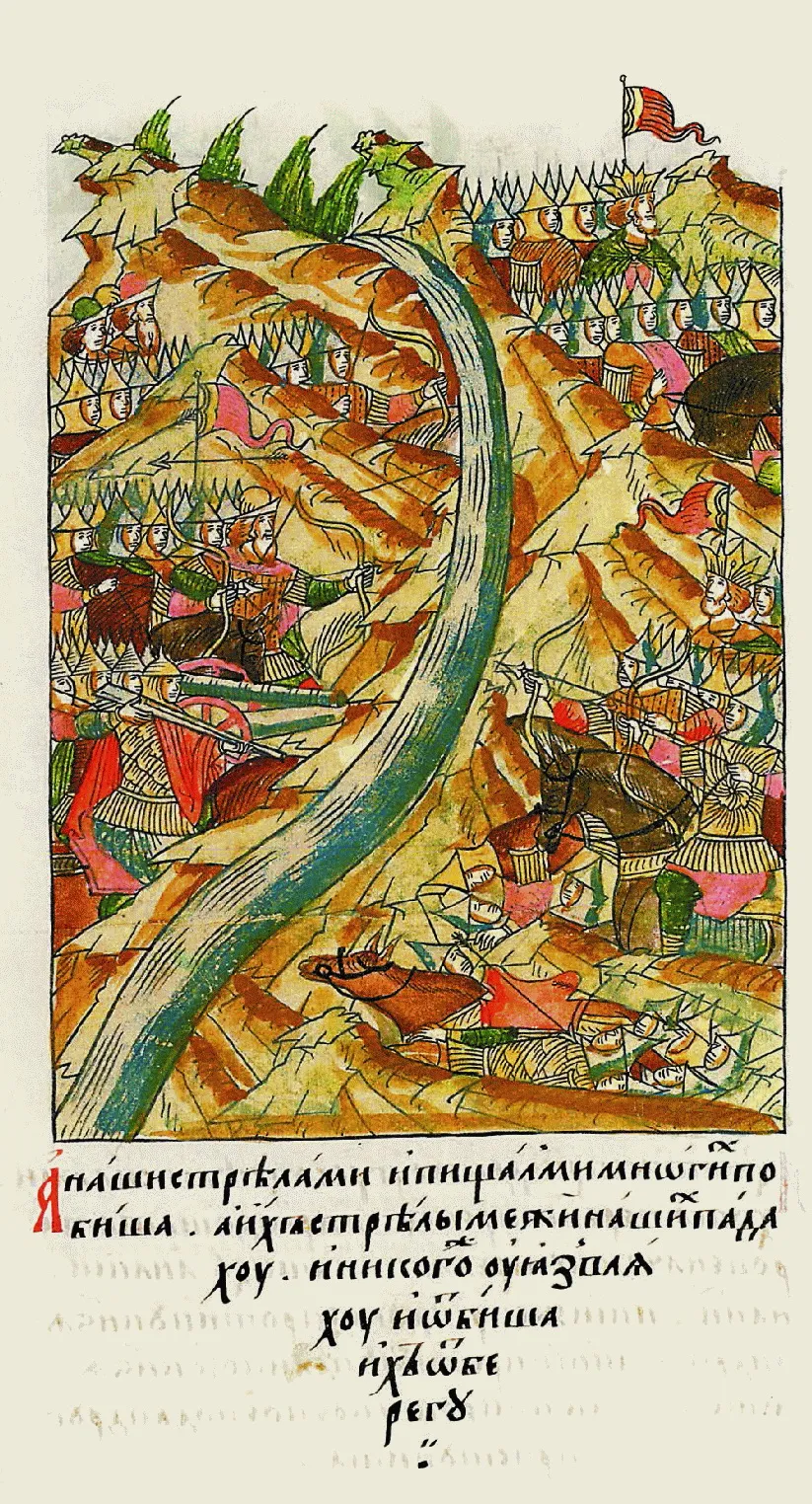
Anonymous Russian manuscript illuminators, 1560-1570s Facial Chronicle (Illustrated Chronicle of Ivan the Terrible) (in 10 volumes: pdf , pdf with translation ) Public domain image · Public domain · Source
After Batu’s campaigns in the 13th century the Russian principalities paid tribute to and were ruled by the Golden Horde (the “Tatar yoke”). The Grand Principality of Moscow grew strong by collecting tribute on the khan’s behalf, and Ivan III, who came to the throne in 1462, gathered the Russian lands, annexing the Novgorod Republic in 1478. He stopped paying tribute, and when Akhmat Khan of the Great Horde, successor to the Golden Horde, invaded in autumn 1480, the two armies faced each other across the Ugra River for weeks. The khan withdrew without a major battle, and Mongol rule came to an end.
Ivan III married Sophia, niece of the last Byzantine emperor (1472), and adopted the double-headed eagle and the title “tsar”, presenting Moscow as Byzantium’s heir. Italian architects rebuilt the Kremlin, and in the early 16th century the idea of Moscow as the “Third Rome” emerged. At this time Joseon was in the reign of King Seongjong.