China · History1927 – 197624 events

From the Chinese Civil War to the Cultural Revolution

From the collapse of the United Front in 1927, through rural bases, the Long March and Yan’an, to the Communists’ victory in the civil war and the founding of the People’s Republic — then land reform, the Great Leap Forward and famine, the Sino-Soviet split and the Cultural Revolution, up to Mao’s death and the arrest of the Gang of Four in 1976, while the Nationalist government withdrew to Taiwan
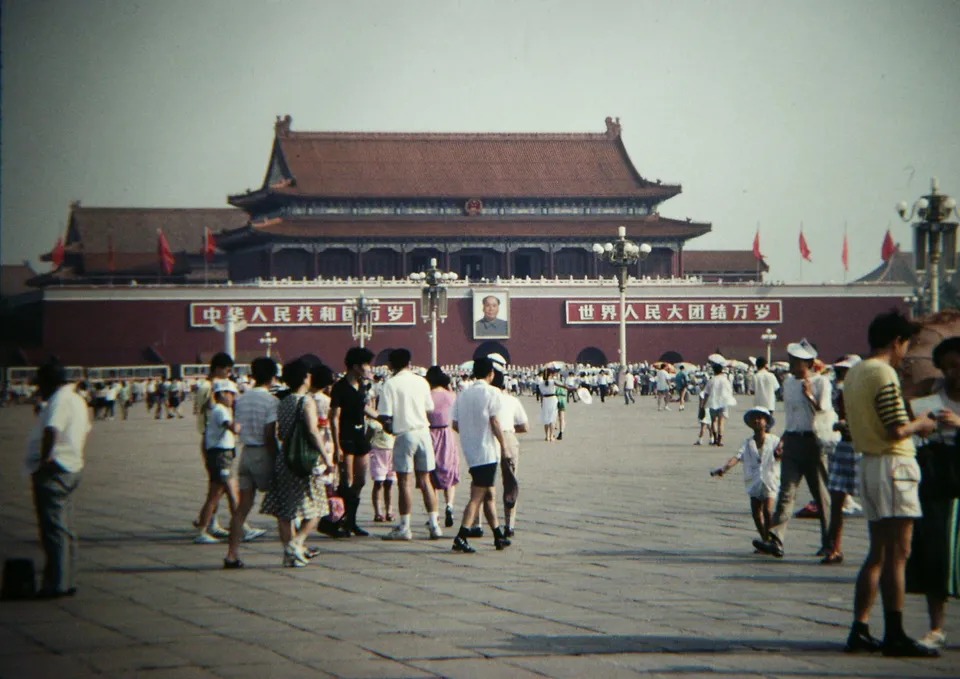
마오쩌둥의 초상이 걸린 베이징 톈안먼 — 1949년 건국 선포와 1966년 홍위병 집회의 무대, 게리 토드 촬영, 1991년

Gary Todd · CC0 · Source

The theme on the map

OpenFreeMap © OpenMapTiles © OpenStreetMap contributors

24 events in this theme

  1. On 12 April 1927, in the middle of the Northern Expedition, Chiang Kai-shek violently purged Communists and labour organizations in Shanghai, and on 18 April set up a National Government in Nanjing. The First United Front was broken.

  2. On 1 August 1927, after the Shanghai coup and the collapse of the United Front, some 20,000 Communist-led troops of the National Revolutionary Army rose in Nanchang, Jiangxi. They gave up the city within days and were scattered in the south, but the uprising is commemorated as the birth of the Communists’ own army.

  3. After the failed Autumn Harvest Uprising, Mao Zedong built a rural base in the Jinggang Mountains in 1927, and on 7 November 1931 the Chinese Soviet Republic was proclaimed at Ruijin in Jiangxi. After five Nationalist encirclement campaigns the base was abandoned in 1934 at the start of the Long March.

  4. 1934 – 1935Long March

    Driven from its base at Ruijin in Jiangxi by Nationalist encirclement campaigns, the Communist Red Army walked about 12,000 km over a year from October 1934 to northern Shaanxi; along the way Mao Zedong took the leadership.

  5. During the Long March in January 1935, an enlarged Politburo meeting at Zunyi in Guizhou criticised the military leadership of Bo Gu and Otto Braun and raised Mao Zedong into the party’s leading core.

  6. On 12 December 1936 Chiang Kai-shek was detained in Xi’an by his own commanders, Zhang Xueliang and Yang Hucheng, who pressed him to stop fighting the Communists and turn against Japan. Mediation by the Communist Zhou Enlai won Chiang’s release, paving the way for the Second United Front.

  7. After the Long March the Communist leadership made Yan’an in northern Shaanxi its capital for ten years from January 1937. There the Rectification Movement (1942–1945) bound the party to Mao Zedong, and the Seventh Party Congress of 1945 made “Mao Zedong Thought” its guiding ideology.

  8. 1937 – 1941Second United Front

    When the war with Japan broke out, the Nationalists and Communists joined hands again in September 1937 to form an anti-Japanese national united front; the Red Army was reorganized as the Eighth Route Army and the New Fourth Army of the National Revolutionary Army.

  9. 1946 – 1949Chinese Civil War

    After Japan’s surrender, full-scale civil war between the Nationalists and the Communists resumed in 1946. Having won over the peasants through land reform, the Communists triumphed in three great campaigns in 1948–1949, and the Nationalist government moved to Taiwan.

  10. Between September 1948 and January 1949 the People’s Liberation Army won the Liaoshen campaign in the Northeast, the Huaihai campaign around Xuzhou and the Pingjin campaign around Beiping and Tianjin, destroying the Nationalist main forces. Beiping changed hands without a fight.

  11. Defeated in the civil war, the Republic of China government moved to Taipei in December 1949. Somewhat over a million soldiers, officials and their families crossed from the mainland, and Chiang Kai-shek resumed the presidency in Taipei in March 1950.

  12. Victorious in the civil war, the Communist Party proclaimed the People's Republic in Beijing. The Nationalist government withdrew to Taiwan.

  13. The Agrarian Reform Law of June 1950 launched a nationwide redistribution of landlords’ land to peasants that lasted until 1952–1953. At village “struggle sessions” many landlords were publicly tried and executed.

  14. Chinese forces crossed the Yalu and entered the war, driving South Korean and UN forces south again; the eastern front withdrew by sea from Hungnam.

  15. In spring 1957 the Communist Party invited intellectuals to criticise it under the slogan “Let a hundred flowers bloom, let a hundred schools of thought contend”. When criticism grew fierce it turned in June to an Anti-Rightist Campaign in which, by official count, over 550,000 people were labelled “rightists” and lost their jobs or were sent to labour camps.

  16. In 1958 Mao Zedong launched the Great Leap Forward, with people’s communes and backyard steel furnaces, vowing to overtake Britain within fifteen years. Grain was requisitioned on the basis of inflated harvest reports and farming was disrupted, causing the famine of 1959–1961, whose death toll is estimated by different studies at roughly 15 to 45 million.

  17. 1960 – 1969Sino-Soviet Split

    Disagreement between China and the Soviet Union over de-Stalinisation and peaceful coexistence led to the withdrawal of Soviet experts in 1960, open polemics in the 1960s and armed clashes on Zhenbao Island in the Ussuri River in 1969. The rift set the stage for China’s opening to the United States.

  18. 1966 – 1976Cultural Revolution

    A political movement launched by Mao Zedong in May 1966, claiming that “representatives of the bourgeoisie” had infiltrated the party. Red Guards and rebel factions attacked party organisations and fought one another, and leaders such as Liu Shaoqi and Deng Xiaoping were purged. Society and the economy were convulsed for ten years until the arrest of the Gang of Four in 1976.

  19. 1966 – 1968Red Guards

    After Mao Zedong first received Red Guards in Tiananmen Square on 18 August 1966, the student Red Guard movement spread across China. By November eight rallies had drawn 11 to 13 million young people to Beijing, and the Red Guards turned to violence in the name of smashing the “Four Olds”.

  20. On 13 September 1971 Lin Biao, Mao Zedong’s designated successor, fled China by air with his family; the plane crashed near Öndörkhaan in Mongolia, killing all on board. The Chinese government announced that he had fled after a coup plot was exposed, but much about the affair remains unclear.

  21. US President Nixon visited Beijing, met Mao Zedong and issued the Shanghai Communiqué. Sino-American rapprochement ushered the Cold War into an era of détente.

  22. After Premier Zhou Enlai died on 8 January 1976, wreaths and poems piled up at the Monument to the People’s Heroes in Tiananmen Square at the Qingming festival on 4–5 April. When the authorities removed the wreaths crowds protested, and on the night of the 5th militia and police cleared the square. The incident was declared “counter-revolutionary” and Deng Xiaoping was purged again.

  23. Before dawn on 28 July 1976 an earthquake of magnitude 7.6 (7.8 on the Chinese scale) struck Tangshan in Hebei, levelling almost the entire city. The official death toll is 242,419, and some estimates put it higher.

  24. Mao Zedong died on 9 September 1976, and a month later, on 6 October, Hua Guofeng, with Ye Jianying and Wang Dongxing, arrested the “Gang of Four” — Jiang Qing, Zhang Chunqiao, Yao Wenyuan and Wang Hongwen. The Cultural Revolution was effectively over.

Key people

  • Mao Zedong1893 – 1976

    Chairman of the Chinese Communist Party who won the civil war and founded the People’s Republic in 1949, and launched the Great Leap Forward and the Cultural Revolution

  • Zhou Enlai1898 – 1976

    First premier of the People’s Republic of China (1949–1976), long in charge of diplomacy, who arranged Nixon’s 1972 visit

  • Chiang Kai-shek1887 – 1975

    Leader of the Chinese Nationalist Party who unified China through the Northern Expedition and led the Nanjing government through the war with Japan; after losing the civil war he moved to Taiwan and ruled the Republic of China there

  • Deng Xiaoping1904 – 1997

    General Secretary of the Communist Party (1956–1966), twice purged during the Cultural Revolution, and from 1978 China’s paramount leader who launched “reform and opening up”

  • Jiang Qing1914 – 1991

    Wife of Mao Zedong, a former Shanghai actress who married him in Yan’an, led the Central Cultural Revolution Group and was arrested in 1976 as one of the “Gang of Four”

  • Zhu De1886 – 1976

    Commander-in-chief of the Red Army and the People’s Liberation Army; he joined Mao Zedong at Jinggangshan in 1928 (“Zhu–Mao”) and was made a marshal in 1955

  • Liu Shaoqi1898 – 1969

    Chairman of the People’s Republic (1959–1968) who led economic readjustment after the Great Leap Forward, but was branded a “capitalist roader” in the Cultural Revolution, expelled from the party and died in detention

  • Lin Biao1907 – 1971

    PLA marshal who led the Liaoshen and Pingjin campaigns and, as defence minister, spread the “Little Red Book”; named Mao’s successor in the 1969 party constitution, he died in a plane crash in Mongolia in 1971

  • Hua Guofeng1921 – 2008

    Mao’s chosen successor, who became premier and party chairman in 1976 and had the Gang of Four arrested, but was eased out by Deng Xiaoping after 1978

  • Zhang Xueliang1901 – 2001

    Son of the Fengtian warlord Zhang Zuolin who joined the Nationalist government after Japanese officers killed his father; in the 1936 Xi’an Incident he detained Chiang Kai-shek to demand resistance to Japan

  • Peng Dehuai1898 – 1974

    PLA marshal who commanded the Chinese People’s Volunteers in the Korean War and became defence minister, but was purged after criticising the Great Leap Forward at the Lushan Conference in 1959

  • Nikita Khrushchev1894 – 1971

    First Secretary of the Soviet Communist Party (1953–1964) who denounced Stalin and preached peaceful coexistence, yet confronted the US over the Berlin Wall and Cuba