Politics9 September – 6 October 1976

Death of Mao Zedong and Arrest of the Gang of Four

Also called: Gang of Four, Death of Mao Zedong, Huairen Hall coup

Mao Zedong died on 9 September 1976, and a month later, on 6 October, Hua Guofeng, with Ye Jianying and Wang Dongxing, arrested the “Gang of Four” — Jiang Qing, Zhang Chunqiao, Yao Wenyuan and Wang Hongwen. The Cultural Revolution was effectively over.
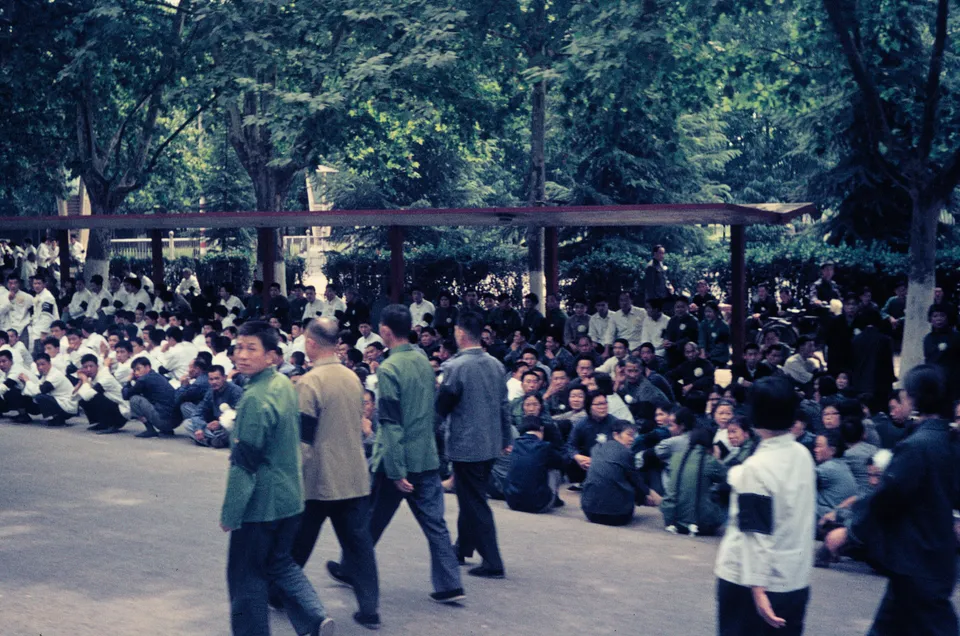
Workers of state-owned enterprises gathered for a mourning rally a few days after Mao’s death — photograph by Karl-Heinz Wellmann, September 1976

Karl-Heinz Wellmann · CC BY-SA 4.0 · Source

Mao died in Beijing at ten minutes past midnight on 9 September 1976, aged 82. A power struggle at once broke out between Hua Guofeng, Mao’s chosen successor, and the leaders of the Cultural Revolution — Jiang Qing, Zhang Chunqiao, Yao Wenyuan and Wang Hongwen. On the evening of 6 October Hua, together with the veteran marshal Ye Jianying and Wang Dongxing, who controlled the Central Guard Unit, summoned the four to Zhongnanhai on the pretext of a meeting and had them arrested; the next day Hua became party chairman. The official account later held that Mao himself had warned them against acting as a “gang of four”.

News of the arrests set off celebratory marches in Beijing and across the country. The Eleventh Party Congress of August 1977 declared the Cultural Revolution over, and Deng Xiaoping, rehabilitated once more, took effective control at the Third Plenum of December 1978 and set China on the path of reform and opening up. The Gang of Four were tried in public with the Lin Biao group from November 1980; in January 1981 Jiang Qing and Zhang Chunqiao were sentenced to death with reprieve (later commuted to life), Wang Hongwen to life and Yao Wenyuan to twenty years.

The map in 1976

OpenFreeMap © OpenMapTiles © OpenStreetMap contributors

States and rulers at the time
People's Republic of China — Paramount leader Mao Zedong → Paramount leader Hua Guofeng
Places
Beijing

People

  • Mao Zedong1893 – 1976

    related figure · Chairman of the Chinese Communist Party who won the civil war and founded the People’s Republic in 1949, and launched the Great Leap Forward and the Cultural Revolution

  • Hua Guofeng1921 – 2008

    key figure · Mao’s chosen successor, who became premier and party chairman in 1976 and had the Gang of Four arrested, but was eased out by Deng Xiaoping after 1978

  • Jiang Qing1914 – 1991

    related figure · Wife of Mao Zedong, a former Shanghai actress who married him in Yan’an, led the Central Cultural Revolution Group and was arrested in 1976 as one of the “Gang of Four”

  • Deng Xiaoping1904 – 1997

    related figure · General Secretary of the Communist Party (1956–1966), twice purged during the Cultural Revolution, and from 1978 China’s paramount leader who launched “reform and opening up”

Before and after

Themes that include this event

  • From the Chinese Civil War to the Cultural Revolution1927 – 1976

    From the collapse of the United Front in 1927, through rural bases, the Long March and Yan’an, to the Communists’ victory in the civil war and the founding of the People’s Republic — then land reform, the Great Leap Forward and famine, the Sino-Soviet split and the Cultural Revolution, up to Mao’s death and the arrest of the Gang of Four in 1976, while the Nationalist government withdrew to Taiwan