Cultural Revolution
Also called: Great Proletarian Cultural Revolution, May 16 Notification, Down to the Countryside Movement
A political movement launched by Mao Zedong in May 1966, claiming that “representatives of the bourgeoisie” had infiltrated the party. Red Guards and rebel factions attacked party organisations and fought one another, and leaders such as Liu Shaoqi and Deng Xiaoping were purged. Society and the economy were convulsed for ten years until the arrest of the Gang of Four in 1976.
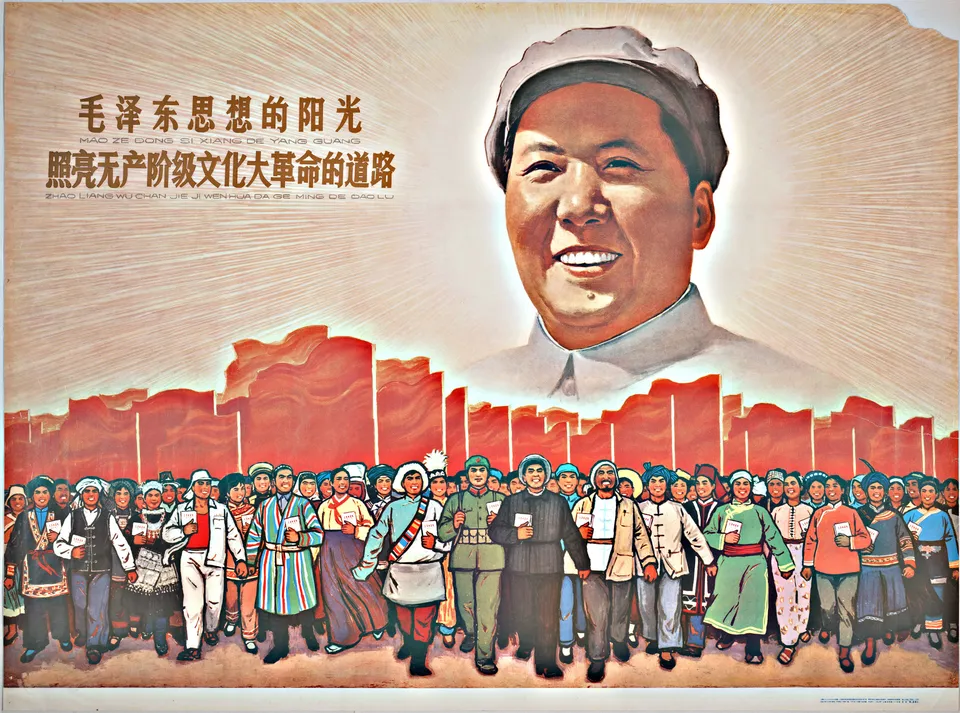
As the economy recovered after the Great Leap under the readjustment policies of Liu Shaoqi and Deng Xiaoping, Mao came to believe that “revisionism” was spreading through party and state. Beginning with Yao Wenyuan’s November 1965 attack on the historical play Hai Rui Dismissed from Office, the “May 16 Notification” of an enlarged Politburo meeting on 16 May 1966 proclaimed the Cultural Revolution and set up the Central Cultural Revolution Group of Chen Boda, Jiang Qing, Kang Sheng, Zhang Chunqiao and others. In August Mao wrote his own big-character poster, “Bombard the Headquarters”, aimed at Liu Shaoqi.
Red Guards set out to smash the “Four Olds”, destroying temples and cultural relics and assaulting teachers, intellectuals and the families of former landlords; in 1967 rebel factions seized party and government power across the country, as in Shanghai’s “January Storm”. The largest numbers died in armed fighting between factions and in purges such as the “Cleansing of the Class Ranks” carried out by the army and the new revolutionary committees in the name of restoring order. Liu Shaoqi was expelled from the party in 1968 and died in detention the next year; from late 1968 to 1980 more than 16 million urban youths were sent to the countryside (“up to the mountains and down to the villages”). The Ninth Party Congress of 1969 named Lin Biao Mao’s successor in the party constitution.
Estimates of the dead range from hundreds of thousands to several million; the sociologist Andrew Walder, compiling local gazetteers, puts the figure at about 1.1 to 1.6 million. The Communist Party’s 1981 Resolution on History called it “a domestic turmoil wrongly launched by a leader and exploited by counter-revolutionary cliques, which brought serious disaster to the party, the state and the people”.