Politics18 August 1966 – 1968

Red Guards

Also called: Red August, Destroy the Four Olds, Great Exchange of Revolutionary Experience

After Mao Zedong first received Red Guards in Tiananmen Square on 18 August 1966, the student Red Guard movement spread across China. By November eight rallies had drawn 11 to 13 million young people to Beijing, and the Red Guards turned to violence in the name of smashing the “Four Olds”.
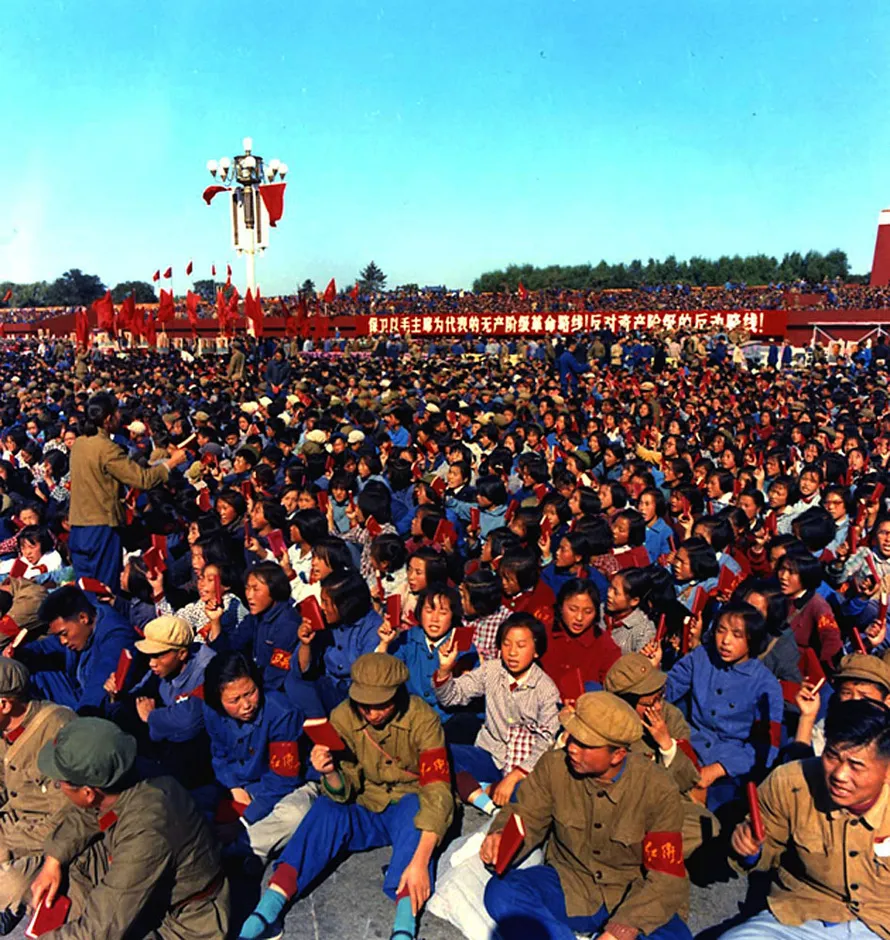
Red Guards in Tiananmen Square waiting to be received by Mao — photograph by Meng Zhaorui, 15 September 1966

孟昭瑞 · Public domain · Source

At the end of May 1966 students at the middle school attached to Tsinghua University first called themselves “Red Guards”, and after Mao wrote a letter backing them on 1 August Red Guard groups sprang up in schools nationwide. At the first mass rally in Tiananmen Square on 18 August Mao wore a Red Guard armband; by official count 11 to 13 million young people travelled free by train to Beijing for the eight rallies held up to 26 November, as part of the “great exchange of revolutionary experience”.

Vowing to destroy the “Four Olds” — old ideas, culture, customs and habits — Red Guards renamed streets and wrecked temples, relics and private homes and libraries. Pupils beat teachers to death in a string of cases; official statistics record some 1,700 people beaten to death in Beijing alone in August–September 1966 (“Red August”). In 1967–1968 Red Guards and rebels split into factions that fought armed battles with rifles and even artillery.

As they grew uncontrollable, Mao sent workers’ propaganda teams into the universities in July 1968 to disband them, and from December young people were sent to the countryside.

The map in 1966

OpenFreeMap © OpenMapTiles © OpenStreetMap contributors

States and rulers at the time
People's Republic of China — Paramount leader Mao Zedong
Places
Tiananmen Square

People

  • Mao Zedong1893 – 1976

    key figure · Chairman of the Chinese Communist Party who won the civil war and founded the People’s Republic in 1949, and launched the Great Leap Forward and the Cultural Revolution

  • Lin Biao1907 – 1971

    related figure · PLA marshal who led the Liaoshen and Pingjin campaigns and, as defence minister, spread the “Little Red Book”; named Mao’s successor in the 1969 party constitution, he died in a plane crash in Mongolia in 1971

  • Jiang Qing1914 – 1991

    related figure · Wife of Mao Zedong, a former Shanghai actress who married him in Yan’an, led the Central Cultural Revolution Group and was arrested in 1976 as one of the “Gang of Four”

Before and after

Themes that include this event

  • From the Chinese Civil War to the Cultural Revolution1927 – 1976

    From the collapse of the United Front in 1927, through rural bases, the Long March and Yan’an, to the Communists’ victory in the civil war and the founding of the People’s Republic — then land reform, the Great Leap Forward and famine, the Sino-Soviet split and the Cultural Revolution, up to Mao’s death and the arrest of the Gang of Four in 1976, while the Nationalist government withdrew to Taiwan