Sino-Soviet Split
Also called: Sino-Soviet border conflict, Zhenbao Island incident, Damansky Island incident
Disagreement between China and the Soviet Union over de-Stalinisation and peaceful coexistence led to the withdrawal of Soviet experts in 1960, open polemics in the 1960s and armed clashes on Zhenbao Island in the Ussuri River in 1969. The rift set the stage for China’s opening to the United States.
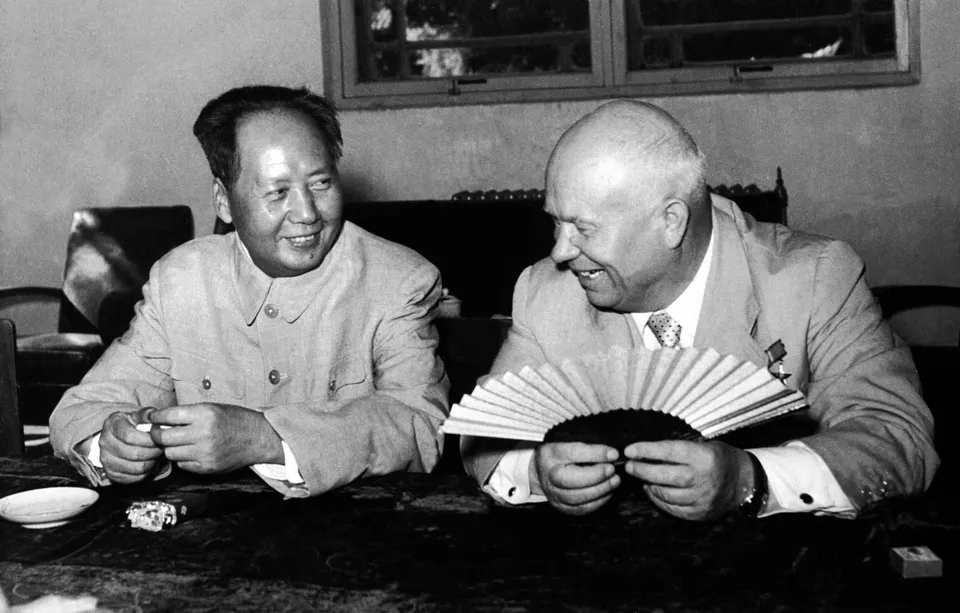
Unknown photographer Unknown photographer at the source. Photo distributed by United Press International from files. · Public domain · Source
The two countries, allied by the Sino-Soviet Treaty of Friendship of 1950, were close through the 1950s. But Mao regarded Khrushchev’s denunciation of Stalin in 1956 and his line of peaceful coexistence with the West as “revisionism”, and the gap widened over Soviet proposals for a long-wave radio station and a joint fleet and China’s shelling of Kinmen in 1958, and in 1959 over Moscow’s suspension of nuclear assistance and its neutrality in the Sino-Indian border dispute. In July 1960 the Soviet Union abruptly recalled more than a thousand experts working in China.
In 1963–1964 the two parties fought for leadership of the international communist movement in open letters and China’s “Nine Commentaries”, and in October 1964 China tested its first atomic bomb. On 2 and 15 March 1969 Chinese and Soviet troops clashed on Zhenbao (Damansky) Island in the Ussuri, killing around a hundred or more on the two sides combined (counts differ), and in August there was fighting on the Xinjiang border. Amid talk of a possible Soviet nuclear strike, China dug air-raid shelters across the country and prepared for war.
Now seeing the Soviet Union as its main enemy, China moved towards rapprochement with the United States, leading to Kissinger’s secret visit in 1971 and Nixon’s visit in 1972. Relations between Beijing and Moscow were normalised only with Gorbachev’s visit to Beijing in 1989.