The Great Leap Forward and the Great Famine
Also called: Great Chinese Famine, People’s communes, Backyard furnaces, Three Years of Great Famine, Lushan Conference
In 1958 Mao Zedong launched the Great Leap Forward, with people’s communes and backyard steel furnaces, vowing to overtake Britain within fifteen years. Grain was requisitioned on the basis of inflated harvest reports and farming was disrupted, causing the famine of 1959–1961, whose death toll is estimated by different studies at roughly 15 to 45 million.
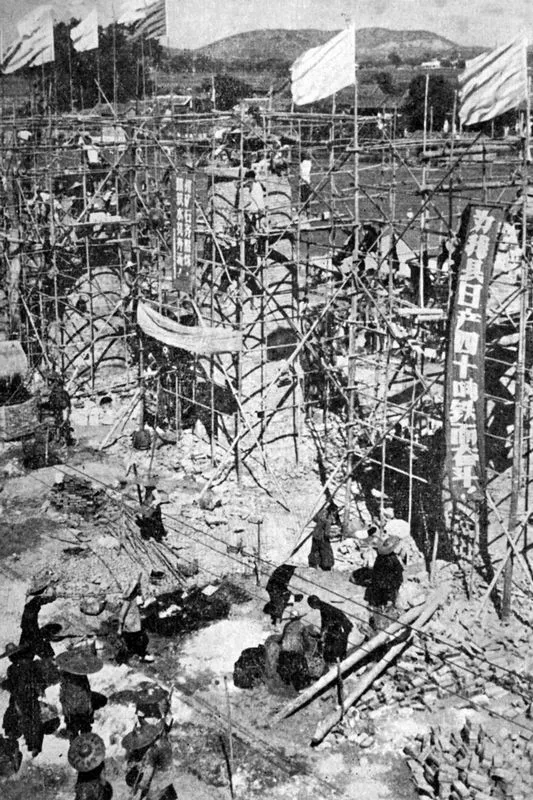
Unknown author · Public domain · Source
In May 1958 the second session of the Communist Party’s Eighth Congress adopted the General Line of building socialism by “going all out, aiming high, and achieving greater, faster, better and more economical results”, promising to overtake Britain in fifteen years. Within months of the Beidaihe meeting in August, the country’s co-operatives were merged into some 26,000 people’s communes with communal dining halls, and to meet that year’s steel target of 10.7 million tonnes tens of millions of peasants melted down pots and tools in small backyard furnaces. Unscientific methods such as deep ploughing and close planting were also imposed.
Local cadres competed to exaggerate harvests, and the state requisitioned — and even exported — grain on the basis of those figures. When defence minister Peng Dehuai raised the problems in a letter to Mao at the Lushan Conference in July–August 1959, Mao denounced him as a “right opportunist” and dismissed him, and the campaign intensified. Famine engulfed the country from 1959 to 1961, with especially heavy loss of life from hunger and violence in places such as Xinyang in Henan.
Estimates of excess deaths vary widely. Demographers’ estimates mostly fall between 15 and 30 million; the journalist Yang Jisheng put the figure at about 36 million in Tombstone, and the historian Frank Dikötter at 45 million. The Chinese government calls the period the “Three Years of Difficulty”. At the Seven Thousand Cadres Conference in January 1962 Liu Shaoqi said the disaster was “three parts natural and seven parts man-made”, and the readjustment policies of Liu and Deng Xiaoping then brought economic recovery.