World history1543 – 179628 events

Scientific Revolution, Enlightenment and the English Revolutions

The Scientific Revolution from Copernicus to Newton, parliamentary government in England won through the Puritan and Glorious Revolutions, and the Enlightenment that sought to remake society by reason — the groundwork of the civic revolutions and the Industrial Revolution
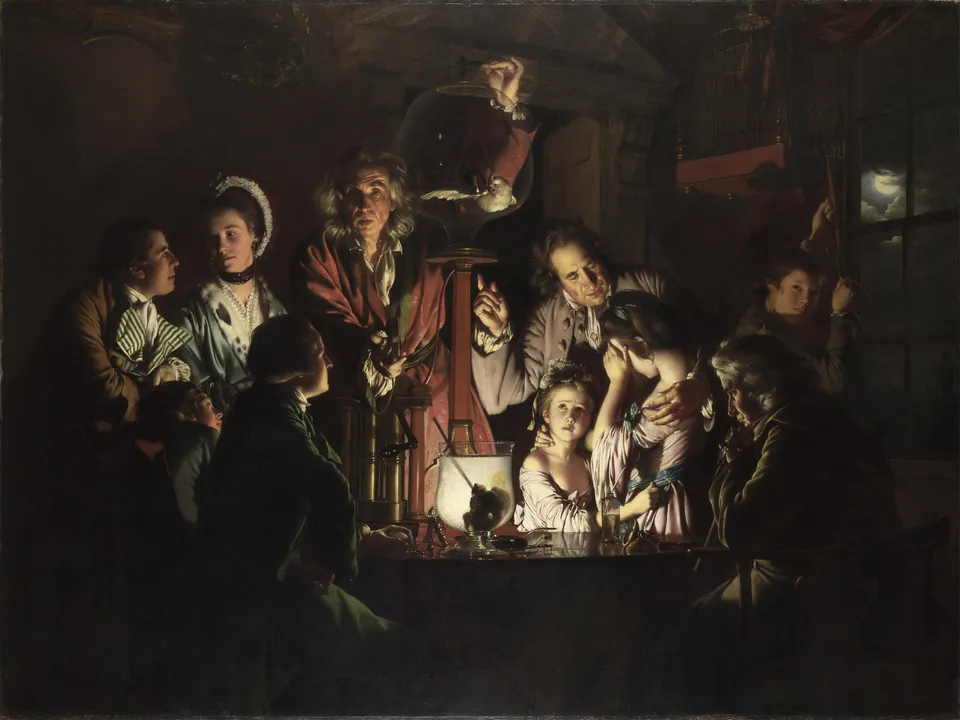
「공기 펌프 속의 새 실험」 — 조지프 라이트의 1768년 그림. 유리 용기의 공기를 빼는 실험을 지켜보는 가족, 과학이 일상 속으로 들어온 계몽의 시대

Joseph Wright of Derby · Public domain · Source

At a glance

YearPerson / eventFieldKey point
1543Copernicus · VesaliusScienceHeliocentrism → Scientific Revolution
1609 · 1610–1633Kepler · GalileoScienceElliptical orbits; telescope → trial
1620 · 1637Bacon · DescartesPhilosophyEmpiricism (induction) · rationalism
1628Petition of RightParliamentCharles I; no tax or arrest without law
1642–1660Puritan RevolutionParliamentCromwell; regicide → republic; Navigation Act
1651 · 1690Hobbes · LockePolitical thoughtSocial contract — sovereign · resistance
1687Newton’s PrincipiaScienceGravitation → revolution complete
1688–1689Glorious RevolutionParliamentWilliam and Mary; constitutional monarchy
1721–1742Walpole ministryParliamentCabinet government; king reigns, not rules
1748MontesquieuPolitical thoughtSeparation of powers → US Constitution
1751–1772Diderot · VoltaireEnlightenmentEncyclopédie; tolerance, reason, progress
1762RousseauPolitical thoughtGeneral will, popular sovereignty
1769Watt’s steam engineTechnologySeparate condenser → factory power
1776Adam SmithEconomic thoughtAgainst mercantilism; laissez-faire
1796Jenner’s vaccinationScienceCowpox (Korea: Jeong Yak-yong, Ji Seok-yeong)

The theme on the map

OpenFreeMap © OpenMapTiles © OpenStreetMap contributors

28 events in this theme

  1. In 1543 Copernicus published On the Revolutions of the Heavenly Spheres, placing the Sun at the centre of the universe, and in the same year Vesalius founded modern anatomy with On the Fabric of the Human Body. It was the beginning of the Scientific Revolution.

  2. In 1582 Pope Gregory XIII promulgated a new calendar correcting the error of the Julian calendar — the calendar the world uses today.

  3. England in 1600 and the Netherlands in 1602 founded East India Companies holding monopolies of Asian trade. The Dutch company, the first joint-stock company with tradable shares, controlled the spice trade from its base at Batavia.

  4. In his New Astronomy of 1609 Kepler showed that planets move in elliptical orbits with the Sun at one focus, giving heliocentrism precise mathematical support.

  5. In 1610 Galileo used telescopes of his own making to observe the mountains of the Moon and the moons of Jupiter, supporting heliocentrism, but in 1633 the Roman Inquisition forced him to abjure it.

  6. Bacon’s Novum Organum (1620) championed induction, finding laws through observation and experiment, while Descartes’ Discourse on Method (1637) set out deduction from certain first principles, opening the two main streams of modern philosophy.

  7. In 1628 the English Parliament presented Charles I with the Petition of Right, forbidding taxation without Parliament’s consent and arbitrary imprisonment, and won his assent.

  8. 1642 – 1660Puritan Revolution

    In 1642 civil war broke out between Parliamentarians and Royalists; Parliament’s side under Cromwell won, executed Charles I in 1649 and set up a republic. This English revolution lasted until the monarchy was restored in 1660.

  9. On 30 January 1649 Charles I, condemned for treason by a special court set up by Parliament, was executed at Whitehall in London.

  10. Hobbes in Leviathan (1651) and Locke in Two Treatises of Government (1690) argued that the state arises from a contract among the people. Hobbes drew from it a strong sovereign; Locke, natural rights and a right of resistance.

  11. On Kim Yuk’s advice Joseon adopted the Shixian calendar, made in Qing on the basis of Western astronomy.

  12. 1653 – 1666Hamel’s shipwreck

    The Dutch ship Sperwer was wrecked on Jeju. Hendrick Hamel and his crew spent 13 years in Joseon before escaping, and his account introduced Korea to Europe.

  13. In 1660 London scientists formed a society to investigate nature by experiment, which received a charter from Charles II in 1662 and became the Royal Society.

  14. In 1687 Newton published the Mathematical Principles of Natural Philosophy (Principia), explaining the motions of heaven and earth alike by three laws of motion and the law of universal gravitation — the culmination of the Scientific Revolution.

  15. In 1688 the English Parliament drove out James II, who sought to restore Catholicism, and welcomed William III and Mary II as monarchs. With the Bill of Rights of 1689, constitutional monarchy — with Parliament above the king — took root.

  16. From 1721 the Whig Robert Walpole led the cabinet and came to be called the first prime minister; when he lost the support of the Commons in 1742 he resigned, beginning the practice of a cabinet responsible to Parliament.

  17. In 1748 Montesquieu published The Spirit of the Laws, arguing that liberty is safe only when power is divided into legislative, executive and judicial branches that check one another — the separation of powers.

  18. In the 18th century the Enlightenment, which used reason to criticise outdated institutions and superstition, spread from France. Voltaire attacked the intolerance of the Church, and from 1751 Diderot and d’Alembert published the Encyclopédie.

  19. Steam power and mechanised industry spread through Britain, transforming production and society.

  20. In 1762 Rousseau published The Social Contract, arguing that sovereignty belongs to the people and that the state must follow the general will, which seeks the common good — the doctrine of popular sovereignty.

  21. Between 1768 and 1779 the British navigator James Cook made three voyages across the Pacific, charting New Zealand and the east coast of Australia and reaching Hawaii.

  22. In 1769 James Watt patented a steam engine with a separate condenser, and later adapted it to produce rotary motion, making the steam engine the power source of factories.

  23. Delegates of the thirteen colonies, meeting in Philadelphia, declared independence from Great Britain.

  24. In 1776 Adam Smith published The Wealth of Nations, criticising mercantilism and arguing that the division of labour and free market competition increase a nation’s wealth — the beginning of classical economics.

  25. Back from Qing, Park Je-ga wrote Bukhagui urging Korea to learn from Qing, use carts and ships to build up commerce and industry, and stop preaching thrift alone, since consumption spurs production.

  26. 1789 – 1799French Revolution

    A popular revolution overthrew the absolute monarchy and founded a republic, spreading the ideals of liberty, equality and fraternity.

  27. In 1789 Lavoisier published his Elementary Treatise of Chemistry, establishing the conservation of mass and combustion by oxygen and ordering the concept of the elements — the founding of modern chemistry.

  28. In 1796 the English physician Edward Jenner showed by experiment that inoculating people with cowpox could protect them from smallpox — the beginning of vaccines.

Key people

  • Charles I1600 – 1649

    King of England and Scotland from 1625 to 1649 whose clash with Parliament brought on the Puritan Revolution; he was tried and executed

  • Oliver Cromwell1599 – 1658

    English soldier and statesman who led the Puritan Revolution, defeated the Royalists with Parliament’s army, founded the Commonwealth and became Lord Protector

  • John Locke1632 – 1704

    English philosopher whose Two Treatises of Government defended natural rights and the right of resistance, justifying the Glorious Revolution; he also systematised empiricism

  • Hyojong1619 – 1659

    Seventeenth king of Joseon; a former hostage in Qing who planned a northern campaign and sent troops against Russia

  • Isaac Newton1643 – 1727

    English physicist and mathematician whose Principia set out the laws of motion and universal gravitation, completing the Scientific Revolution

  • Montesquieu1689 – 1755

    French Enlightenment thinker whose The Spirit of the Laws called for separating legislative, executive and judicial powers so that each checks the others

  • Jean-Jacques Rousseau1712 – 1778

    Genevan Enlightenment thinker whose The Social Contract argued for popular sovereignty guided by the general will, influencing the French Revolution

  • Nicolaus Copernicus1473 – 1543

    Polish astronomer and churchman whose On the Revolutions of the Heavenly Spheres argued that the Earth moves around the Sun

  • Andreas Vesalius1514 – 1564

    Flemish anatomist who dissected bodies himself at Padua and wrote On the Fabric of the Human Body, founding modern anatomy

  • Gregory XIII1502 – 1585

    Pope from 1572 to 1585 who in 1582 promulgated the new calendar that corrected the Julian calendar — the Gregorian calendar

  • Johannes Kepler1571 – 1630

    German astronomer who, working from Tycho Brahe’s observations, found the laws of planetary motion, showing that planets move in ellipses

  • Galileo Galilei1564 – 1642

    Italian astronomer and physicist whose telescopic observations supported heliocentrism, which he was forced to recant before the Inquisition in 1633