Newton’s Principia
Also called: Principia Mathematica, Philosophiæ Naturalis Principia Mathematica, Law of universal gravitation
In 1687 Newton published the Mathematical Principles of Natural Philosophy (Principia), explaining the motions of heaven and earth alike by three laws of motion and the law of universal gravitation — the culmination of the Scientific Revolution.
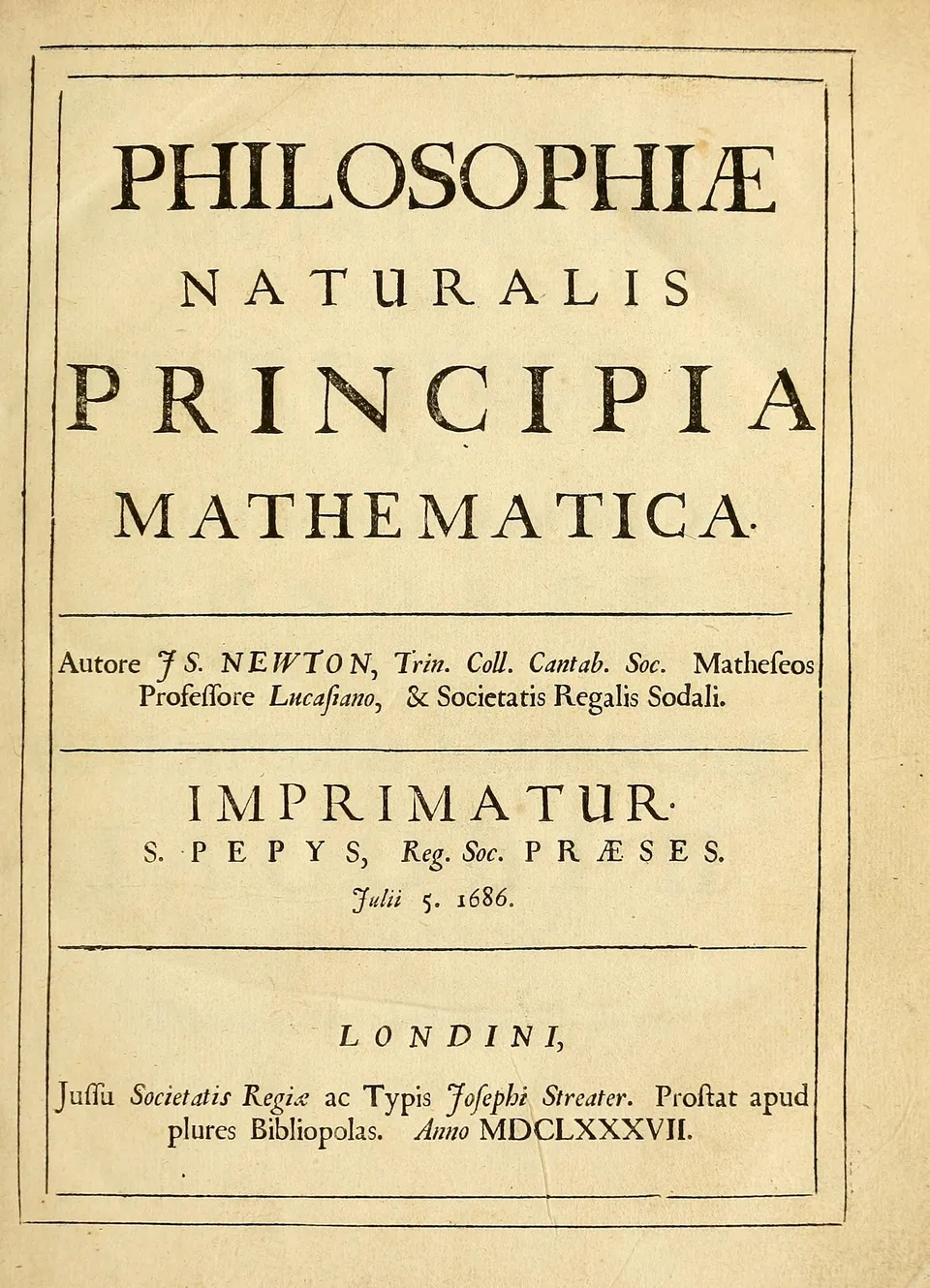
The original uploader was Zhaladshar at English Wikisource . · Public domain · Source
Copernicus, Kepler and Galileo had shown how the planets move but not why. Newton of the University of Cambridge worked on calculus and the nature of light in the 1660s, and at the urging of Edmond Halley — of Halley’s Comet — who also paid for the printing, he published the Principia in 1687.
Newton set out the laws of motion — inertia, acceleration and action and reaction — and the law of universal gravitation, by which all bodies attract one another with a force proportional to their masses and inversely proportional to the square of the distance between them. A falling apple and the Moon circling the Earth were explained by the same law, and Kepler’s laws could be derived from it mathematically. Who had invented calculus first became the subject of a dispute with the German Leibniz.
The Principia established a mechanistic world view in which the universe was a vast machine running by exact laws. The belief spread that if reason could find the laws of nature, it could also find the laws of society and politics — the foundation of the 18th-century Enlightenment.