Science28 November 1660

Founding of the Royal Society

Also called: Royal Society, Royal Society of London, Nullius in verba

In 1660 London scientists formed a society to investigate nature by experiment, which received a charter from Charles II in 1662 and became the Royal Society.
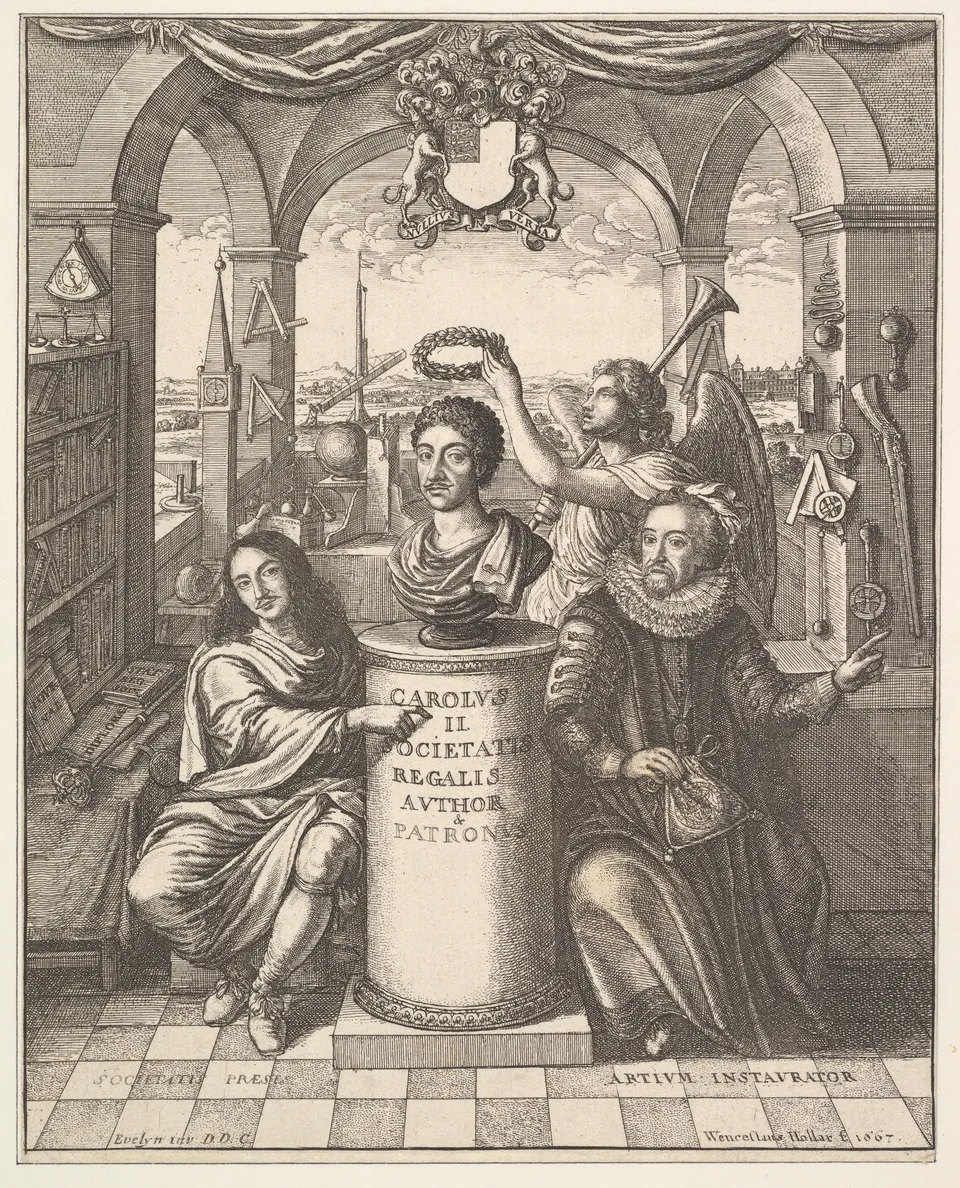
Frontispiece of Thomas Sprat’s History of the Royal Society (1667) — Francis Bacon and the first president, Lord Brouncker, beside a bust of Charles II

Wenceslaus Hollar / John Evelyn · CC0 · Source

On 28 November 1660, the year of the Restoration, scholars who had heard a lecture by Christopher Wren at Gresham College resolved to form a society to promote experimental philosophy. Boyle and Hooke were among its members, and it took as its motto “Take nobody’s word for it”. Its Philosophical Transactions, begun in 1665, is the oldest scientific journal still published, and Newton served as its president from 1703 until his death.

In France, too, an Academy of Sciences was founded in 1666 with Colbert’s backing, and science became an activity supported by learned societies and the state rather than a private pursuit.

The map in 1660

OpenFreeMap © OpenMapTiles © OpenStreetMap contributors

States at the time
England
Places
London

People

  • Isaac Newton1643 – 1727

    related figure · English physicist and mathematician whose Principia set out the laws of motion and universal gravitation, completing the Scientific Revolution

Before and after

Themes that include this event

  • Scientific Revolution, Enlightenment and the English Revolutions1543 – 1796

    The Scientific Revolution from Copernicus to Newton, parliamentary government in England won through the Puritan and Glorious Revolutions, and the Enlightenment that sought to remake society by reason — the groundwork of the civic revolutions and the Industrial Revolution