Glorious Revolution and the Bill of Rights
Also called: Glorious Revolution, Bill of Rights 1689, Revolution of 1688, Declaration of Right
In 1688 the English Parliament drove out James II, who sought to restore Catholicism, and welcomed William III and Mary II as monarchs. With the Bill of Rights of 1689, constitutional monarchy — with Parliament above the king — took root.
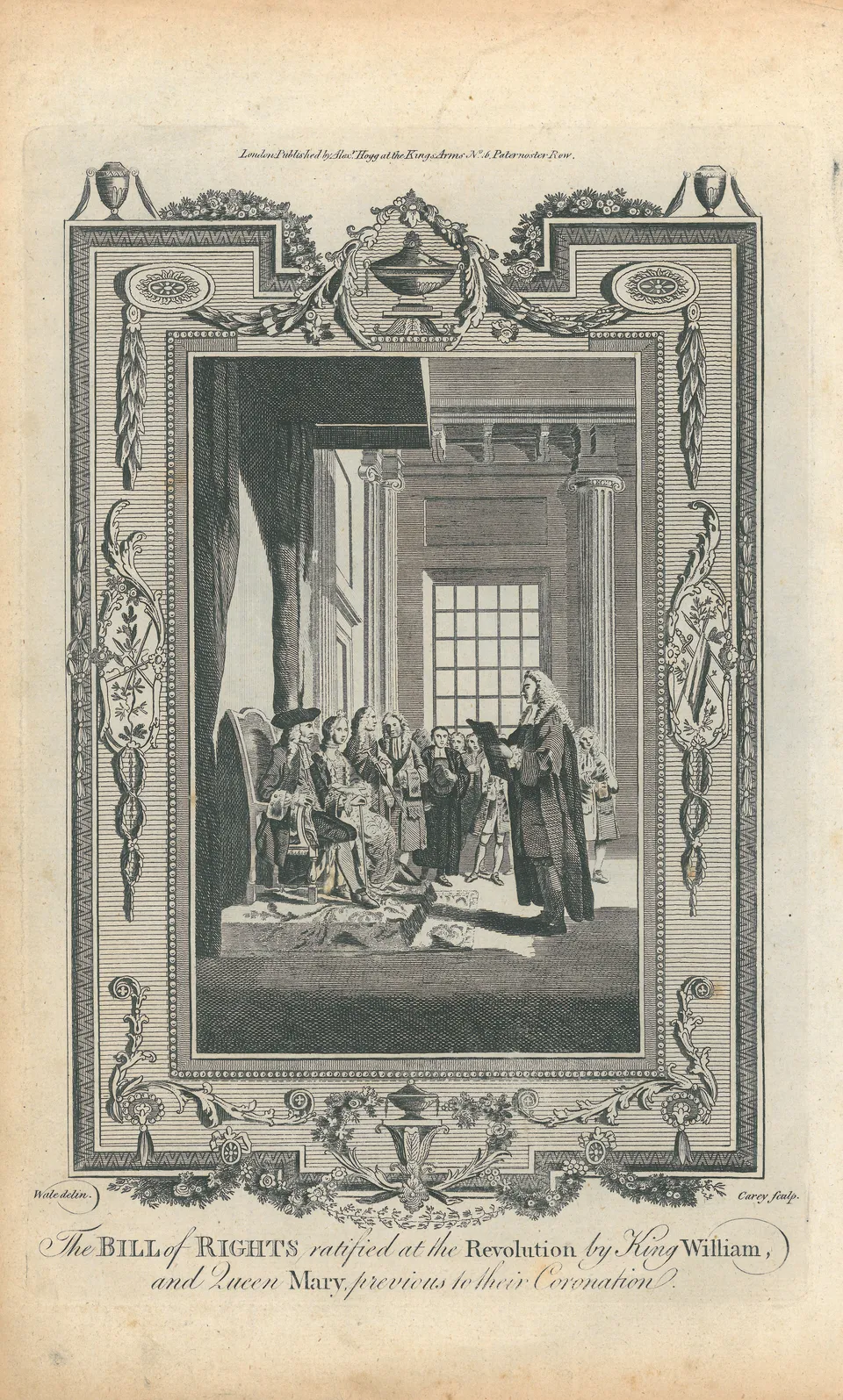
Samuel Wale · Public domain · Source
After the Restoration, as Charles II leaned toward Catholicism, Parliament passed the Test Act (1673), reserving public office for Anglicans, and the Habeas Corpus Act (1679), against unlawful detention. Over whether the king’s brother James should succeed, members split into Whigs, who sought to exclude him, and Tories, who accepted him — the seeds of political parties. When James II, crowned in 1685, appointed Catholics as officials and officers, and a Catholic prince was born in June 1688, leaders of both parties invited William, Stadtholder of the Netherlands and husband of James’s daughter Mary.
When William landed at Torbay with an army on 5 November 1688, James II fled to France without a fight. Because it was accomplished without bloodshed in England it is called the Glorious Revolution, though fighting with James’s supporters went on in Ireland and Scotland. In February 1689 Parliament made William III and Mary II joint monarchs on condition that they accept the Declaration of Right, which it enacted in December as the Bill of Rights.
The Bill of Rights forbade the crown to suspend laws, levy taxes or keep a standing army in peacetime without Parliament’s consent, and guaranteed free elections and freedom of speech in Parliament. Constitutional monarchy based on parliamentary sovereignty was thus established, with Locke’s Two Treatises as its justification. In the same year (1689) in Joseon, King Sukjong ousted the Westerners and brought in the Southerners in the Gisa hwanguk.