Watt’s Improved Steam Engine
Also called: Watt steam engine, Separate condenser
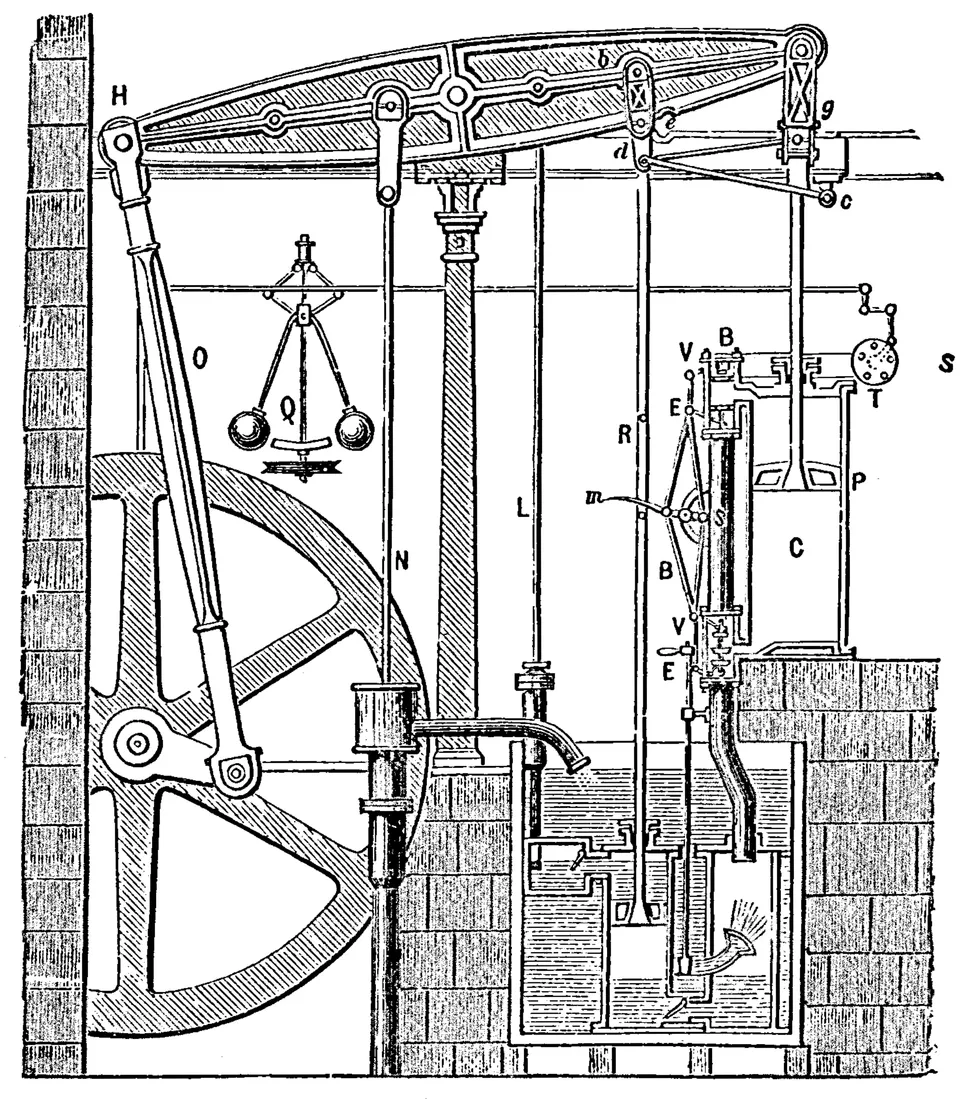
In 1769 James Watt patented a steam engine with a separate condenser, and later adapted it to produce rotary motion, making the steam engine the power source of factories.
Robert Henry Thurston (1839–1903) · Public domain · Source
The steam engine built by Newcomen early in the 18th century was used to pump water from mines, but by heating and cooling its cylinder over and over it burned a great deal of coal. James Watt, an instrument maker at the University of Glasgow, hit upon the idea of a separate condenser to cool the steam while repairing a model of a Newcomen engine, and took out a patent on 5 January 1769.
In 1775 Watt went into partnership with the Birmingham manufacturer Matthew Boulton to build and sell far more efficient engines, and in the 1780s he added gearing to turn the piston’s back-and-forth motion into the rotation of a wheel. Factories no longer had to stand beside rivers to turn waterwheels but could be built anywhere, and the Industrial Revolution, starting with cotton textiles, gathered pace. The steam engine later transformed transport too, in Stephenson’s locomotives and Fulton’s steamboats. The unit of power, the watt (W), is named after him.