Adam Smith’s The Wealth of Nations
Also called: The Wealth of Nations, Invisible hand, Laissez-faire, Classical economics
In 1776 Adam Smith published The Wealth of Nations, criticising mercantilism and arguing that the division of labour and free market competition increase a nation’s wealth — the beginning of classical economics.
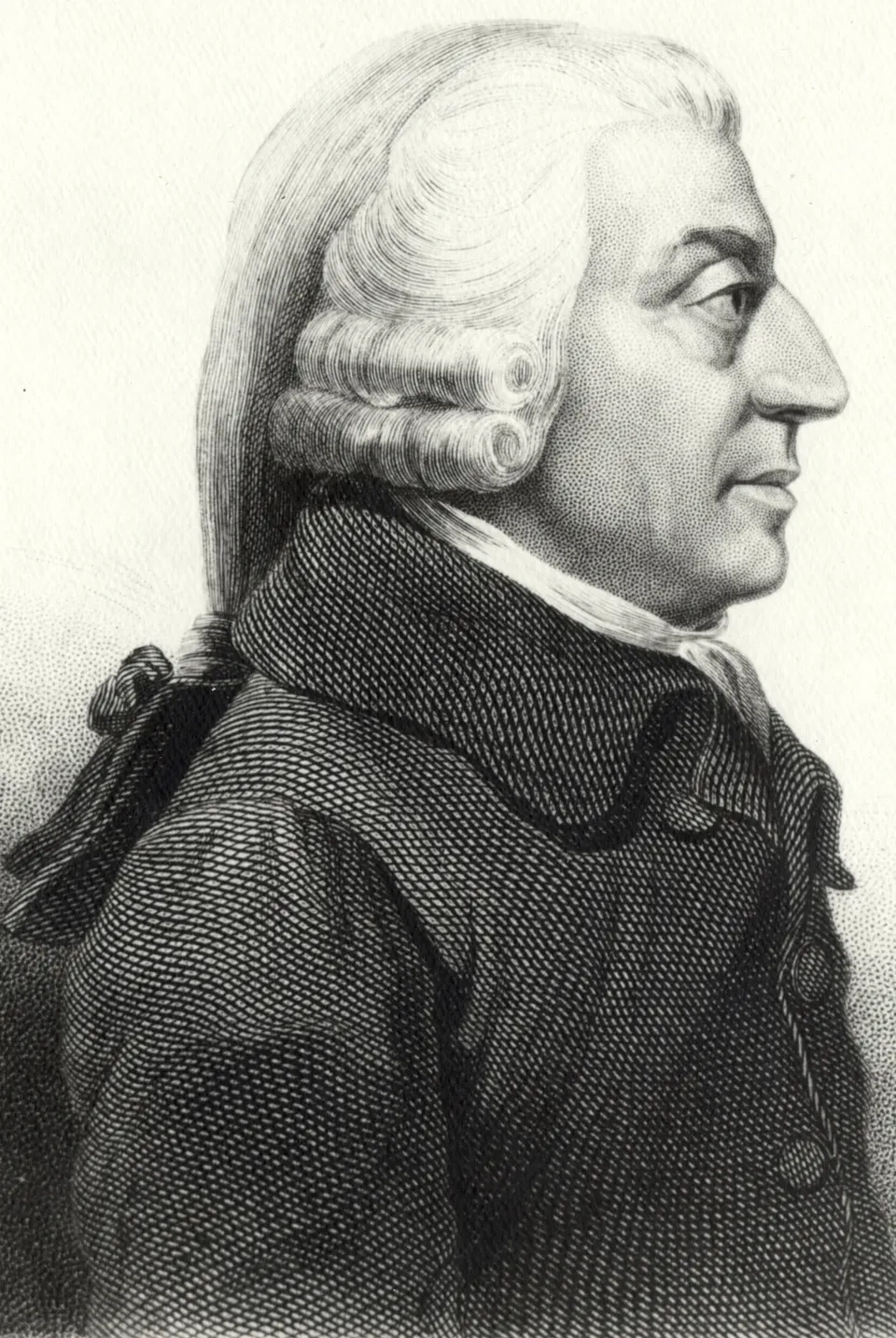
Etching created by Cadell and Davies (1811), John Horsburgh (1828) or R.C. Bell (1872). · Public domain · Source
The states of Europe in the age of absolute monarchy held that national wealth lay in piling up gold and silver and pursued mercantilism, encouraging exports, restricting imports and protecting chartered companies. Adam Smith, professor of moral philosophy at the University of Glasgow, met physiocrats such as Quesnay in France and on 9 March 1776 published The Wealth of Nations in London.
He argued that a nation’s wealth is not gold and silver but the produce of its people’s labour, and that division of labour, as in his example of a pin factory, greatly raises productivity. Even when each person pursues his own interest, the “invisible hand” of the market leads to the good of society as a whole, so the state should confine itself to defence, justice and public works and leave the economy alone — laissez-faire. This classical economics, carried on by Malthus and Ricardo, became the theory of capitalism in the age of the Industrial Revolution. Two years later in Joseon, Bak Je-ga’s Bukhagui argued that consumption stimulates production and criticised the stress on frugality alone.