Copernicus and the Heliocentric Theory
Also called: Heliocentrism, De revolutionibus orbium coelestium, Scientific Revolution
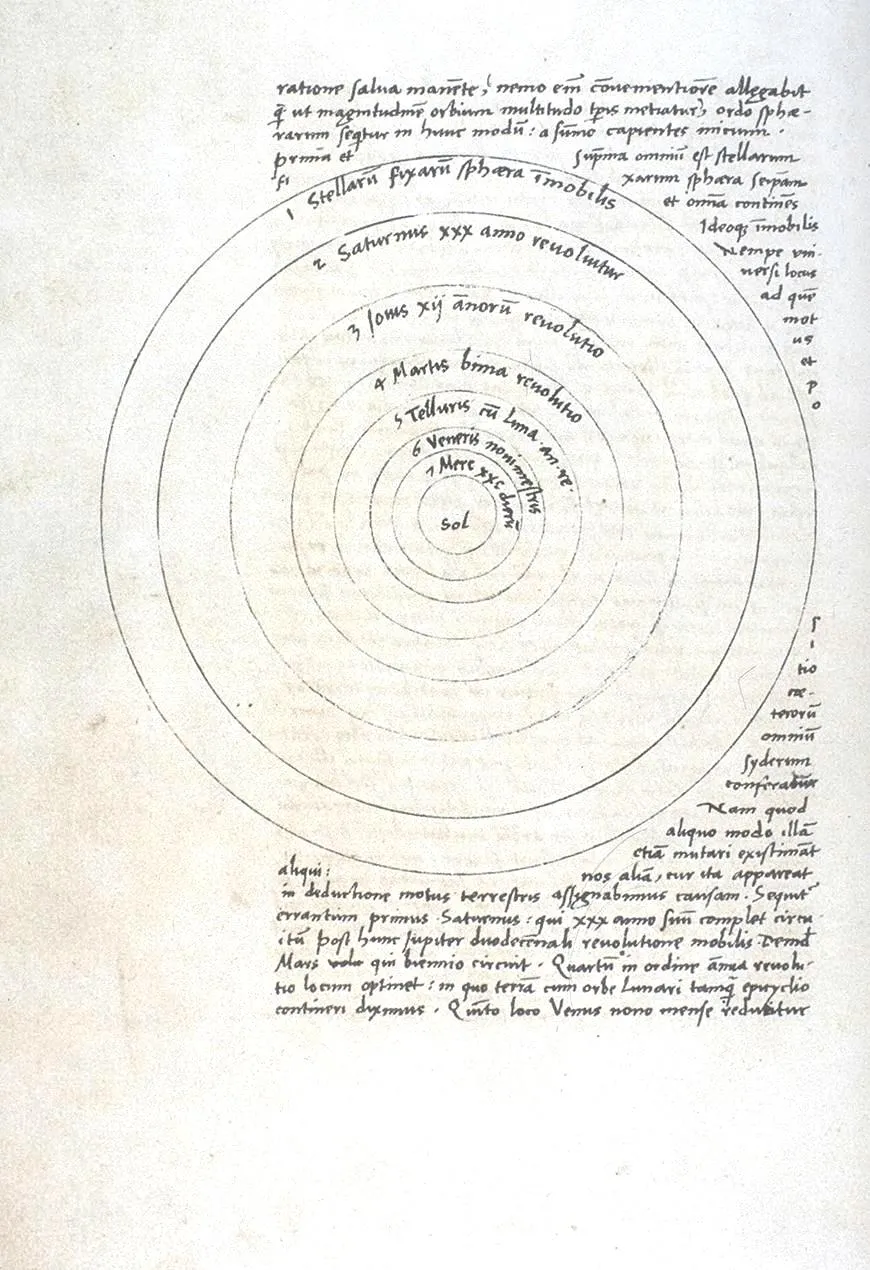
In 1543 Copernicus published On the Revolutions of the Heavenly Spheres, placing the Sun at the centre of the universe, and in the same year Vesalius founded modern anatomy with On the Fabric of the Human Body. It was the beginning of the Scientific Revolution.
Nicolaus Copernicus · Public domain · Source
Medieval Europe accepted, along with the teaching of the Church, Ptolemy’s geocentric system, in which the Earth stood still at the centre of the universe while the Sun and stars moved around it. Yet matching the movements of the planets required complex calculations of circles upon circles, and as Renaissance scholars reread ancient texts some began to doubt it.
Copernicus, a canon of the cathedral at Frombork in Poland, reasoned that the planets’ motions could be explained more simply if the Sun stood at the centre and the Earth turned once a day on its axis and once a year around the Sun. He held back his manuscript for years, publishing On the Revolutions of the Heavenly Spheres at Nuremberg in 1543, the year he died. In the same year Vesalius of the University of Padua, who dissected bodies himself, published On the Fabric of the Human Body at Basel, correcting errors of Galen, whose authority had stood for more than a thousand years.
Heliocentrism was at first treated as a mere method of calculation, but through Kepler and Galileo to Newton it grew into the Scientific Revolution, which explained nature by observation and mathematics rather than authority. The Church placed the book on the Index of Forbidden Books in 1616. In Joseon, too, in the late 17th and 18th centuries Kim Seok-mun and Hong Dae-yong argued that the Earth rotates.