Cultural heritageAD 450 – 189714 events

The Course of Korean Painting

From Goguryeo tomb murals to Jang Seung-eop — daily life and guardian deities, Goryeo Buddhist painting, early Joseon landscapes, true-view landscapes and genre painting, literati and folk painting
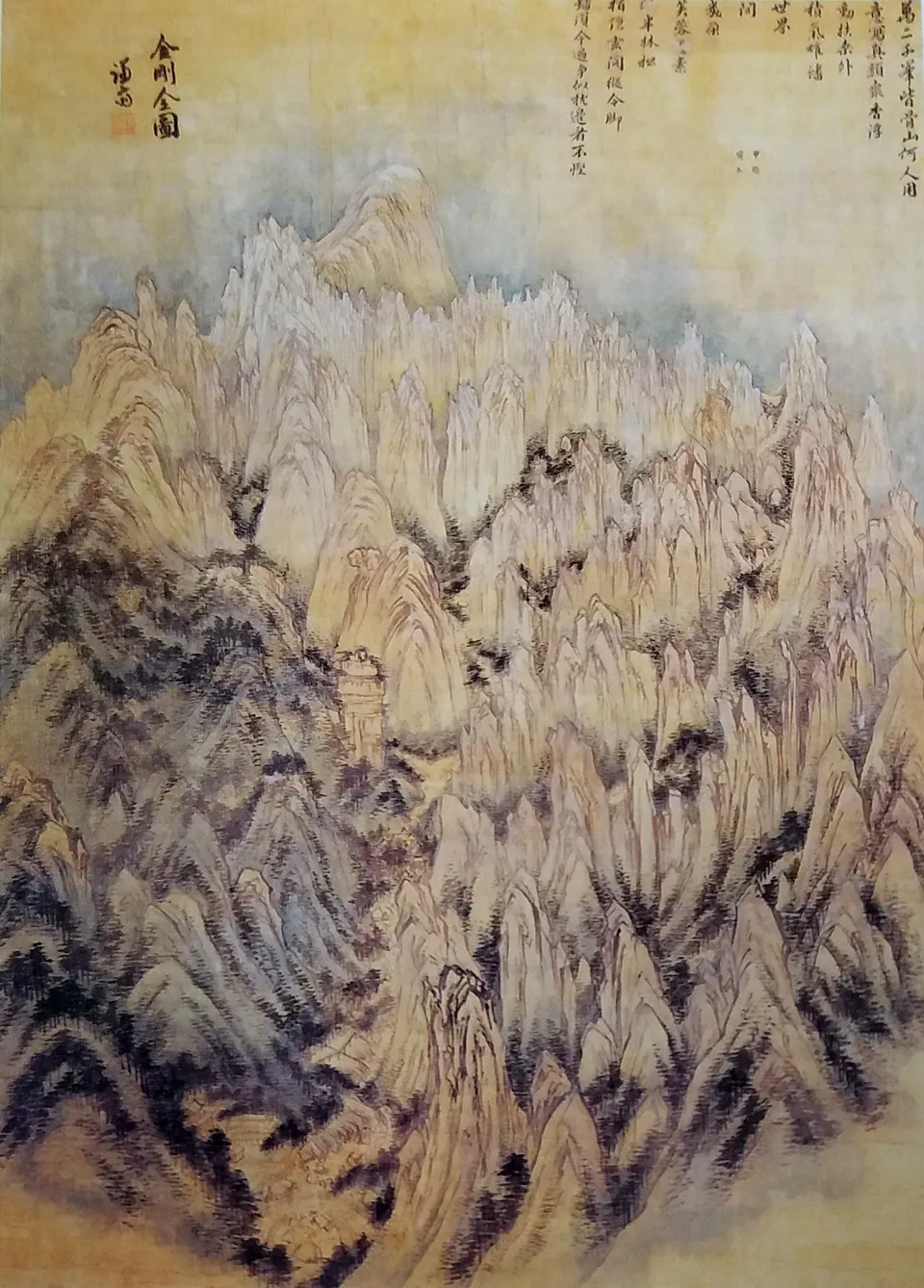
정선의 금강전도(1734) — 우리 산천을 직접 보고 그린 진경산수화

Jeong Seon · Public domain · Source

At a glance

WorkPeriod · artistFeatures
Muyongchong hunting sceneGoguryeo, 5th c. (Ji’an)Mounted hunters; stone-chamber tomb mural; vigour
CheonmadoSilla, c. 500 (Cheonmachong)Painted birch-bark mudguard from a stone-mound tomb
Four Guardians, Gangseo Great TombLate Goguryeo (c. 600)Blue dragon, white tiger, red bird, black tortoise; Daoist
Water-Moon AvalokiteshvaraLate Goryeo (14th c.)Buddhist painting; colour and gold; sheer veil; mostly in Japan
Dream Journey to the Peach Blossom LandJoseon 1447 · An GyeonPrince Anpyeong’s dream; real world to paradise; Tenri Univ.
Scholar Gazing at the WaterMid-15th c. · Gang Hui-anContemplative scholar; literati painting; Zhe school
Plants and InsectsEarly 16th c. · attr. Sin SaimdangPlants, flowers, insects; delicate colour
Complete View of the Diamond Mountains1734 · Jeong SeonTrue-view landscape; circular composition
Inwang jesaekdo1751 · Jeong SeonTrue-view landscape; Mount Inwang after rain; dark-ink rocks
Village School · Wrestling · Boy DancerLate 18th c. · Kim Hong-doCommoners’ life; no background; circular composition; humour
Dano pungjeong · Lovers · Beautyc. 1800 · Sin Yun-bokUrban romance and leisure; fine lines; bright colour
Folk painting (tiger and magpie, ideographs, books)Late Joseon · anonymousHome decoration; wishes of commoners
Sehando1844 · Kim Jeong-huiPainted in exile for Yi Sang-jeok; literati painting; pines of loyalty
Two Horses and a Man, etc.Late 19th c. · Jang Seung-eopBold brushwork; one of the Three Won; bridge to modern painting

The theme on the map

OpenFreeMap © OpenMapTiles © OpenStreetMap contributors

14 events in this theme

  1. A mural in the Goguryeo Tomb of the Dancers: mounted warriors twist back to shoot at fleeing tigers and deer — an image of Goguryeo vigour.

  2. A Silla painting from the Cheonmachong tomb in Gyeongju: a white horse flying across a saddle flap — almost the only painting surviving from Silla.

  3. A late Goguryeo stone-chamber tomb with a passage, its four walls painted with the Four Guardian Deities.

  4. Goryeo Buddhist paintings of Avalokiteshvara seated on a rock by the water — rich colour and gold with exquisitely transparent veils.

  5. An Gyeon painted in three days the peach-blossom paradise Prince Anpyeong saw in a dream — a monumental landscape leading from the real world into paradise, masterpiece of early Joseon painting.

  6. Gang Hui-an’s painting of a scholar resting on a rock gazing at the water — the ideal of the literatus who forgets worldly affairs and cultivates himself in nature.

  7. Paintings of grasses and flowers with the insects among them, attributed to Sin Saimdang — delicate observation and colour by a woman painter.

  8. Jeong Seon gathered the peaks of the Inner Diamond Mountains into one circular composition — a true-view landscape with sharp lines for rock and soft ink dots for earthen hills.

  9. Jeong Seon painted Mount Inwang as the mist lifts after rain — a masterpiece of “true-view” landscape painting drawn from Korea’s own scenery.

  10. The court painter Kim Hong-do depicted commoners at work and play — the village school, wrestling, a boy dancer — in humorous circular compositions without backgrounds.

  11. Practical paintings by anonymous artists to decorate homes — tiger and magpie, birds and flowers, ideographs and books — full of commoners’ wishes for luck and long life.

  12. Sin Yun-bok painted the pleasures and romances of urban aristocrats and women in delicate lines and bright colours — Dano pungjeong, Lovers under the Moon and Portrait of a Beauty.

  13. Painted by the exiled Kim Jeong-hui for his student Yi Sang-jeok, who kept sending him books — pines and cypresses in winter as a symbol of unchanging loyalty.

  14. The late Joseon painter Jang Seung-eop painted figures, animals, birds and flowers with bold brushwork. Grouped with Kim Hong-do and Sin Yun-bok as the “Three Won”, he bridged traditional and modern Korean painting.

Key people

  • Jeong Seon (Gyeomjae)1676 – 1759

    Painter who pioneered “true-view” landscapes of Korea’s own scenery; his masterpieces include Inwang jesaekdo and Geumgang jeondo

  • Yeongjo1694 – 1776

    Twenty-first king of Joseon, known for his impartiality policy and tax reform, and for the death of his son

  • Bak Paeng-nyeon1417 – 1456

    Jiphyeonjeon scholar executed as one of the Six Martyred Ministers for plotting with Seong Sam-mun to restore Danjong

  • Sin Suk-ju1417 – 1475

    Jiphyeonjeon scholar who helped create Hunminjeongeum, wrote the Haedong jegukgi after a mission to Japan, and became Chief State Councillor under Sejo

  • Seong Sam-mun1418 – 1456

    Hall of Worthies scholar executed for plotting to restore Danjong; one of the Six Martyred Ministers

  • Sejong the Great1397 – 1450

    Fourth king of Joseon, creator of Hangul, patron of science and of the northern frontier

  • Kim Hong-do (Danwon)1745

    Court painter who portrayed King Jeongjo and is best known for genre scenes of commoners such as The Village School and Ssireum; he died around 1806

  • Jeongjo1752 – 1800

    Twenty-second king of Joseon, founder of the Gyujanggak library and builder of Hwaseong Fortress

  • Sin Yun-bok (Hyewon)1758

    Painter of the leisure and romance of urban aristocrats and women in fine line and colour, as in Dano pungjeong and Portrait of a Beauty; year of death unknown

  • Kim Jeong-hui (Chusa)1786 – 1856

    Epigrapher and calligrapher who created the Chusa style, identified the Bukhansan stele as King Jinheung’s, and painted Sehando in exile on Jeju

  • Heonjong1827 – 1849

    Twenty-fourth king of Joseon, enthroned at eight while the Pungyang Jo and Andong Kim clans fought for power; the 1839 persecution took place in his reign

  • Gojong1852 – 1919

    Twenty-sixth king of Joseon and first emperor of the Korean Empire