Myths1400 BC – 190019 events

Heroes of Greek Myth

Perseus and Medusa, the labours of Heracles, Jason and the Golden Fleece, Theseus and the Minotaur, the wings of Icarus, Oedipus and Antigone — the heroes of Greek myth, alongside the real sites of Tiryns, Knossos and Thebes, the first performance of a tragedy, and the sculptures and paintings their stories inspired
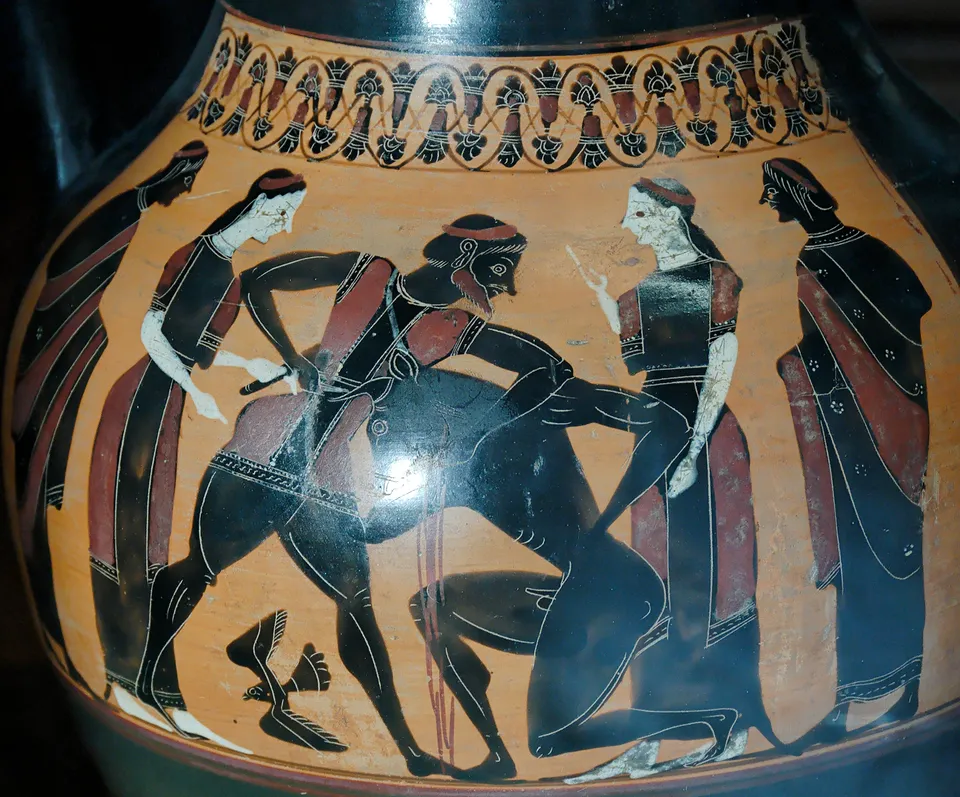
미노타우로스를 찌르는 테세우스 — 아테네의 검은 그림 항아리, 기원전 540년 무렵, 루브르 박물관

Group of London B 174 · Public domain · Source

At a glance

StorySource / siteKind
Perseus and MedusaHesiod; Apollodorus; Ovid, Metamorphoses 4–5Myth
Citadel of Tiryns (14th–13th c. BC)Argolid; Cyclopean wallsHistory
The twelve labours of HeraclesApollodorus, Bibliotheca 2Legend
Olympia metopes (c. 470–456 BC)Temple of Zeus → Olympia Museum, LouvreHistory
Farnese Hercules found (1546)Baths of Caracalla, Rome → NaplesHistory
Death and apotheosis of HeraclesSophocles, Women of Trachis; Metamorphoses 9Myth
Jason and the ArgoPindar; Apollonius, ArgonauticaMyth
MedeaEuripides, MedeaMyth
Colchis (6th–4th c. BC)Western Georgia; gold of VaniHistory
The Argonautica (3rd c. BC)Alexandria; ApolloniusHistory
Theseus and the MinotaurPlutarch, Life of Theseus; ApollodorusLegend
Ariadne on NaxosCatullus 64; Metamorphoses 8Myth
Daedalus and IcarusMetamorphoses 8Legend
Landscape with the Fall of Icarus (c. 1560)Bruegel (?); Royal Museums, BrusselsHistory
Excavation of Knossos (1900)Evans; the “Minoan” civilisationHistory
Oedipus and the SphinxSophocles; Apollodorus 3Legend
Oedipus the King first staged (c. 429 BC)Theatre of Dionysus, AthensHistory
AntigoneSophocles, AntigoneMyth
Mycenaean Thebes (14th–13th c. BC)Kadmeia; Linear B tabletsHistory

The theme on the map

OpenFreeMap © OpenMapTiles © OpenStreetMap contributors

19 events in this theme

  1. UndatedPerseus and MedusaLegend

    A Greek myth told in Hesiod’s Theogony, Apollodorus’ Bibliotheca and Ovid’s Metamorphoses. With the help of the gods, Perseus, son of Zeus, cut off the head of the Gorgon Medusa, whose gaze turned people to stone, and on his way home rescued Andromeda.

  2. 1400 BC – 1200 BCThe Citadel of Tiryns

    In the 14th–13th centuries BC a Mycenaean citadel rose at Tiryns in the Argolid. Its walls of huge stones, about six metres thick, were so massive that they were said to be the work of the one-eyed giants, the Cyclopes — hence “Cyclopean” walls. The palace fell around 1200 BC.

  3. A Greek myth and legend told in Apollodorus’ Bibliotheca and other works. Driven mad by Hera, Heracles killed his own children, and in atonement served Eurystheus, king of Tiryns (or Mycenae), carrying out twelve labours from the Nemean lion to Cerberus, the hound of the underworld.

  4. Over the front and rear porches of the temple of Zeus built at Olympia around 470–456 BC, twelve metopes showed the twelve labours of Heracles — thought to be the earliest clear example of the set of “twelve labours”.

  5. In 1546 a colossal marble statue of Heracles resting on his club came out of the ruins of the Baths of Caracalla in Rome. Taken by the Farnese, the family of Pope Paul III, it is known as the Farnese Hercules and is now in the National Archaeological Museum of Naples.

  6. A Greek myth told in Sophocles’ tragedy Women of Trachis and Book 9 of Ovid’s Metamorphoses, among others. When a robe soaked in the blood of the centaur Nessus — sent by his wife Deianira, who thought it a love charm — burned his flesh, Heracles had a pyre built on Mount Oeta, mounted the flames and rose to Olympus as a god.

  7. A Greek myth told in Pindar’s odes and Apollonius’ Argonautica. To win back his throne, Jason sailed in the ship Argo with heroes such as Heracles and Orpheus to Colchis at the far end of the Black Sea, and with the help of the princess Medea took the Golden Fleece guarded by a dragon.

  8. UndatedMedeaLegend

    A Greek myth best known from Euripides’ tragedy Medea (431 BC). Medea, the Colchian princess who followed Jason to Greece, was abandoned in Corinth when Jason sought to marry the king’s daughter; she killed the bride with a poisoned robe, killed her own children and escaped in the chariot of the Sun.

  9. Colchis, at the eastern end of the Black Sea in what is now western Georgia, was known for fine metalwork from the Bronze Age, and from around the 6th century BC Greeks founded colonies such as Phasis on its coast. Gold jewellery from the graves of Vani shows why the Greeks called it rich in gold.

  10. In the 3rd century BC, in Ptolemaic Alexandria, the poet and scholar Apollonius composed the Argonautica, an epic in four books on the voyage of the Argo. Its searching portrait of Medea’s love for Jason influenced Virgil’s Aeneid.

  11. A Greek myth and legend told in Plutarch’s Life of Theseus, Apollodorus and Ovid, among others. Theseus, prince of Athens, killed the bull-headed Minotaur shut in the Labyrinth of King Minos of Crete, and found his way out by the thread given him by the princess Ariadne.

  12. UndatedAriadne on NaxosLegend

    A Greek myth told by Hesiod’s Theogony, Catullus and Ovid. Ariadne, who left Crete with Theseus, was abandoned on the island of Naxos; the wine god Dionysus found her, made her his wife and set her crown among the stars.

  13. 1400 BCDaedalus and IcarusLegend

    A Greek myth and legend told in Book 8 of Ovid’s Metamorphoses and by Apollodorus. Imprisoned on Crete, the craftsman Daedalus made wings of feathers and wax and flew away with his son Icarus, but Icarus flew too high, the sun melted the wax and he fell into the sea.

  14. Around 1560 the Landscape with the Fall of Icarus was painted in Flanders after a composition by Pieter Bruegel. In a calm scene of a ploughman and ships at sea, only Icarus’ legs can be seen in a corner of the water. Whether the painting in the Royal Museums of Fine Arts of Belgium in Brussels is by Bruegel’s own hand is debated.

  15. In March 1900 the British archaeologist Arthur Evans began excavating Knossos on Crete, uncovering a great palace, the “Throne of Minos” and inscribed tablets. He named the civilisation “Minoan” after the legendary King Minos.

  16. A Greek myth and legend told in Sophocles’ tragedies and by Apollodorus. Exposed at birth because of an oracle that he would kill his father and marry his mother, Oedipus unknowingly killed his father Laius on the road, solved the riddle of the Sphinx that plagued Thebes, became king and married the queen, Jocasta.

  17. Around 429 BC Sophocles’ tragedy Oedipus the King was first performed at the City Dionysia in the Theatre of Dionysus in Athens. It won only second prize that year, but Aristotle held it up in his Poetics as the model of tragedy, and it has become the most famous Greek tragedy.

  18. UndatedAntigoneLegend

    A Greek myth told in Sophocles’ tragedy Antigone (c. 441 BC). Antigone, daughter of Oedipus, defied King Creon’s order that her brother Polynices, killed attacking Thebes, should lie unburied; she buried him, was shut alive in a tomb and took her own life.

  19. 1400 BC – 1200 BCMycenaean Thebes

    In the 14th–13th centuries BC a Mycenaean palace stood on the Kadmeia hill at Thebes in Boeotia. It burned at the end of the 13th century BC, and nearly 250 Linear B tablets found in the 1990s show that Thebes was a major centre of the Mycenaean world.

Key people

  • Arthur Evans1851 – 1941

    British archaeologist who excavated the palace of Knossos on Crete from 1900 and named the “Minoan” civilisation

  • Sophocles406 BC

    Tragic poet of ancient Athens, author of Oedipus the King and Antigone, counted with Aeschylus and Euripides among the three great tragedians