Oedipus and the Sphinx
Also called: Riddle of the Sphinx, Laius, Jocasta
A legend handed down over the centuries.
A Greek myth and legend told in Sophocles’ tragedies and by Apollodorus. Exposed at birth because of an oracle that he would kill his father and marry his mother, Oedipus unknowingly killed his father Laius on the road, solved the riddle of the Sphinx that plagued Thebes, became king and married the queen, Jocasta.
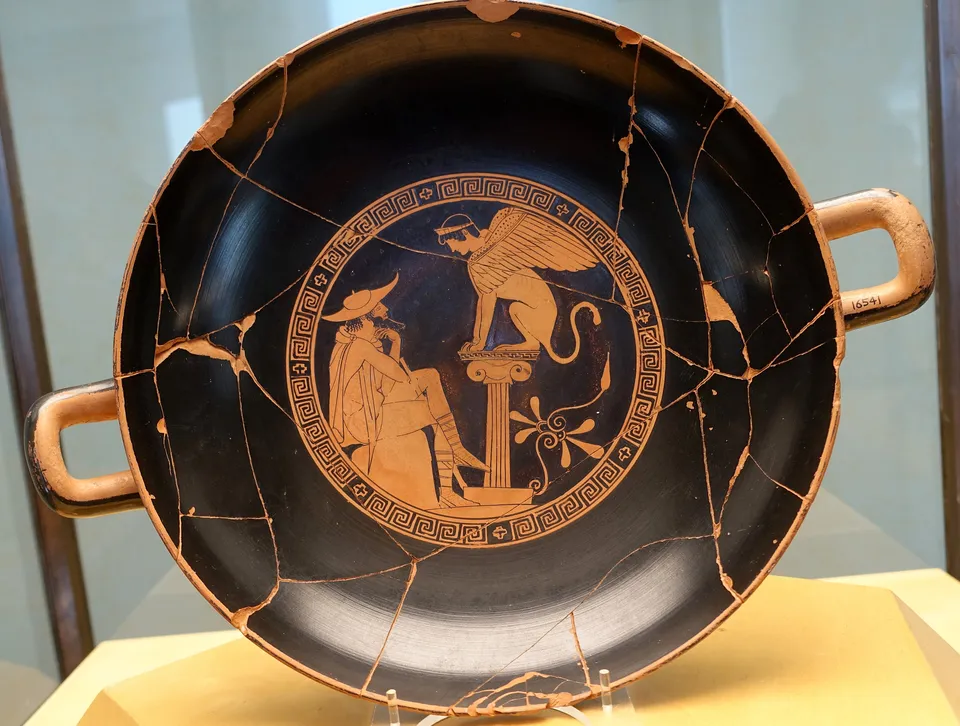
Daderot · Public domain · Source
This Greek myth and legend is told in Sophocles’ Oedipus the King and Apollodorus’ Bibliotheca (Book 3), among others; Book 11 of Homer’s Odyssey briefly says that Oedipus’ mother Epicaste (Jocasta) unknowingly married her son. Laius, king of Thebes, warned by an oracle that he would be killed by his son, had his baby son’s ankles pierced and left him on a mountain. The child was raised by King Polybus of Corinth and his wife, and was named Oedipus, “swollen foot”.
Grown up, Oedipus heard from the Delphic oracle that he would kill his father and marry his mother, and, to avoid returning to Corinth, wandered abroad; at a place where three roads met he quarrelled with an old man and killed him. It was Laius. Thebes at the time was plagued by the Sphinx, a monster with a woman’s face, a lion’s body and wings, who posed a riddle and devoured those who could not answer. Asked “what walks on four feet in the morning, two at noon and three in the evening?”, Oedipus answered “man”, and the Sphinx threw herself to her death. The Thebans made him king, and he married the widowed queen Jocasta.
The story of Oedipus is one of several legends set in Thebes, along with the founding by Cadmus and the attack of the Seven. Here it is placed as a legend of Mycenaean Thebes, but it has no fixed date.