Discovery of the Farnese Hercules
Also called: Hercules Farnese, Weary Herakles
In 1546 a colossal marble statue of Heracles resting on his club came out of the ruins of the Baths of Caracalla in Rome. Taken by the Farnese, the family of Pope Paul III, it is known as the Farnese Hercules and is now in the National Archaeological Museum of Naples.
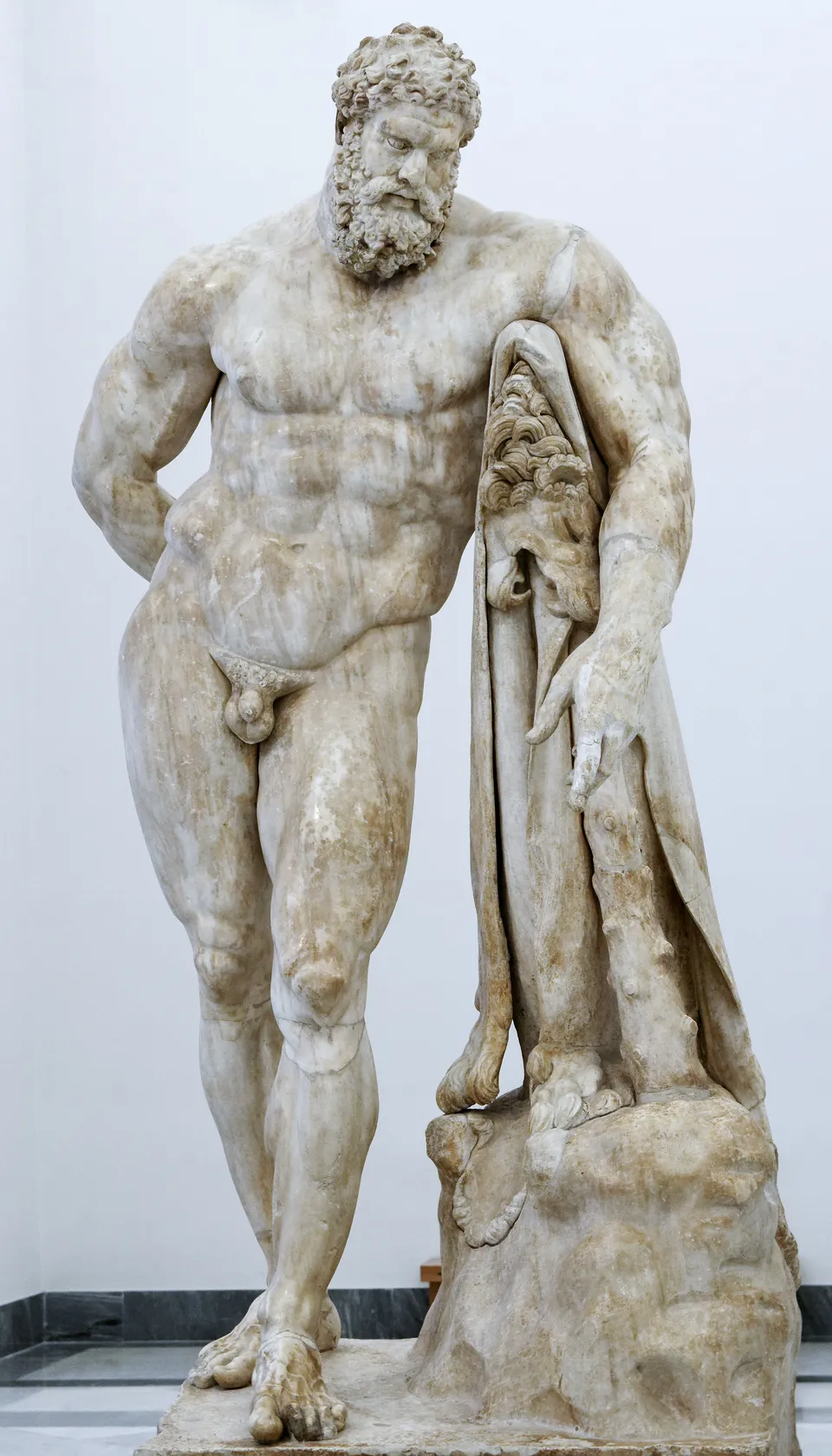
Glycon of Athens (copy), Lysippos (original type) · CC BY 2.5 · Source
In 1546, while the family of Pope Paul III (Alessandro Farnese) was digging in the ruins of the Baths of Caracalla in Rome, a marble Heracles over three metres high was found. He leans wearily on his club draped with the lion skin, and in his right hand, held behind his back, are the golden apples of the Hesperides, showing that he has just finished his labours. The rock bears the signature “Glykon of Athens made it”. It is thought to be an enlarged Roman copy, made when the baths were dedicated in the early 3rd century (around AD 216), of a bronze by the 4th-century BC sculptor Lysippos or his circle.
The statue was placed in the courtyard of the Palazzo Farnese in Rome. According to the story, it was at first missing its legs, which the sculptor Guglielmo della Porta replaced; when the original legs turned up they were left aside to show that modern sculptors could rival the ancients. The original legs were restored only in 1787, the year the Bourbons of Naples, heirs to the Farnese collections, moved the statue to Naples.
Copied endlessly in statues and prints from the Renaissance on, this muscle-bound Heracles fixed the image of the hero and was a favourite of painters such as Rubens.