Antigone
Also called: Polynices, Creon, Seven against Thebes
A legend handed down over the centuries.
A Greek myth told in Sophocles’ tragedy Antigone (c. 441 BC). Antigone, daughter of Oedipus, defied King Creon’s order that her brother Polynices, killed attacking Thebes, should lie unburied; she buried him, was shut alive in a tomb and took her own life.
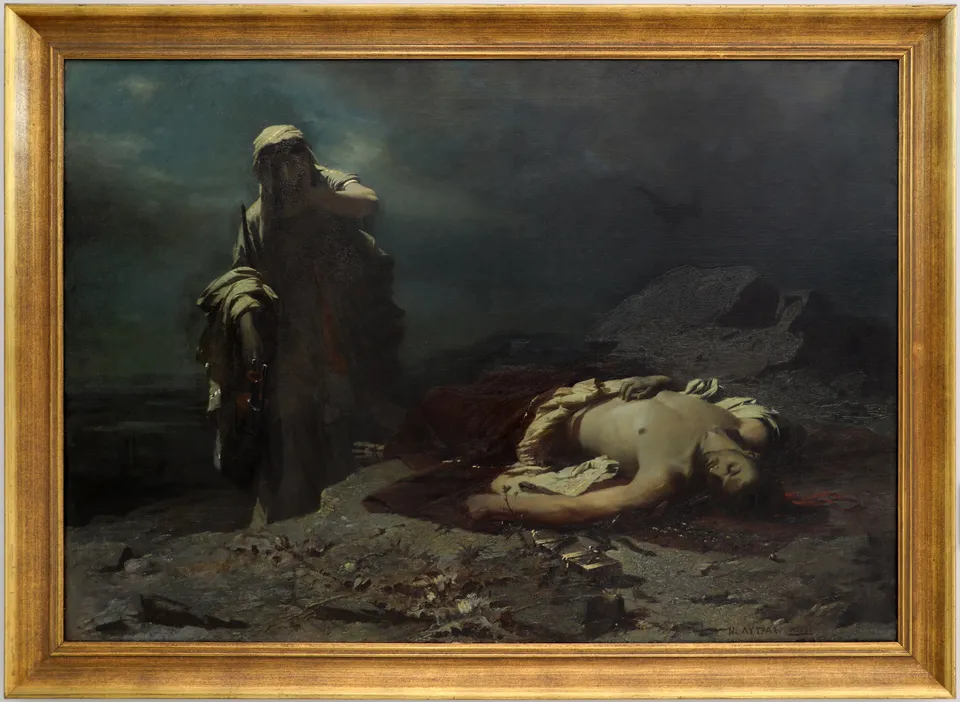
Francesco Bini · CC BY-SA 4.0 · Source
This Greek myth is best known from Sophocles’ tragedy Antigone (first performed c. 441 BC), while Aeschylus’ Seven against Thebes (467 BC) shows what came before. After Oedipus, learning the truth, blinded himself and left Thebes, his two sons Eteocles and Polynices fought over the throne. The exiled Polynices attacked Thebes with seven champions from Argos, and the two brothers met in combat and killed each other.
Their uncle Creon, now king, gave Eteocles, who had died defending the city, a funeral, but ordered that the body of Polynices, who had attacked it, be left unburied in the field. Antigone, daughter of Oedipus, appealed to “the unwritten laws of the gods” and covered her brother’s body with earth, and Creon had her shut alive in a rock tomb. By the time the warnings of the seer Tiresias changed his mind, Antigone had already hanged herself, and Creon’s son Haemon, her betrothed, and his wife Eurydice also took their own lives.
Antigone, a drama of the clash between the law of the state and conscience (the law of the gods), has been much discussed by philosophers such as Hegel and rewritten in every age, as in Anouilh’s Antigone, staged in German-occupied Paris in 1944.