Jason and the Voyage of the Argo — the Golden Fleece
Also called: Argonauts, Golden Fleece, Argo
A legend handed down over the centuries.
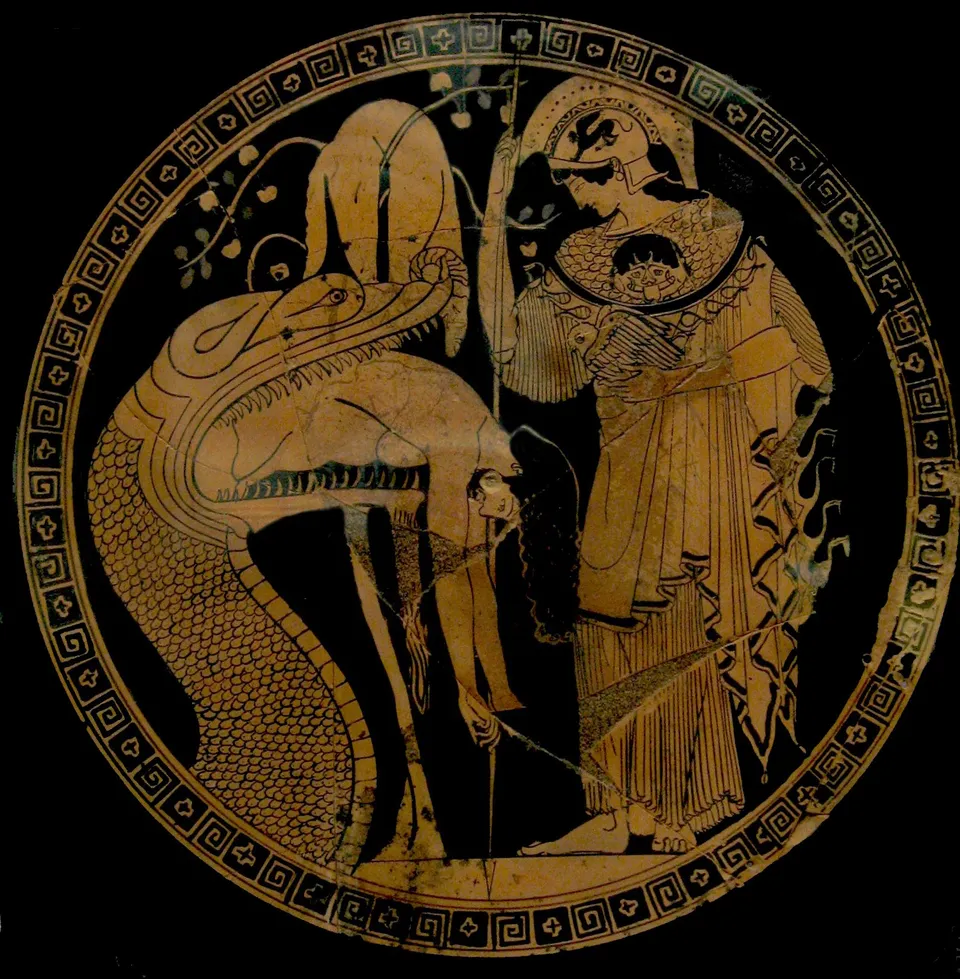
A Greek myth told in Pindar’s odes and Apollonius’ Argonautica. To win back his throne, Jason sailed in the ship Argo with heroes such as Heracles and Orpheus to Colchis at the far end of the Black Sea, and with the help of the princess Medea took the Golden Fleece guarded by a dragon.
Douris · Public domain · Source
This Greek myth is told in Pindar’s Fourth Pythian Ode (462 BC), the Hellenistic epic Argonautica of Apollonius and Apollodorus’ Bibliotheca; Book 12 of the Odyssey already speaks of “the Argo, known to all”. Pelias, who had seized the throne of Iolcus in Thessaly, was warned by an oracle to beware a man wearing one sandal. When his nephew Jason appeared, having lost a sandal crossing a river, Pelias sent him to fetch the Golden Fleece from Colchis at the end of the world. The fleece came from the flying ram that had carried Phrixus to Colchis, and King Aeëtes kept it guarded by a sleepless dragon.
The Argo, built with Athena’s help, carried some fifty heroes, among them Heracles, the singer Orpheus, the twins Castor and Polydeuces and Peleus, father of Achilles. They passed the women of Lemnos, the seer Phineus tormented by the Harpies, and the Symplegades, clashing rocks that crushed ships (Heracles was left behind searching for his companion Hylas). In Colchis Aeëtes set Jason to yoke fire-breathing bulls, plough a field, sow dragon’s teeth and defeat the warriors who sprang up. Medea, the king’s daughter and a sorceress who had fallen in love with Jason, helped him with drugs and cunning and put the dragon to sleep so that he could take the fleece.
Accounts of the voyage home differ, taking the Argo up the Danube, into the Adriatic or across the Libyan desert; on Crete Medea brought down the bronze giant Talos. Colchis was in fact a gold-bearing land at the eastern end of the Black Sea, and the ancient geographer Strabo explained the story of the Golden Fleece by the local practice of catching gold dust with sheepskins.