The Twelve Labours of Heracles
Also called: Labours of Hercules, Nemean lion, Lernaean Hydra, Cerberus, Apples of the Hesperides
A legend handed down over the centuries.
A Greek myth and legend told in Apollodorus’ Bibliotheca and other works. Driven mad by Hera, Heracles killed his own children, and in atonement served Eurystheus, king of Tiryns (or Mycenae), carrying out twelve labours from the Nemean lion to Cerberus, the hound of the underworld.
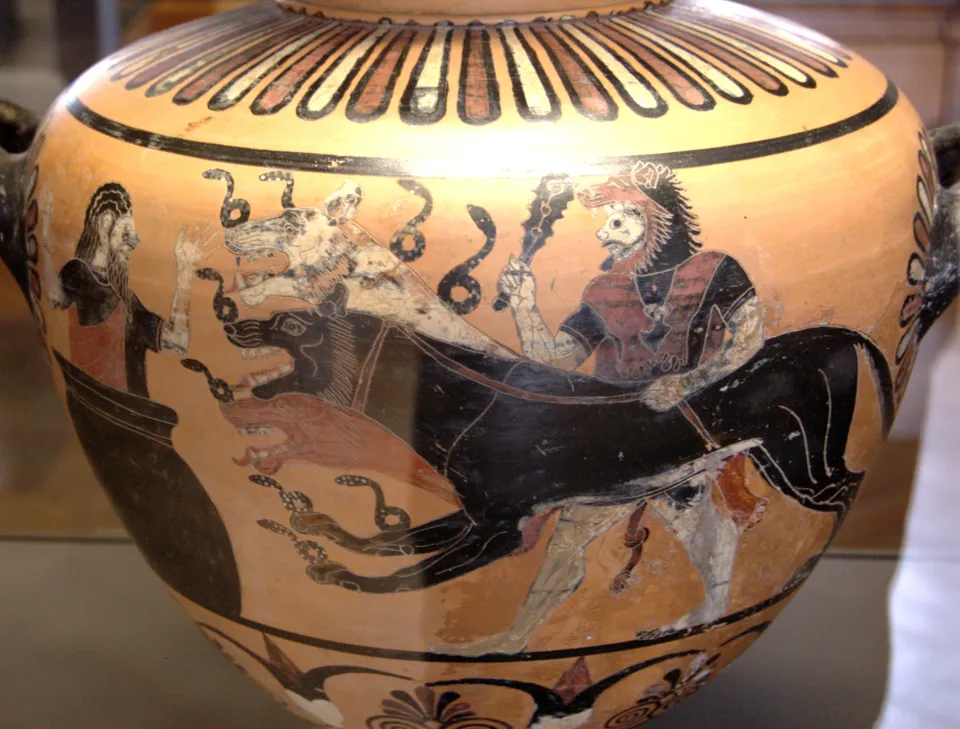
Eagle Painter · Public domain · Source
This Greek myth and legend is told in order by Apollodorus’ Bibliotheca (Book 2) and Diodorus of Sicily, among others; Homer, too, mentions in the Iliad and the Odyssey that Heracles served Eurystheus and fetched Cerberus. As the son of Zeus by the mortal Alcmene, Heracles was hated by Hera. Struck with madness by her, he killed his own children, and the Delphic oracle ordered him to serve his cousin, King Eurystheus, and do whatever he commanded.
The labours were: (1) the Nemean lion, whose hide no blade could pierce; (2) the Lernaean Hydra, whose heads grew back; (3) the golden-horned Ceryneian hind; (4) the Erymanthian boar; (5) cleaning the stables of King Augeas, which he did in a day by diverting rivers; (6) the Stymphalian birds; (7) the Cretan bull; (8) the man-eating mares of Diomedes; (9) the girdle of the Amazon queen Hippolyta; (10) the cattle of Geryon; (11) the golden apples of the Hesperides, which he had Atlas, who holds up the sky, fetch for him; and (12) Cerberus. According to Apollodorus there were originally ten, but Eurystheus refused to count the Hydra, since Heracles’ nephew Iolaus had helped, and the stables, since he had been paid, so two more were added.
The number and order of the labours vary among ancient writers; the set of “twelve labours” is thought to appear clearly for the first time on the metopes of the 5th-century BC temple of Zeus at Olympia. Here the legend is placed at the citadel of Tiryns, where Heracles lived, but it has no fixed date.