Landscape with the Fall of Icarus
Also called: Fall of Icarus, Bruegel’s Icarus
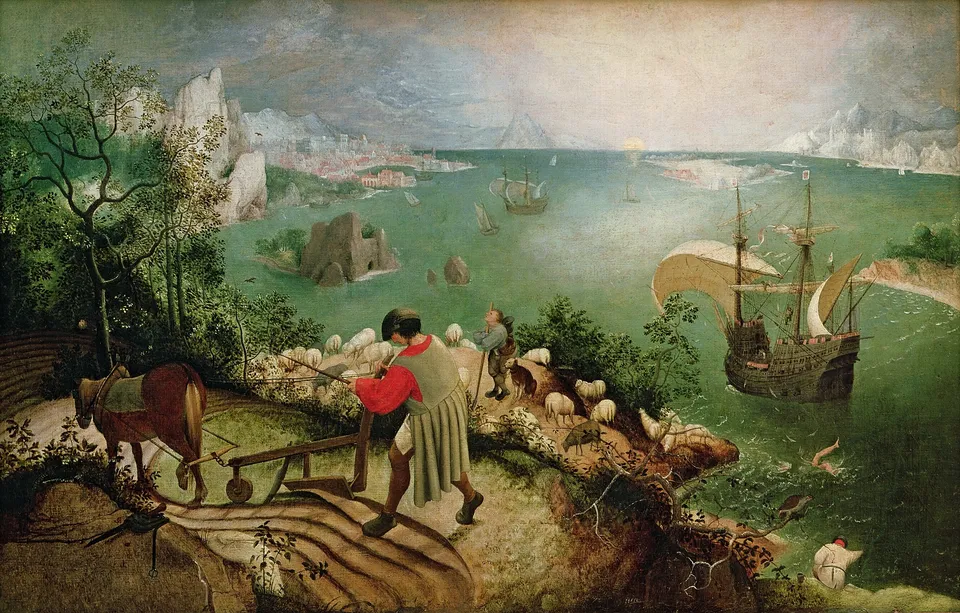
Around 1560 the Landscape with the Fall of Icarus was painted in Flanders after a composition by Pieter Bruegel. In a calm scene of a ploughman and ships at sea, only Icarus’ legs can be seen in a corner of the water. Whether the painting in the Royal Museums of Fine Arts of Belgium in Brussels is by Bruegel’s own hand is debated.
After Pieter Brueghel the Elder · Public domain · Source
This painting (oil on canvas, 73.5 × 112 cm), acquired by the Royal Museums of Fine Arts of Belgium in Brussels in 1912, was long known as a work of Pieter Bruegel the Elder. In the foreground a ploughman, a shepherd and an angler are absorbed in their work, and a great ship sails by; Icarus appears only as a pair of flailing legs in the sea at lower right. Ovid wrote that an angler, a shepherd and a ploughman saw Daedalus and his son flying and took them for gods, but no one in the painting looks up. Some connect it to the Flemish proverb “no plough stops for a dying man”.
Technical examination in 1996 cast serious doubt on Bruegel’s authorship. His other oil paintings are all on panel while this one is on canvas, and radiocarbon dating of the canvas in 1998 concluded that Bruegel, who died in 1569, could not have painted it. That dating was challenged in 2006, however, and later research suggested it might be a panel painting transferred to canvas. The museum holds that the composition is Bruegel’s but that the hand is uncertain; many scholars see it as a copy made around the 1560s of a lost original of about 1558.
Whoever painted it, the picture is famous for pushing a hero’s tragedy into the corner of an everyday landscape. After seeing it in 1938, the English poet W. H. Auden wrote in “Musée des Beaux Arts” that suffering takes place beside the indifferent ordinary lives of others.