Korean history1953 – 202431 events
Inter-Korean Relations: Thaw and Freeze
From the armistice to “two hostile states” — inter-Korean relations, thawed by talks and exchanges and frozen again by provocations and clashes
From the armistice to “two hostile states” — inter-Korean relations, thawed by talks and exchanges and frozen again by provocations and clashes
| Year | Event | Temperature | What happened |
|---|---|---|---|
| 1953 | Armistice Agreement | Starting point | Fighting stopped without a peace treaty; the Armistice Line divided the peninsula |
| 1968 | January 21 Incident | Freeze | North Korean commando raid on the Blue House; Pueblo seized two days later |
| 1971 | Red Cross talks | Thaw | Proposal to trace separated families opens the first dialogue since division |
| 1972 | July 4 Joint Statement | Thaw | Three principles: independence, peace, national unity |
| 1976 | Panmunjom axe murders | Freeze | Two US officers killed while overseeing the trimming of a poplar |
| 1983 | Rangoon bombing | Freeze | Bomb aimed at the president’s party in Burma kills 17 Koreans |
| 1985 | Separated families’ visits | Thaw | First hometown visits and exchange of arts troupes |
| 1987 | Korean Air Flight 858 | Freeze | Airliner bombed before the Seoul Olympics; 115 killed |
| 1991 | Unified table-tennis team | Thaw | First joint team wins the women’s title in Chiba |
| 1991 | Joint UN admission | Thaw | Both Koreas become UN members |
| 1991 | Basic Agreement | Thaw | Mutual recognition, non-aggression, exchanges; denuclearization declaration |
| 1993–1994 | First nuclear crisis | Freeze | NPT withdrawal; summit lost with Kim Il Sung’s death; Agreed Framework |
| 1998 | Chung Ju-yung’s cattle | Thaw | 1,001 cattle taken across Panmunjom in two trips |
| 1998 | Mount Geumgang tours | Thaw | Ships carry South Korean tourists to Mount Geumgang |
| 1999 | First Battle of Yeonpyeong | Freeze | Clash with boats crossing the NLL; North Korean torpedo boat sunk |
| 2000 | June 15 Declaration | Thaw | First inter-Korean summit, in Pyongyang |
| 2000 | Joint march at Sydney | Thaw | First joint entry behind the Unification Flag |
| 2002 | Second Battle of Yeonpyeong | Freeze | Ambush sinks Chamsuri 357; six killed |
| 2003 | Kaesong Industrial Complex | Thaw | Southern capital and northern labour in one industrial zone |
| 2006 | First nuclear test | Freeze | Test at Punggye-ri; UN Security Council sanctions |
| 2007 | October 4 Declaration | Thaw | Second summit; West Sea peace and cooperation zone |
| 2008 | Geumgang tourist shot | Freeze | Tourist killed by a sentry; tours suspended |
| 2010 | Cheonan sinking | Freeze | 46 killed; investigators blame a North Korean torpedo; May 24 Measures |
| 2010 | Yeonpyeong shelling | Freeze | Shelling of an inhabited island; two marines and two civilians killed |
| 2016 | Kaesong shut down | Freeze | Closed after the fourth nuclear test and a missile launch |
| 2018 | PyeongChang Olympics | Thaw | Joint march, unified women’s hockey team, high-level delegation |
| 2018 | Panmunjom Declaration | Thaw | Summit at Panmunjom; denuclearization, liaison office |
| 2018 | Singapore summit | Thaw | First US–North Korea summit (Hanoi talks failed in 2019) |
| 2018 | Pyongyang Declaration | Thaw | Summit in Pyongyang; September 19 military agreement |
| 2020 | Liaison office blown up | Freeze | Hotlines cut, then the Kaesong office demolished |
| 2023–2024 | “Two hostile states” | Freeze | Kinship disowned; agencies for the South abolished; road links blown up |
After more than two years of talks, the armistice was signed at Panmunjom, fixing the Military Demarcation Line and the Demilitarized Zone.
Thirty-one North Korean commandos tried to raid the presidential residence and were stopped in Seoul; the Homeland Reserve Forces were created in response.
A Korean Red Cross proposal to trace separated families opened the first inter-Korean dialogue since division, with preliminary talks at Panmunjom and full talks in Pyongyang and Seoul.
For the first time since division, the two Koreas agreed on three principles of unification — independence, peace and national unity — announced simultaneously in Seoul and Pyongyang.
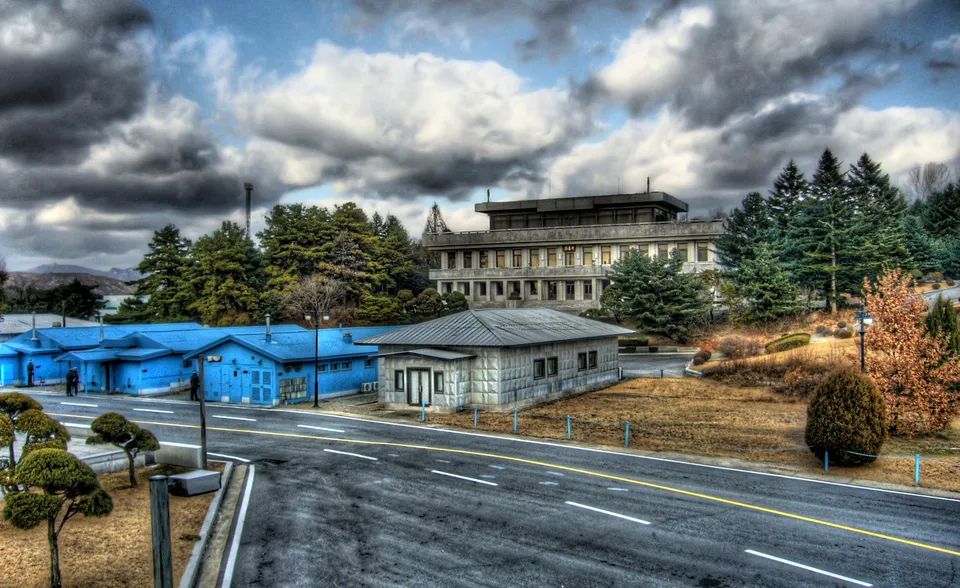
Two US Army officers supervising the trimming of a poplar tree in the Joint Security Area at Panmunjom were killed by North Korean soldiers with axes; afterwards a dividing line was drawn even inside the JSA.
A bomb planted by North Korean agents to kill President Chun Doo-hwan on a visit to Burma exploded at the Aung San Mausoleum in Rangoon, killing 17 Koreans including the deputy prime minister and cabinet ministers.
For the first time since division, groups of separated family members and performing artists from South and North visited Seoul and Pyongyang.
Korean Air Flight 858 from Baghdad to Seoul was destroyed over the Andaman Sea by a bomb left by North Korean agents, killing all 115 people aboard.
The first unified inter-Korean team since division, "Korea", competed at the World Table Tennis Championships in Chiba, Japan, and beat China to win the women’s team title.
At the 46th UN General Assembly, North and South Korea became members of the United Nations together.
The two Koreas adopted an agreement recognizing each other’s systems and pledging non-aggression, exchanges and cooperation, followed by a joint declaration on denuclearization.
North Korea’s announced withdrawal from the Nuclear Non-Proliferation Treaty raised the threat of war on the peninsula, until the US–North Korea Agreed Framework of October 1994 contained it.
Hyundai’s honorary chairman Chung Ju-yung twice crossed Panmunjom into North Korea with trucks carrying a total of 1,001 cattle, opening the way for the Mount Geumgang tours.
After Chung Ju-yung crossed into North Korea with a herd of cattle, a ship carrying South Korean tourists sailed from Donghae for Mount Geumgang.
When North Korean patrol boats that had crossed the Northern Limit Line opened fire, the South Korean navy fought back and sank a North Korean torpedo boat
At the opening ceremony the athletes of South and North Korea marched in together behind the Korean Unification Flag for the first time since division. Taekwondo, which originated in Korea, became an official Olympic sport.
The first inter-Korean summit since division was held in Pyongyang, and a joint declaration was issued.
On the day of the World Cup third-place match, a North Korean patrol boat that had crossed the Northern Limit Line ambushed the South Korean patrol boat Chamsuri 357, killing six sailors.
After the June 15 Declaration, an industrial zone combining southern capital and technology with northern land and labour was built at Kaesong.
North Korea conducted its first nuclear test at Punggye-ri. The UN Security Council responded with sanctions.
President Roh Moo-hyun and Chairman Kim Jong Il held the second inter-Korean summit in Pyongyang and issued a declaration on inter-Korean development and peace and prosperity.
A South Korean tourist walking on the beach at dawn in the Mount Geumgang tourist zone was shot dead by a North Korean sentry, and the government suspended the tours.
The navy corvette Cheonan broke in two and sank off Baengnyeong Island, killing 46 sailors. A joint civilian–military investigation concluded that a North Korean submarine had torpedoed it; North Korea denied it.
North Korea fired some 170 shells at Yeonpyeong Island, killing two marines and two civilians — the first direct North Korean shelling of a civilian-inhabited area of South Korean territory since the armistice.
After North Korea’s fourth nuclear test and a long-range missile launch, the South Korean government shut down the Kaesong Industrial Complex completely; the North expelled South Korean staff and froze their assets.
South Korea’s second Olympics, thirty years after Seoul, and its first Winter Games. The two Koreas marched together and fielded a joint women’s ice-hockey team, and a visit by a high-level North Korean delegation led on to inter-Korean summits.
President Moon Jae-in and Chairman Kim Jong Un met at Panmunjom and issued the Panmunjom Declaration for Peace, Prosperity and Unification of the Korean Peninsula.
Kim Jong Un and US President Donald Trump held the first North Korea–US summit in Singapore and signed a joint statement on new relations and the complete denuclearization of the Korean peninsula.
President Moon Jae-in visited Pyongyang for a summit with Kim Jong Un and issued the Pyongyang Joint Declaration of September 2018, together with the September 19 military agreement to reduce tension.
North Korea blew up the building of the inter-Korean joint liaison office set up in Kaesong under the Panmunjom Declaration.
Kim Jong Un declared inter-Korean relations to be “relations between two hostile states”, no longer those of one nation. North Korea abolished its agencies for the South and blew up the roads and railways linking the two Koreas.
Son of Kim Jong Il and leader of North Korea since 2011; his birth year is unconfirmed
Leader of North Korea (1948–1994): chairman of the Provisional People’s Committee, then premier and president. Purged rivals after the Korean War and built one-man rule
15th President (1998–2003), the first transfer of power to the opposition by election. Steered recovery from the currency crisis and held the first inter-Korean summit; Nobel Peace Prize 2000
19th President (2017–2022). Held three inter-Korean summits in 2018, beginning at Panmunjom
Son of Kim Il Sung and leader of North Korea (1994–2011). Named successor in 1980; ruled as chairman of the National Defence Commission under "military-first" politics. North Korea gives his birth year as 1942
5th–9th President (1963–1979). Led the May 16 coup, the five-year economic plans and the Yushin system; killed in the October 26 incident
11th–12th President (1980–1988), leading figure of the new military group that seized control in the December 12 incident; tried in 1996 over 12 December and 18 May
13th President (1988–1993). Announced the June 29 Declaration, became the first president directly elected under the 1987 constitution, and pursued Nordpolitik
Founder of the Hyundai group; crossed Panmunjom with a herd of cattle in 1998 and opened the Mount Geumgang tours
16th President (2003–2008). Held the second inter-Korean summit in Pyongyang in 2007 and issued the October 4 Declaration
18th President (2013–2017), removed from office by the Constitutional Court’s impeachment ruling in March 2017