Politics27 July 1953

Korean Armistice Agreement

After more than two years of talks, the armistice was signed at Panmunjom, fixing the Military Demarcation Line and the Demilitarized Zone.
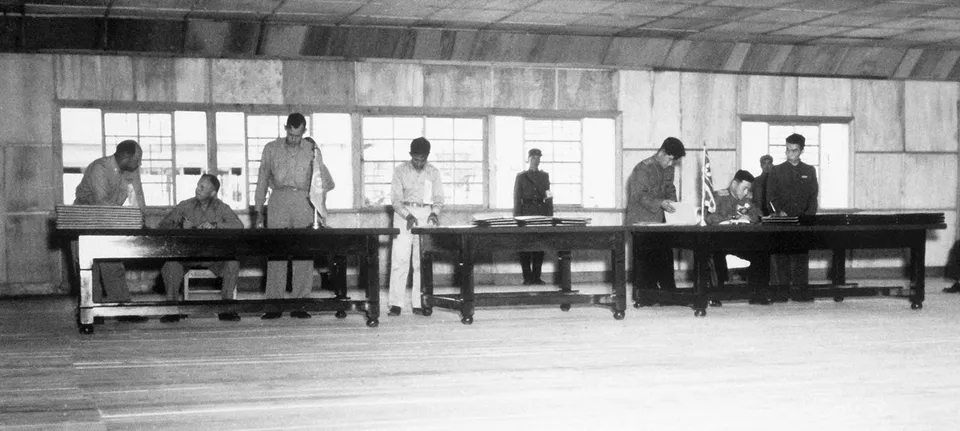
Lt. Gen. William Harrison (UN) and Nam Il (KPA/CPV) signing the armistice at Panmunjom, 27 July 1953

U.S. Department of Defense (F. Kazukaitis. U.S. Navy) · Public domain · Source

At Soviet suggestion, armistice talks began at Kaesong in July 1951 and later moved to Panmunjom. The main issues were where to draw the demarcation line and how to repatriate prisoners (voluntary or automatic). Opposing an armistice, the Rhee government released anti-communist prisoners in June 1953.

On 27 July 1953 the UN commander and the North Korean and Chinese commanders signed the agreement; the South Korean government did not sign. It set the Military Demarcation Line and the Demilitarized Zone and created the Military Armistice Commission and the Neutral Nations Supervisory Commission.

The map in 1953

OpenFreeMap © OpenMapTiles © OpenStreetMap contributors

States and rulers at the time
United States · UN forces — President Dwight D. Eisenhower
North Korea · signatory — Supreme Leader Kim Il Sung
People's Republic of China · signatory — Paramount leader Mao Zedong
South Korea — President Syngman Rhee
Places
Panmunjom

People

  • Kim Il Sung1912 – 1994

    related figure · Leader of North Korea (1948–1994): chairman of the Provisional People’s Committee, then premier and president. Purged rivals after the Korean War and built one-man rule

  • Syngman Rhee1875 – 1965

    related figure · First President of the Provisional Government, who worked through diplomacy in the US; later first President of the Republic of Korea

Before and after

Related works

Dramatized works (films, dramas, novels) may differ from the historical record.

Themes that include this event

  • GaeseongAD 901 – 2003

    From Wang Geon, lord of Songak, to the Kaesong Industrial Complex — Gaegyeong, Goryeo’s capital for five centuries, and home of the Song merchants